
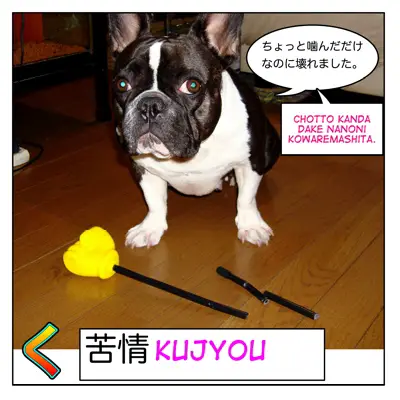
「ちょっと噛んだだけなのに壊れました。」
= Chotto kanda dake nanoni kowaremashita.
= “I just chewed a little bit and it broke just like that.”
Today’s word is 苦情 ( = kujyou)! It means “complaint(s)” or“grievance”
I chewed my toy just a little bit but it broke right away.. 😢
「ちょっと噛んだだけなのに壊れました。」
= Chotto kanda dake nanoni kowaremashita.
🔸Sentence pattern:
ちょっと〜(し)た/(〜だ) だけなのに(or だけで)*****(し)た。
= Chotto ~ (shi)ta (or ~da) dakenanoni (or dake de) ****(shi)ta.
= Just did something and …→ + Result
( だけなのに ( = dakenanoni) and だけで ( = dakede) mean almost the same but だけなのに ( = dakenanoni) involves more emotion.)
Ex. 1) ちょっとからかっただけなのに彼女はめちゃくちゃ怒った。
= Chotto karakatta dake nanoni kanojyo wa mechakucha okotta.
= I just teased her a little bit but she got really mad.
Ex.2) ちょっと泳いだだけで疲れた。
= Chotto oyoida dake de tsukareta.
= I just swam a little bit but I got tired (already).
So, I have to go “complain” to the store where I bought the toy.
This kind of complaints is called 苦情 ( = kujyou)
Let’s take a look at the kanjis first.
🔸 苦:く/にがい/くるしむ = ku / nigai / kurushimu : distressful, painful, rough
情:じょう/なさけ ( = jyou/nasake ) feeling
事情 = じじょう ( = jijyou ) circumstance, situation
If you happen to purchase defective products or you are treated badly or unfairly in the places like hotels, restaurants or public places, you are going to….
• 苦情を言う ( = kujyou wo iu) to complain
• 苦情を申し立てる ( = kujyou wo moushitateru.) to file a claim/a grievance
Also some people make 苦情の電話 ( = kujyou no denwa ) calls to make complaints to the TV station when they hear or see something unacceptable on TV.
If a company sell a bad product, they have to anticipate upcoming 苦情( = kujyou)
• 苦情が寄せられる
= kujyou ga yoserareru.
= to draw complaints
• 苦情に対処する
= kujyou ni taisho suru.
= to respond to a complaint
• 苦情の電話が殺到する
= kujyou no denwa ga sattousuru
= to be flooded with complaints over the phone
苦情 ( = kujou) is something more official and it is usually towards some entities such as stores, restaurants, companies, schools or groups but it can be used in a daily conversation in a person-to-person level.
• 苦情が来る ( = kujyou ga kuru) to get a complain
Ex. ゴミを間違った日に出したらご近所から苦情が来た。
= Gomi wo machigatta hi ni dashitara gokinjyo kara kujyou ga kita.
= I took out the trash in a wrong day so the neighbors complained.
( 📝 Note! →If you are going to live in Japan, you have to be very careful when to take out the trash and how to divide the trash. Every residential area has a different system. Each type of trash (burnable, nonburnable, plastic, paper trash, big trash) has different day and different plastic bag to throw away to avoid 苦情 ( = kujou) from your neighbors.)
You often see some mothers yelling at their children,
“そんなにうるさくしているとご近所から苦情が来ますよ!”
= Sonnani urusaku shiteiru to gokinjyo kara kujyou ga kimasuyo.
= “If you make that loud noise the neighbors will complain” →”Keep it quiet or the neighbors will complain! ”
「文句」( = monku ) “complaint” is a common word in a daily life.
「文句を言う」( = monku wo iu) to complain, to bitch about something
Ex.妻はいつも私の給料が少ないと文句を言う。
= Tsuma wa itsumo watashi no kyuuryou ga sukunai to monku wo iu.
= My wife always bitches about my low salary.
(These cases are all personals o we don’t use “苦情 ( = kujou)” )
cf. 文句なしの ( = monku nashi no) No complains →perfect ,well-done
Ex. 文句なしの作品 ( = monku nashi no sakuhinn) an excellent piece of work
Now, let’s see the modern Japanese for 苦情 ( = kujyou) which is クレーム ( = kureemu) .
(Please see the difference between 苦情 ( = kujyou) and クレーム( = kureemu ) in the comment below.)
It originally came from an English word, “to claim”
The real meaning of to claim is “to assert”or “to proclaim” (「要求する」( = youkyuu suru) or「主張する 」( = shuchou suru) in Japanese) . However Japanese people mistook the word and use it in Katakana as in “to complain” and an equivalent term of 苦情 ( = kujou) even in a business situation.
• クレームをつける ( = kureimu wo tsukeru) to complain
• クレームが出る ( = kureimu ga deru) to complain
• クレームに対処する ( = kureimu ni taisho suru) to respond to a complaint
•クレームレター ( = kureimu retaa) letters to make complaints
• Ex.「お客様から沢山のクレームを頂きました。」
= Okyakusama kara takusan no kureimu wo itadakimashita.
= We have received lots of complaints from our customers.
And this is a relatively new word but the people who complain a lot is called クレーマー ( = kureimaa) a complainer.
It has a negative connotation. Some クレーマー ( = kureimaa) complain falsely to take advantage of their position and get some benefits such as money or some gifts in return.
Also the parents who complain a lot to the school are called モンスターペアレンツ. monsutaazu pearentsu. (←Monster Parents.) They are overly protective parents and spoil their children. Whatever problem they find in a school, they complain selfishly.
Sometimes their behaviors are very extreme.
For example, when a teacher scold their kids, they called the school immediately and ask for the apology. If their kids are often late for the school they ask their teachers to come pick them up. Or when their kids failed an entrance examination, they ask the school to pay back the tuition and etc.
cf. モンスターペーシェント ( = monsutaa peishento) (←Monster patient ) : You can guess its meaning. The patients who complain to their doctors or hospitals and claim money back unreasonably.
 マギー先生から = Maggie-sensei kara = From Maggie-sensei
私のブログに間違いがあってもクレームつけないでね。
= Watashi no burogu de machigai ga attemo kureimu tsukenai dene.
= Even if you find a mistake in my blog, don’t complain!
***
Will you be my Patron?
I appreciate your support! サポートありがとう!
8 Comments
Hi Maggie!
A friend of mine always says “ぐち” and says things like ”ぐちばかりでごめんね”
Is this used commonly? I think it sounded to me more harsh, more like “whining” than “complaining”, but I’d like to be able to use it correctly!
Thanks!!!
Patrick
@Patrick
Hello Patrick!
When you look up in a dictionary, 苦情(kujou), 不平(fuhei), 文句(monku) and 愚痴(guchi) might be all “complaints”
(I have a lesson on ぼやく and mentioned all these words so please go check. Click here!)
Actually 愚痴 and ぼやき are very similar.
I don’t know what you meant by “harsh” but 愚痴(ぐち)を言う means “to complain, to whine, to grumble” about something which may not be so important to other people on and on.
How to use :
Ex. ちょっと愚痴っていい?
= Can I whine a bit?
(In casual Japanese)
Ex. ちょっと愚痴ってもいい?
Or as your friend says,
いつも愚痴ってばかりいてごめんね。
I am sorry I always whine/complain.
Ex. いつも愚痴を聞いてくれてありがとう。
= Thank you for always listening to my complaints.
Ex. いつでも愚痴っていいよ。
= Itsudemo guchitte iiyo.
= You can always complain.
yeah I am NOT looking forward to having to learn about trash rules in japan… seems so complicated…
how do foreigners usually learn that stuff?? is it OK to ask a neighbor for a guideline? or is that too much to ask??
@Aki
Nobody likes to separate the trash here either.
Don’t worry. There are plenty of nosy neighbors around you and tell you to learn how to do it.
Here’s a lesson for you in future. 分別=bunbetsu
Thanks for the lesson.
I remember one episode from Hammer Session where the teachers call one of their student’s mother a Monster Parent.
Now it makes sense to me. :)
@aaninoue8
Thank you for your (first!?) comment! I always enjoy reading comments! モンスターペアレンツ do exist. They are scary….
Hey Maggie-sensei, thanks for the post!
Now, if I’m writing a small piece, for my composition class at the uni, about a bad company not responding to complaints, should I use 苦情 or クレーム?
Konbanwa, furetosan!
It depends on the context of the complaints.
The precise difference between 苦情 and クレーム is…
-苦情 : It is more emotional. You simply complain about something to improve the situation. And by doing that you want to express your feelings.
-クレーム : You usually require or expect some compensation.
But in a business situation, we tend to use クレーム more.
So in your case, the composition is for クレームに応じて(oujite)くれない /クレームに対処(taisho)してくれない会社.
Hope this helps…
また来てね!