
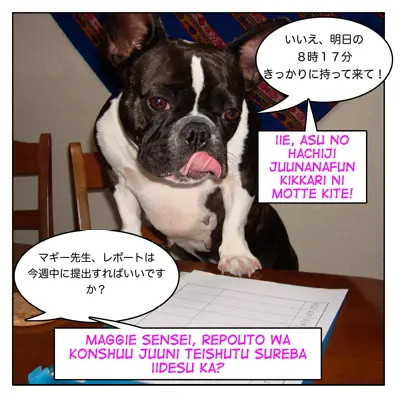
「マギー先生、レポートは今週中に提出すればいいですか?」
=Maggie sensei, repouto wa konshuu juuni teishutsu sureba iidesu ka?
“Miss Maggie, will it be OK if I turn in the report by the end of the week?”
🐶「いいえ、明日の8時17分きっかりに持って来て!」
=Iie, asu no hachiji juunanafun kikkari ni motte kite!
“No, bring it at 8:17 sharp tomorrow! “
Hi everyone! Today I will teach you time-related vocabulary.
🔹 Here are very basic time units :
• 時( =とき or じ – toki or ji) : time / hour(s)
• 時間( = じかん = jikan) : time / hour(s)
• 分 ( = ふん/ぷん/っぷん = fun / pun/ ppun) : minute(s)
• 秒 ( = びょう= byou) : second(s)
• 日( =にち/ひ = nichi / hi ) : day(s)
• 週 ( = しゅう= shuu) : week(s)
• 月 ( = つき/げつ/がつ = tsuki / getsu/ gatsu ) : month(s)
• 年 ( = とし/ねん= toshi / nen) : year(s)
*How do you say “every ~” ? :
You simply put 毎 ( = まい= mai) on top.
• every day : 毎日 ( = まいにち= mainichi)
• every week : 毎週 ( = まいしゅう= maishuu)
• every month :毎月 ( = まいつき= maitsuki)
• every year : 毎年 ( = まいとし = maitoshi)
Ex. マギーは毎年ハワイに行きます。
(=Maggie wa maitoshi hawai ni ikimasu.)
Maggie goes to Hawaii every year.
Note : If you want to say “every Monday“ →毎週月曜日 ( = maishuu getsuyoubi)
and if you want to say “on the 10th of each month” →毎月10日に ( = maitsuki touka ni)
and “on the January 1st every year” → 毎年1月1日に( = maitoshi ichigatsu tsuitachi ni)
★*How about “every other“?
Whether you put 隔 ( = kaku) on top or number+ time unit + おきに ( = okini)
• every other week : 隔週 ( = かくしゅう= kakushuu)
• every other month : 隔月 ( =かくつき= kakutsuki)
• every other day : 隔日 ( = かくじつ = kaku jitsu) or 一日おきに ( = いちにちおきに~ ichinichi oki ni)
• every other year : 隔年 ( = かくねん = kaku nen) or 一年おきに ( = いちねのきに= Ichinen oki ni))
Note 1) :
隔週でピアノを習いに行っている。
= Kakushuu de piano wo narai ni itte iru.)
一週間おきにピアノを習いに行っている。
=Isshuukan oki i piano wo narai ni itteiru.
= I go take a piano lesson every other week
隔 (=かく = kaku) is usually for written Japanese.
(Except 隔週 ( =かくしゅう= kakushuu) as I showed in the above example.) So if we want to say “every other day” we use 一日おきに ( = いちにちおきに = ichinichi oki ni) more than 隔日 ( = かくじつ – kakujitsu) in conversation.
Note 2) : The difference between おきに ( = okini) and 毎に ( =ごとに = gotoni)
二日おきに ( = ふつかおきに = futsuka oki ni) every three days ↔二日毎に ( = ふつかごとに = futsuka gotoni) every two days
★*How do you say “next ~“?
You put “来”( =らい = rai) in front of the time unit.
• next year : 来年 ( = らいねん = rainen)
• next week : 来週 ( = らいしゅう = raishuu)
Note : Coming week is 次週 ( = じしゅう = jishuu)
★When you want to say “the following day/week/year “, you put 翌 ( = よく = yoku)
• the following day : 翌日 (= よくじつ = yokujitsu)
• the following week : 翌週 (= よくしゅう= yokushuu)
• the following year : 翌年 (= よくとし = yokutoshi/yokunen)
★How about “last week/month/year”?
You add “先” ( =せん = sen)
• last week : 先週 ( = せんしゅう= senshuu)
• last month : 先月 ( = せんげつ = sengetsu)
Note :先日 ( = せんじつ = senjitsu) means “ the other day”
Ex. 先日はお世話になりました。
=Senjitsu wa osewa ni narimashita.
= Thank you for taking care of me / helping me the other day.
★*If you want to say “previous ~” you put “前の” ( = まえの = mae no) or “前”( =ぜん= zen)
• previous year : 前の年 ( = まえのとし = mae no toshi) or 前年 ( = ぜんねん = zennen)
• previous month : 前の月( = まえのつき = mae no tsuki)
• previous day: 前の日 ( = まえのひ = mae no hi) or 前日 ( = ぜんじつ = zennjitu)
★How do you say once (or twice) a year/month/day?
• once a year : (毎年)一年に一回 ( = (まいとし)いちねんにいっかい = (maitoshi) ichinen ni ikkai) / (毎年)一年に一度 (=(まいとし)いちねんにいちど = (maitoshi) ichinen ni ichido)
• twice a month : 毎月二回 ( = まいつきにかい = maitsuki nikai) or 毎月二度 ( = まいつきにど = maitsuki nido)
★How do you say “for ~ days/weeks/months“?
You add “間” ( = kan) after the number.
Ex. for two days: 二日間 ( = ふつかかん = futsuka kan) / for two years : 3年間 ( = さんねんかん = san nenkan)
*How to count days:
Even if you can count all the numbers in Japanese ex. ichi, ni, san, etc., you may have a little trouble remembering how to count a day or referring to certain dates.
For example, May 4th is not “gogatsu yon-nichi”. It is “gogatsu yokka”.
And if we want to say “I will stay in Tokyo for three days”, we usually say
Ex. 東京に三日間滞在します。
=Toukyou ni mikka kan taizai shimasu.
not “san-nichikan”.
Here are some more examples of how to read the dates.
(Note: We use both Arabic numbers and kanji when we write numbers.)
• 一日 ( = tsuitachi) the first / ( = ichinichi) one day
Note: When you count a day, you don’t use ついたち (= tsuitachi). You use いちにち ( = ichinichi).
• 二日 ( =ふつか = futsuka) the second, two days
• 三日 ( = みっか = mikka) the third, three days
• 四日 ( =よっか = yokka) the fourth, four days
• 五日 ( = いつか = itsuka) the fifth, five days
• 六日 ( =むいか= muika) the sixth, six days
• 七日 ( = なのか = nanoka) the seventh, seven days
• 八日 ( =ようか= youka) the eighth, eight days
• 九日 ( = ここのか= kokonoka) the ninth, nine days
• 十日 ( =とおか = tooka) the tenth, ten days
• 二十日 ( =はつか = hatsuka)the twentieth, twenty days
* However, in some occasions we hear people saying with regular way of reading numbers,
Ex. 8日間 (= はちにちかん = hachinichi kan) instead of “youka-kan”. (=for eight days.)
★How to count years:
Just add “年” ( = ねん = nen)
Ex. 3年 ( = san nen) three years
Note : “Three and a half years” is 三年半 ( = san nen han)
★How to count months:
You add “ヶ月” ( = かげつ = kagetsu)in the end.
Ex. 1ヶ月 ( = いっかげつ = ikkagetsu), 2ヶ月 ( = にかげつ = ni kagetsu)
★How to count weeks:
〜週間 ( = しゅうかん= shuukan)
Ex. 2週間 ( = にしゅうかん = ni shuukan) two weeks
OK, here are the basic units.
• 今日 ( =きょう = kyou) : today (本日 ( = ほんじつ = honjitsu) more formal*)
• 明日 ( = あした/あす = ashita/asu) : tomorrow ( 明日 ( = みょうにちmyounichi) more formal*)
• 明後日 ( = あさって = asatte) : the day after tomorrow ( 明後日 ( = みょうごにち = myougonichi) more formal*)
• 一昨日 ( = おととい = ototoi) : the day before yesterday ( 一昨日 ( = いっさくじつ = issakujitu) more formal*)
* You may hear/see this in a business situation or on the news
•明々後日 ( = しあさって = shiasatte) three days from now
•一昨々日( = さきおととい = sakiototoi) three days ago
★ * How do you say “~ ago“?
You add “前” ( = まえ = mae) in the end.
• 二日前 ( = ふつかまえ = futsuka mae) : two days ago
• 三日前 ( = みっかまえ = mikka mae): three days ago
• 2、3日前( =にさんにちまえ = ni san nichi mae) : a couple of days ago
• 9時間前 ( =くじかんまえ = kujikan mae) : nine hours ago
• 一週間前 ( = いっしゅうかんまえ = isshuukan mae) : a week ago
• 2ヶ月前 ( = にかげつまえ = nikagetsu mae) : two months ago.
• 4年前 ( = よねんまえ = yonen mae) four years ago
★ How about “~ later” or “after ~“?
You put “後 ” ( =ご = go) in the end.
数年後 ( すうねんご = suunen go) a couple of (or several) years later
2週間後 ( =にしゅうかんご = nishuukan go) two weeks later
★ How do you say “~end of (month, year)?
You put “末” ( = まつ = matsu) in the end.
週末 ( = しゅうまつ = shuumatsu) weekend
月末 ( = げつまつ = getsumatsu) end of month
年末 ( =ねんまつ = nenmatsu) year-end
世紀末 ( = せいきまつ = seikimatsu) end of the century
★Months : 月 ( = がつ = gatsu):
• January : 一月 /1月 ( = いちがつ = ichigatsu)
• February : 二月 /2月 ( =にがつ = nigatsu)
• March : 三月 /3月 ( = さんがつ = sangatsu)
• April : 四月/4月 ( = しがつ = shigatsu)
• May : 五月/5月 ( = ごがつ = gogatsu)
• June : 六月/6月 ( = ろくがつ = rokugatsu)
• July : 七月/7月 ( = しちがつ = shichigatsu/nanagatsu)
• August : 八月/8月 ( = はちがつ = hachigatsu)
• September : 九月/9月 ( = くがつ = kugatsu)
• October : 十月/10月 ( = じゅうがつ = juugatsu)
• November : 十一月 /11月 ( = じゅういちがつ = juuichigatsu)
• December : 十二月/12月 ( = じゅうにがつ = juuni gatsu)
★The days of the week : 曜日 ( = ようび = youbi):
• Monday : 月曜日 ( =げつようび= getsuyoubi)
• Tuesday : 火曜日 ( =かようび = kayoubi)
• Wednesday : 水曜日 ( = すいようび = suiyoubi)
• Thursday : 木曜日 ( = もくようび = mokuyoubi)
• Friday : 金曜日 ( = きんようび = kinyoubi)
• Saturday : 土曜日 ( = どようび = doyoubi)
• Sunday : 日曜日 ( = にちようび = nichiyoubi)
Ex.日曜日は何もしない。
= Nichiyoubi wa nanimo shinai.
= “I don’t do anything on Sundays.”
★weekday(s) : 平日 ( = へいじつ = heijitsu) ↔ weekend : 週末 ( = しゅうまつ = shuumatsu)
★holidays :
休日 ( = きゅうじつ = kyuujitsu) 、祭日 ( = さいじつ = saijitsu) 、祝日 ( = しゅくじつ = shukujitsu) : holiday
国民の祝日 ( =こくみんのしゅくじつ = kokumin no shukujitsu) National holidays
休み ( = やすみ = yasumi) holidays, day-off, vacation
夏休み ( = なつやすみ = natsuyasumi) summer holidays(vacation)
(お)盆休み ( =(お)ぼんやすみ = (o)bon yasumi) obon holidays (around Aug.13~15)
冬休み ( = ふゆやすみ = fuyu yasumi) winter holidays
(お)正月休み( = (お)しょうがつやすみ = (o)shougatsu yasumi) New Year’s holidays
Ex. 夏休みに入ったらどこに行きますか?
=Natsuyasumi ni haittara dokoni ikimasu ka?
= Where are you going on summer vacation?
Ex. 正月休みにスキーに行きました。
=Shougatsu yasumi ni sukii ni ikimashita.
=I went skiing during the New Year’s holiday.
★*Here are more example sentences:
Ex. 今日は何曜日ですか?
=Kyou wa nanyoubi desu ka?
= What day is today?
Ex. 今日は、月曜日です。
=Kyou wa getsuyoubi desu.
= It is Monday.
Ex. 今日は何日ですか?
=Kyou wa nannichi desu ka?
= What’s the date today?
Ex. 今日は8月15日です。
=Kyou wa hachigatsu juugonichi desu.
= It’s August 15th.
Ex. 今日は1月6日、水曜日です。
=Kyou wa ichigatsu muika suiyoubi desu.
= It’s January 6th, Wednesday.
★*Other time-related words:
• 時間 ( = じかん = jikan) : time (in general)
Ex. 「今、お時間ありますか? 」
=Ima, ojikan arimasu ka?
= Do you have some time now?
Ex. 「 いえ、もう時間がありません。」
=Ie, mou jikan ga arimasen.
= No, I don’t have any time left.
• 今 ( = いま = ima): now
• 先ほど ( = さきほど = sakihodo) : a little while ago (さっき( = sakki):more casual)
• 午後 ( = ごご = gogo) in the afternoon P.M.、午前 ( = ごぜん = gozen) in the morning A.M.
• 朝 ( = あさ = asa) morning
• 昼 ( = ひる = hiru) daytime
• 夕方( = ゆうがた = yuugata) evening
• 晩 ( = ばん = ban) evening/night
• 夜 ( = よる = yoru) night
Related words:
*朝食 ( = choushoku) or 朝ご(or 御)飯 ( = asa gohan) : breakfast
*昼食 ( = chuushoku)/ 昼ご(or 御)飯 ( = hirugohan) : lunch
*夕食 (=yuushoku) 夕飯 ( = yuuhan) 夕ご(or 御)飯 ( = yuugohan)
or 晩(or 御)飯 dinner( = bangohan) / 夜食( = Yashoku) late dinner
• 早朝 ( = souchou) early in the morning
Ex.早朝割引 ( = souchou waribiki) early bird discount(specials)
• 正午 ( = しょうご = shougo) at noon
• 夜中 ( =よなか = yonaka) middle of the night
• 真夜中 ( = まよなか = mayonaka) midnight
• 今朝 ( = けさ = kesa) this morning
• 今夜 ( = こんや = kon-ya) tonight
or 今晩 ( = こんばん = konban) tonight
• 昨夜 ( = さくや = sakuya) last night or 昨晩 ( = さくばん = sakuban) last night
Ex. 昨晩は冷えましたね。
= Sakuban wa hiemashita ne.
= “It was cold last night, wasn’t it?”
Ex.今朝、何を食べましたか?
= Kesa nani wo tabemashita ka?
= “What did you eat this morning?”
★年 (ねん = nen) year:
•1年 ( = いちねん = ichinen) one year、2年 ( = にねん = ninen) two years
•1年間 ( = いちねんかん= ichinenkan) for a year 2年間 ( = にねんかん = ninenkan) for two years
•1年目 ( =いちねんまえ = ichinen-me) the first year 2年 目 ( = にねんめ = ninen-me) the second year
• 今年 ( = ことし = kotoshi) this year
• 去年 ( = きょねん = kyonen) & 昨年 ( = さくねん = sakunen) last year ( 昨年 ( = さくねん = sakunen) is more formal.)
• 一昨年 ( = ototoshi/issakunen) two years ago
• 来年 ( = らいねん = rainen) next year 再来年 ( = さらいねん = sarainen) year after next
•2年後 ( = にねんご = ninen go) two years later
•3年前 ( = さんねんまえ = san nen mae) three years ago
• 数年 ( = すうねん = suunen) a couple of (several) years
Note: 数 ( =すう = suu) means a couple (of) or several
• 数ヶ月 ( =すうかげつ = suukagetsu) a couple of (several)months
• 数日 ( =すうじつ = suujitsu) a couple of (several) days
★時間 ( =じかん = jikan) time, hour(s)
1時 ( = いちじ = ichiji) one o’clock 、2時 ( = にじ = niji) two o’clock、3時 ( =さんじ = sanji) three o’clock
Ex. 今、何時ですか?
=Ima nanji desu ka?
= What time is it now?
Ex. 8時10分前です。
=hachiji jippun (juppun) mae desu.
= It’s 10 minutes before eight.
Ex. 今、4時ちょうどです。
=Ima yoji choudo desu.
= It’s just four o’clock sharp.
Ex. 7時半です。
= Shichiji han desu.
= It’s seven thirty.
Ex. 2時過ぎ
=niji sugi
= It’s past two.
Ex. 6時前
=rokuji mae
=It’s before six.
Ex. 5時頃
=goji goro
=Around 5 o’clock. 5ish
Note: In Japan, it is very common to use 13:00~24:00 for the timetable instead of 1:00 P.M ~ 12:00 A.M.
🔹 What particle do we need to use when we say “at +number+ o’clock”?
Usually, we use “に” ( = ni).
Ex. 明日何時に会いましょうか?
=Ashita nanji niaimashou ka?
= What time shall we meet tomorrow?
Ex. 7時に会いましょう。
=Shichiji ni aimashou.
= Let’s get together at 7 o’clock!
Ex. 9時頃に会いましょう。
=Kuji goro ni aimashou.
= Let’s meet around nine.
Ex. 昨夜、2:40に東京で地震がありました。
= Sakuya niji yonjyuppu ni toukyou de jishin ga arimashita.
= There was an earthquake at 2:40 last night. in Tokyo.
Ex. 8時に約束があります。
=Hachiji ni yakusoku ga arimasu.
= I have an appointment (an engagement) at 8:00 tomorrow.
Ex. 9時に予定が入っています。
=Kuji ni yotei ga haitte imasu.
= I have plans for 9:00 tomorrow.
Note: Cookie Sensei made a sequel lesson just focusing on how to tell time. Please go check that lesson. 時間(=jikan) Time Related Lesson Part 2
Also there is a lesson on particles with time-related expressions. Time-related Expressions with and without particles.
• 早い ( = はやい = hayai) early まだ早い(です) ( = mada hayai (desu)) It is still early.
Ex. 彼は、朝早く出かけた。
= Kare wa asa hayaku dekaketa.
= He left early in the morning.
• 遅い ( = おそい = osoi) late
Ex. もう遅い(です) ( = mou osoi( desu)) It is already late.
• 季節 ( = きせつ = kisetsu) season(s)
Ex. 季節の挨拶 ( =きせつのあいさつ = kisetsu no aisatsu) Season’s greetings
Ex. 季節の変わり目 ( =きせつのかわりめ = kisetsu no kawarime.) changing seasons, turn of the year
• 四季 ( = しき = shiki) four seasons:
• spring : 春 ( = はる = haru)
• summer : 夏 ( = なつ = natsu)
• fall/autumn: 秋 ( = あき = aki)
• winter : 冬 ( = ふゆ = fuyu)
Ex. 今は秋です。
=Ima wa aki desu.
= It’s fall/autumn now.
Ex. もうすぐ冬が来ます。
=Mousugu fuyu ga kimasu.
= Winter is coming soon.
Ex. 春が来たら、会いましょう。
=Haru ga kitara, aimashou.
= Let’s get together in spring.
From the picture above :
「マギー先生、レポートは今週中に提出すればいいですか?」
( = Maggie sensei, repouto wa konshuu juu ni teishutsu sureba iidesu ka?)
“Miss Maggie, is it all right if I submit the report by the end of the week?”
• 提出する ( = ていしゅつする = teishutsu suru) to submit, to turn in
• 〜すればいいですか?( = sureba ii desu ka?) Will it be OK if I + verb
•今週中 ( =こんしゅうちゅう = konnshuu chuu): sometime within the week before the week is over?
~中 ( = ちゅう/じゅう = chuu/juu) :within ~ 今年中( = ことしじゅう = kotoshi juu)、今月中 ( =こんげつちゅう = kongetsu chuu)
「いいえ、明日の8時17分きっかりに持って来て!」
( = Iie, asu no hachiji juunanafun kikkari ni motte kite!)
“No, bring it at 8:17 sharp tomorrow! “
•きっかり ( = kikkari) = 丁度(ちょうど)( = choudo) : just, on the dot, sharp.
Note : You can also use it for money.
Ex. Just 100 yen →きっかり(ちょうど)100円。( = kikkari (choudo) hyakuen)
Note: If you want to learn “what particle you need/you don’t need with time expressions” go check this lesson. →Time Expressions with and without a particle.
 Maggie先生より ( = Maggie-sensei yori) From Maggie-sensei
今日のレッスンも長くなっちゃったなあ。でも明日も明後日も毎日ここに来て勉強してね。
( = Kyou no ressun mo nagaku nacchatta naa.. Demo asshita mo asatte mo mainichi koko ni kite benkyou shitene.)
It ended up being a long lesson again today. But please come back here tomorrow, the day after tomorrow…well, every day to study!
***
Will you be my Patron?
I appreciate your support! サポートありがとう!

84 Comments
Maggie sensei, I have a question.
1/ 3ヶ月間日本語を勉強している。
2/ 3ヶ月日本語を勉強している。
Is there any difference between these two sentences? Why do we need to use “間” when “3ヶ月” is already the duration of month? Can I omit it? I don’t really get how it works tho..
Btw, thank you for such detailed lesson! 🙏
Hello Mimi
For your example sentences, you can use both 3ヶ月・3ヶ月間 and they mean the same.
I have been studying Japanese for three months.
You can omit 間 and just say ヶ月.
The nuance difference is you tend to use 〜間 when you are constantly doing something during certain period of time or stress the time period more. And ヶ月 is just mentioning the period of time.
なるほど!! Thank you so much 🥰🥰
どういたしまして :)
こんにちは先生!!素晴らしいレッスンを作ってくれてありがとうございます!
「置きに」と「毎に」について質問があるけど、
I was about to ask the same as Harinさん, but then read the comment and your response and it became clear as water, but then another question came to my mind.
When it’s a short action every x days/weeks/months/years, 毎に and 置きに have a clear difference as you explained, but what happens when the action’s duration is similar to the interval? Do 毎に and 置きに become equivalent?
For example, if you’re doing some workout where you rest during 1 minute for every 30 seconds round:
Would「一分毎に三十秒の運動です」 imply that the minute of 一分毎に starts after we’ve finished the workout, thus being equivalent to 「一分おきに三十秒の運動です」? Or would it mean that the minute includes the 30 seconds of workout, thus getting only 30 seconds of rest? What would happen if the workout is one minute or greater :o?
こんな細か過ぎてすみません、先生 (m;_ _)m、そんなことを考えることは楽しいけどwww
Oh and another question (^^;), how formal or casual are 直後、直前 and 寸前?本で読んだからわからないww
素敵な一日を過ごしてね!!ありがとうございます!!
Hello Orti,
面白い質問ですね。
In that case,
30秒ごとに運動する
or
30秒おきに運動するの方
might be more natural.
Generally speaking when the unit you use is small or short, like 秒, 分, 時間 (second(s) /minute(s)/hour(s)), おき and ごと are interchangeable but if it gets longer such as 日・週間・年 (day(s)/ week(s) / year(s)) the meaning change.
But some cases are very complicated and confusing even for native speakers.
直前 ・ 直後 ・ 寸前
You use them in conversation but they are not neither formal nor too casual.
旅行に行く直前に飛行機がキャンセルになった。
旅行の直前まで飛行機が出るかどうかわからない。
向こうから車が出てくる寸前でブレーキをかけた。
Ortiもいい週末を過ごしてくださいね。
説明してくれてほおおおおおおおおんとうにありがとう!!!!
新しいこと教えてくれて嬉しい!!
Dear Orti,
お役に立てたらうれしいです。💕
Hi,
Can you explain to me the difference between「~るとき、…」and「~まえに、…」?
パリへ行くとき、かばんを買いました。→ I bought a bag, before going to Paris.
パリへ行くまえに、かばんを買いました。→ I bought a bag before going to Paris.
I can’t find the difference in grammar book; I guess (I hope) there is a nuance. ^^
Hello HnK
Good question. Basically they are the same but
行くまえに focusing on the order of two actions, 1) buying a bag 2) going to Paris.
Maybe you didn’t take the bag with you when you went to Paris.
行くとき(に) the action of buying the bag has stronger connection to the trip to Paris than 行くまえに.
I bought a bag and took it to Paris./ I bought a bag in order to take it to Paris.
Hi,
Thank you for your anwser.
So, we can translate「パリへ行くとき、かばんを買いました。」into “I bought a bag, just before going to Paris.” or “…, on the way to Paris.”?
If,I understand correctly,「~るとき…」made a continuity between the two actions; and「~まえに,…」no continuity.
The difference is the same between「~たとき、…」and「~あとで、…」?
Yes, that’s right.
And the difference between たとき and たあと is .
パリに行ったときにかばんを買いました you bought a bag in Paris or could be right before the trip/on the way to Paris
パリに行ったあとでかばんを買いました。 you bought a bag after you went to Paris and came back home.
Thank you, for your explanation.
Have a nice day ^^
You’re very welcome! :)
Hello Maggie 先生!<3
Thank you, thank you, thank youuuuu, THANK YOU! A million thank yous for this lesson .< Do I use 前日?
Thanks again for all your wonderful lessons! ^^ I'll keep studying hard!
~Ali
Hi Ali,
Thank you for all your “thank you”! :)
Yes, you say 前日 = ぜんじつ= the day before.
Ex. パーティーの前日は準備が大変です。
= パーティーのぜんじつはじゅんびがたいへんです。
= Paatii no zenjitsu wa junbi ga taihen desu.
= There are lots of things to do the day before the party.
Hi thank you very much for this it is very informative :)) byw what is EVERY NOON? まいひる?
Some people use the word 毎昼 but compare to 毎朝・毎晩 it is not so common.
You can say 毎日、昼に〜do something.
hello Maggie
you are missing Since xxx
Example:
Since 1990, Apple was made iphone.
@linh
Hi linh
Check my time expressions with/without time expressions lesson.
Hi Maggie,
How would you say ” for 2 years and 3 weeks” ?
二年間と三週間 ?
Could you help me with the okurigana please ?
@dee
二年間と三週間 is fine but you can also say
二年と3週間の間 ( = にねんとさんしゅうかんのあいだ)
Oh, thank you for your reply ;).
@dee
You’re very welcome! :)
Hi. How can I say “during 3 years”? For example, “I’ve been travelling during 3 years”
@mike
You can say
3年間(さんねんかん)
or
この3年間(このさんねんかん)/この3年の間(このさんねんのあいだ)
ここ3年間(このさんねんかん)/ここ3年の間(ここさんねんのあいだ)
Hi Maggie-sensei,
授業で「翌年」を学んだけど、使い方よく分かりません。
ある出来事の次の年という意味あると言われていました。
具体的にはどういうことですか。
例文を書いてくださいませんか。
@Thalia
Hi Thalia,
翌年と来年の違いから説明しますね。
翌年は”the next year” / “the following year”
来年は”next year”
*****
For example, if you say
Ex. 1) 来年、日本に行きます。
now, it means “I will go to Japan next year. ”
It’s 2016 now so you will come to Japan in 2017.
You can’t say
翌年、日本に行きます。
翌年 is used in past tense. You mention one past event first and then add what happened in the following year.
Ex. 2) 2010年に日本に行きました。翌年はどこにも行きませんでした。
= I went to Japan in 2010. I didn’t go anywhere in the following year.
So in this case, 翌年 refers to 2011. (the following year of 2010)
You can mention two actions.
one action →翌年→the other actions.
Ex. 3) 卒業(そつぎょう)した翌年、日本に行った。
= I went to Japan the year after the graduation (year).
Note: You can’t use 来年 in Ex.2) and Ex.3)
You can also say 次の年(とし)instead of 翌年
How about I have sixth period (in school) period is 6校時 or 6 時間. But what is “have” for teacher or students?
@Michael
I’m sorry but I don’t understand your question well but
When you refer to the classes in school,
the first class1時間目
the second class 2時間目
the sixth class 6時間目
If you say I have three classes today, you say
今日はクラス(授業)が3つある
Dear Maggie Sensei,
Wow, there were great many expressions that were new for me, thanks a lot! !happyface!
I have only one question which I haven’t found the answer for in the post.
If I would like to say, for example, that “The package is going to arrive on the 4th day”, do I need to put に after 四日目, like there is “on” in the English version: “on the 4th day”, or not?
I have learnt that when a time expression contains any number, we usually put に after it, but I’m not sure here.
Thank you very much in advance! :w:
Berry
@Berry
Hi Berry.
Yes, you need に
4日目に:荷物は4日目に届きます。
If you are interested in particles with time related word, go check this lesson.
Hi, Maggie-sensei! I love your website, it’s so helpful.
How would I say something like “I’m going to Japan in January”?
@Lia
Hi Lia!
Glad to hear you find my site helpful! :)
I’m going to Japan in January. = 一月に日本へ行きます。= いちがつににほんへいきます。= Ichigatsu ni nihon e ikimasu.
Maggie sensei,
Great resource you created, hontou ni.
Just one shitsumon: how do you say “I have been in Japan many times”? and “I have been in Japan more than 10 times” ?
@Peter
Hi Peter,
I have been in Japan many times”?
日本(にほん)に/へ何回(なんかい)も行(い)ったことがあります。
I have been in Japan more than 10 times”
日本(にほん)に/へ10回以上(かいいじょう)、行(い)ったことがあります。
Dear Maggie Sensei
If I want to say end of July, can I say 7月末? which will read as しちがつまつ.
ありがとう ございます。
Man Hua
@Man Hua
Hi Man Hua,
end of July (a few days in the end of July) 7月末= しちがつすえ
July 31st = 7月末= しちがつまつ
Maggie sensei.
If 2000年前 means 2000 years ago, then how to say “before 2000” (e.g: 1999, 1900).
Thank you.
@Rudi
Hi Rudi
before 2000
You can say 2000年以前(izen)
Thank you Maggie Sensei.
I learn a lot from this website.
@Rudi
You’re welcome, Rudi!
マギ先生 こんにちは
Hope you can help me with use of とき, mostly I don’t understand the difference between 1st two
Ex. 部屋を出るとき電気を消します
部屋に入ったとき電気をつけます
去年日本へ行ったとき京都へ行きました
ありがとうね!
@Pauu
1) 部屋を出るとき電気を消します I turn off the light when I leave a(the) room.
2) 部屋に入ったとき電気をつけます I will turn on the light when/once/ if I enter a(the) room.
I don’t know if I understand your question but the tense of the verbs in 1) and 2) are different.
1) says what you do habitually when you leave a room.
2) says I don’t know when but when I enter the room, I will turn on the light.
FYI I have been working on the lesson on “when”
2) 去年日本へ行ったとき京都へ行きました isn’t so difficult.
It simply state what you did when you went to Japan.
I visited Kyoto when I went to Japan last year.
Thank you!!!
I think my problem was more on the 2 nd example since verb is in past form and I don’t understand why… ~ 入った
Looking forward for the lesson about when =]
Maggie-sensei,
how would you say “It’s been X minutes/hours/days/weeks/months/years since”.
As in, for example, “It’s been 6 months since I last went swimming.”
On that note, how would you say “several” or “a few” minutes/hours/days etc. instead of using an exact number?
And is there a way to simply say, “It’s been a while since [I last did something]”?
Sorry for using English–I’ve only been learning Japanese for around three months.
Thank you as always for your help!! boucingheart!
@seimei
Hi Seimei,
~ぶりに〜をしました。
→半年(6ヶ月)ぶりに泳ぎに行きました。
Check this lesson.
several” or “a few” minutes/hours/day →You can use 数 (数分、数時間、数日、数ヶ月、数年)
“It’s been a while since [I last did something]”?
I also explained this in the lesson which I gave you the link above. →久しぶりに〜をしました・した
こんにちは、マギー先生!
質問があります。
「Over the past few days」または「During the past few days」ってどう書きますか?
「数日前中」っていいですか?
全ての助け,頂きありがとうございます!
@Dan
こんにちは、Dan
over the past few days/ during the past few daysは
ここ数日、ここ数日間
で言い表せますよ。:)
Maggie sensei,
How do you say “… days to go”?
Hontou ni arigatou gozaimashita :)
@Nikita
Hi Nikita,
“… days to go” = 後、〜日= あと〜日= ato ~ nichi
Hello Sensei,
I read somewhere and I saw 数月 as in a couple of months…any difference between this version and your version as in 数ヶ月? Thank you !happyface!
@Anne
Hello Anne.
Hmmmm we usually use 数ヶ月 for a couple of months.
If you see someone using 数月 somewhere, give me a link. I will take a look.
How would you say: “it’s already late where you are, please sleep well”
@Marie
もう(the name where you are)は遅い時間だから+もう寝て下さい。ゆっくり休んでね。(ね suffix = girl/casual)
Sensei, T-T Can you explain in detail about the time difference for mayonaka and yonaka? I read online that mayonaka should not be used as 12am as in midnight. And there is this word shinya as well.
@Anne
Hello Anne!
Sorry I can’t explain from what time to what time is which one but the most general word for the middle of the night is 夜中. Technically 真夜中 is midnight but 深夜(=shinya) and 真夜中(mayonaka) are both used as middle of the night.
For your information, NHK did the survey
夜中= from 23:00 ish~ 2:00 ish
深夜= from 24:00 usg ~ 2:00 ish
Thanks for your reply, Sensei. So basically you mean mayonaka can be used for both midnight and middle of the night? Ok, between mayonaka and yonaka which one is later in the night? Can I just summarized as in mayonaka is 12am and yonaka as in after 12am?
Sorry…I still have difficulty curbing with this issue. Sorry sensei!! (usg and ish??)
@Anne
真夜中 has a meaning as “midnight” but usually we used it for no specific time and use it as “middle of the night”.
Let me see if I can explain the concept in a more graphic way.
There is no rules rules but
23:45ish or later—————————————2:00ish
<-----------------夜中(yonaka)/深夜(shinya)------------> ~~~~~~~~~~~~~~~~<----真夜中(mayonaka)----->~~~~~~~~~~~~~~~ ~~~~~~~~~~~~~~~~~~ ↑★24:00/正子(shoushi)~~~~~~~~~~~~~
Thank you!! !JYANE! Thank you so much for your patience! Love you so much, Sensei boucingheart!
@Anne
You’re very welcome!
Love you,too!! <3
waaa, this is so cool, sensei :-D
I wonder how to say things like “eight hours a day”, “24/7”, “two days a week/month”, “three months a year”. Do you have a lesson for these?
@iji
Hello iji,
eight hours a day = 1日(に)8時間= Ichinichi (ni) hachijikan
24/7 いつも(=itsumo) / 常に(=tsuneni)
“two days a week/month” = 1週間(isshuukan) or 1ヶ月(ikkagetsu) (に=ni)二日(=futsuka)
three months a year = 1年(に)3ヶ月 (=ichinen (ni) sankagetsu)
I have a related lesson. 頻度
I found this kanji 時期 and 期間
It’s means ‘period’ What’s the difference?
マギー先生 こんにちは (^^)
質問が一つだけあるね。書いた前のコメントで「マギーのassistant」というassistantには日本語で何と言いますか? by the way, do my sentences make any sense? haha. I meant to ask, how do you say assistant in Japanese as in Maggie’s assistant which you’ve written in an earlier comment? まえもって教えてくれてありがとう!(thanks for replying in advance!) :)
@Campbell C arsley
今日は!
assistantは日本語で「アシスタント」といいます。また「助手(じょしゅ)=joshu」とも言いますよ。
watashino shashin wa donko desu ka?
wow!!! so detailed and clear – I LOVED IT!!! you should make a quiz out of this on twitter!
@Aki
OK, I will sometime!
I’m sorry, it didn’t finish before I submitted. For the last one I meant:
今は午後10時5分前です。 It is 5 minutes to 10.
Hello again Maggie!
I have another question.
Is it correct to say this:
今は午後10時5分過ぎです。 It is 5 past 10.
今は午後10時
Harin-san,
The both sentences are perfect!
どちらの文章も完璧です!
よく出来ました〜!!
あぁ!凄いだね!私はたくさん日本語の文法に習いました。ありがとうございましたマギー先生。
goldenzephyr-san,
こちらこそ、ありがとう!
せっかく来てくれたからコメントの文法直してあげるね。
凄いだね ー>凄いね
日本語に習いました。ー>日本語を習いました。
あとは完璧!!goldenzephyrさんの日本語は凄いよ!
がんばってね!
Watashi no bokokugo ha furansugo desu.
Yours is english or japanese ? :o
Saikin, Maggie sensei no video “okinasai” o mimashita. Sugoi kawai ne ^^
Laetitia-san,
Furansu go mo Furansu mo daaaaisuki! Maggie no bokokugo wa inu-go desu! Yukari (Maggie no assistant) no bokokugo wa nihongo desu.
Okinasai no video mite kurete arigatou! Ibiki ga sugoi desho!
Thank you for the correction ^^ As I wrote this sentence I knew there was something wrong but couldn’t correct it myself ^^;;
By the way, sorry if my english sounds wrong too, I hope it’s still comprehensible.
Arigatou :O
Have a nice day !
Laetina-san,
No problem! Your English is better than mine! What is your mother language? (あなたの母国語は何ですか?)
Watashi ha futsuka goto ni gurai Maggie sensei no blog o yomimasu. Lesson ha nagai no ni, totemo omoshiroi desu ! Demo, oboeranakya ikenai koto ga takusan aru no de, raishuu, watashi ha benkyouu o sureba ii ! (<– Machigai ga attara, sumimasen ; ; )
Kyou no lesson, arigatou ^^
Mata ne !
Laetina-san,
Kinou lesson wo keshite shimatta node comment mo kiechatte gomennasai!
(I deleted the lesson yesterday and your comment was gone. I am sorry!)
You made a great sentence. May I correct just a bit?
“Watashi wa futsuka goto ni gurai Maggie sensei…..” -> “Daitai futsuka goto ni”
(Or if you really want to use “gurai” you could say “futsuka gurai goto ni”)
Itsumo kono blog ni kite kurete hontou ni arigatou!! Tottemo ureshii desu!
Hello again Maggie-sensei!
I have a question regarding ~おきに and ~ごとに
If you say 二日おきに、does it have the same meaning as 一日ごとに?
二日おきにコンピューター授業を受けています。
I take computer lessons every two days.
一日ごとにコンピューター授業を受けています。
I take computer lessons every two days.
違いは不明ですね ^^;
Harrin-san
前のコメント消えちゃってごめんなさい!説明のところ書き直しました。m(_ _)m
As I wrote you in my previous comment, even many many Japanese people get confused with the difference between “gotoni” and “okini”
If you have to do something, (“o” means the day you do and “x” means the day you don’t do, OK?)
futsuka gotoni= xo xo
mikka gotoni = oxx oxx oxx oxx
yokka gotoni =oxxx oxxx oxxx oxxx
And
futsuka oki ni = oxx oxx
mikka oki ni = oxxx oxxx oxxx
yoykka okini = oxxxx oxxxx oxxxx
So technically “mikka goto ni” has the same pace as “futsuka oki” ni.
And “二日おきに” has the same pace as “三日毎に”
“goto” is one unit that the number indicates. Oki’s kanji is 置き. (置く= to place, to put) So you leave the number of the time unit in between.
一日毎に (日毎:higoto) means every day. (But there is a slight nuance difference between 毎日. And some Japanese think it means every other day)
Thank you! Your questions always make me think. I will talk to other Japanese doggies about it.
Arigato!! :maggie-small:
Dear Maggie-Sensei,
This is very useful information! Might I request you add the word for “weekend” (週末) into the lesson?
~Draquoir
Dear Draquoir-san,
そ〜でした!それを忘れたなんて信じられない!。早速追加しました。(=soudeshita. Sore wo wasureta nante shinjirarenai! Sassoku tsuika shimashita.)
That’s riiiight! I can’t believe I missed that one. I have just added it now.
助かりました。ありがとう!(=Tasukarimashita. Arigatou) Thank you for your help!