
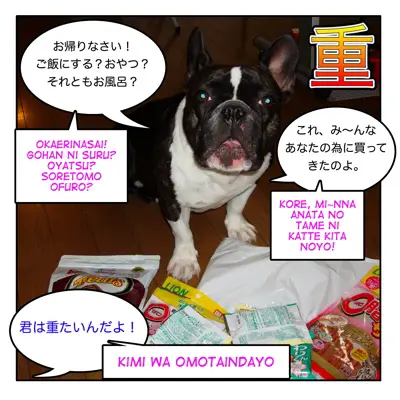
:maggie-small: 「お帰りなさい!ご飯にする?おやつ?それともお風呂?」
= Okaerinasai! Gohan ni suru? Oyatsu? Soretomo ofuro?
= “Hi hon, Do you wanna have dinner first? A snack? How about a bath?”
「これ、み〜んなあなたの為に買って来たのよ。」
= Kore, mi~nna anata no tame ni katte kita noyo!
= “I bought all of these just for you!”
:h: 「君は重たいんだよ!」
= Kimi wa omotain dayo!
= “You do too much for me!”
After studying 軽 , we will focus on this kanji!
 重 おもい・おもたい・かさ・じゅう・ちょう ( = omoi / omotai / kasa / juu/ chou)
• 重い = おもい ( = omoi)
heavy
• 重たい = おもたい ( = omotai)
heavy
Note: 重い ( = omoi) & 重たい ( = omotai) both have the same meaning: “heavy” . We don’t usually distinguish between them very much but I think 重たい
( = omotai)is a bit stronger than 重い ( = omoi).
重い ( = omoi) is objective and 重たい ( = omotai) is subjective. So if you carry it yourself and feel the weight, you use 重たい ( = omotai)
• 身重 ( = miomo)
be pregnant
Ex. 彼女は身重で仕事をするのは大変だと言っている。
= Kanojo wa miomo de shigoto wo suruno wa taihen da to itte iru.
= She said it is hard to work because she is pregnant.
•重なる ( = kasanaru)
to go over, to overlap st
•度重なる ( = tabi kasanaru)
go over, repeat
Ex. 度重なる不幸
= tabi kasanaru fukou
= a succession of misfortunes
•二重 ( =ni juu) = double
•重油 ( = juuyu) = heavy fuel oil
•重量 (=juuryou) = weight, heft
Ex. 重量超過手荷物
= juuryou chouka tenimotsu
= excessively heavy luggage
•重要 ( = juuyou)
important
<heavy / hefty >
•「どちらのスーツケースが重い/重たいですか?」
= Dochirano suutsu keisu ga omoi /omotai desu ka?
= “Which suitcase is heavier?”
•「この赤ちゃんは重たいね。」
= Kono akachan wa omotaine.
= “This baby is very heavy, isn’t he?”
•重い責任 ( = omoi sekinin) or 責任が重い ( = Sekinin ga omoi.)
heavy responsibility
<serious >
•重い病気 ( = omoi byouki)
serious illness
Ex.彼のお父さんは重い病気にかかっているらしい。
= Kare no otousan wa omoi byouki ni kakatte iru rashii
= They said his father has a serious disease.
• 「重たい/ 重い 話を聞かせてごめんなさい。」
= Omotai/Omoi hanashi wo kikasete gomennasai.
= “I am sorry to make you listen to my heavy stories.”
<Other expressions>
•腰が重い ( = koshi ga omoi.) = slow starter, lazy/ to be slow to take action
•口が重い ( =kuchi ga omoi.) = describes someone who is discreet in their communication, a person who can keep a secret, the opposite of a blabbermouth
Ex. 「彼は口が重いので会話がはずまない。」
= Kare wa kuchi ga omoi no de kaiwa ga hazumanai.
= He doesn’t talk much so we can’t have stimulating conversation.
•重い口を開く
= omoi kuchi wo hiraku.
= to start to talk reluctantly (finally).
Ex. 父はやっと重い口を開いた。
= Chichi wa yatto omoi kuchi wo hiraita.
= My dad finally broke his silence.
Ex. 口が堅い人
= Kuchi ga katai hito
= a person who can keep a secret, tight-lipped
•「気が重い」
= kiga omoi
= to feel depressed, describing someone with a heavy heart
Ex. 「明日の会議のことを考えると気が重い。」
= Asu no kaigi no koto wo kangaeru to ki ga omoi.
= Thinking of the meeting tomorrow makes me feel depressed/stressed me out.
<serious/ solemn/grave>
•重々しい ( = omoomoshii) = grave, solemn, dignified, grave
Ex. 重々しい雰囲気
= Omoomoshii fun iki
= serious (solemn ) atmosphere
•重苦しい ( = omokurushii)
= serious (solemn ), gloomy, oppressive
<important / significant >
•重大 ( = juudai) = serious, significant, important, severe
Ex. 今年の重大ニュース
= Kotoshi no juudai nyuusu
= The most important news of the year
Ex.これは重大な問題です。
= Kore wa juudaina mondai desu.
= This is a serious problem
:rrrr: Focus!!!(From today’s picture!)
:kkk: 彼女は重たい/重い。( = Kanojo wa omotai/omoi.)
She is too serious for me.
We use this adjective, 重い ( = omoi) or 重たい ( = omotai) negatively to describe a person in a relationship who obsesses over someone, demanding a lot, expecting too much from their relationship, tries to take care of someone too much, or gets jealous excessively. They love someone too much and overwhelm their partner.
•彼女のことが、段々重たく/重くなってきた。
= Kanojo no koto ga dandan omotaku/omoku natte kita.
= Her love is getting to be a burden to me.
•「君は重いん/重たいん だよ!」
= Kimi wa omoin/omotain dayo!
= The way you love me is suffocating! / You do too much for me! / You expect too much from me! / You mother me too much!
•重い/ 重たい 女はウザい。
= Omoi/Omotai onna wa uzai.
= A woman who is too serious about their relationship (or takes too much care of her boyfriend) is annoying.
•彼に、重たい/重い 女と思われたくない。
= Kare ni omotai/omoi onna to omowaretaku nai.
= I don’t want to be his burden. / I don’t want him to think I am mothering too much.
•彼の愛が私には重過ぎる/重た過ぎる
= Kare no ai ga watashi ni wa omosugiru/omota sugiru..
= His love is too much for me. / His love is a burden for me.
:s: From the picture above:
Culture note :
We say「お帰りなさい」( = Okaerinasai) to welcome our family member when they come back home. If you are the one who comes back home, you are supposed to say 「ただいま!」(=Tadaima), which means“I am home! “. (只今 ( = tadaima) literally means ”right now”.)
“(I came back) home just now!”→“I am home! “
When we leave home, we say 「行って来ます。」( = Itte kimasu.) or 「行って参ります。」 ( = Itte mairimasu.) ,←more polite, to your family members who stay home or see you off. Those who see off the family (those who stay at home) say 「行ってらっしゃい!」 ( = Itte rasshai!) .
 マギー先生より = Maggie sensei yori= From Maggie sensei
私ってそんなに重たい女かしら..
= Watashi tte sonnnani omotai onna kashira.
= I wonder if I am the type of woman who suffocates her lovers?
確かに最近食べ過ぎかも…
=Tashika ni saikin tabesugi kamo.
= Now that I think of it, maybe I have been eating too much lately.
あら、その重いじゃないのね。
=Ara sono omoi ja nai none.
.= Oh, you don’t mean my weight, huh?
***
Will you be my Patron?
I appreciate your support! サポートありがとう!
10 Comments
I don’t think Maggie sensei is 重い she’s just 細やかな性格だ。:)
「お帰りなさい!ご飯にする?おやつ?それともお風呂?」きゃ~~!細やかな~!
I’ll make sure I use that on 亀梨 ふふ
<3
@Aki
Hehe, Thank you, Aki! And yes, use that phrase to Kame-chan!! I somehow feel like talking to a Japanese girl whenever I talk to you.
HAHAHA actually the international students at my college (they come from all over the world) tend to tell me that I don’t seem western or American in the way I behave and when it comes to stuff I like :) funny that you said that even though you only know me through the internet!^~^
well sensei, I always tell people I should’ve been born in a different country (Japan >.>) >.<
@Aki That matters!
I bet you won’t have much trouble adopting Japanese culture when you come here.
Either way, nationality doesn’t matter. Just be you. Stay wonderful!
ありがとう先生
クリスティアンさん、
こちらこそ、コメントありがとう!!
Great lesson!
Arigatou, Maggie-chan!
Parano-san,
Kochirakoso arigatou!
Mata kitene!
Maggie sensei, you are doing such an amazing job. I’ve just started my beginner 2 Japanese lessons. Can’t say that I can really understand completely your lessons (cose they are really advanced stuff) but seriously, your site is the most useful one I’ve found so far.
Thank you, Maggie sensei!
Harch-san,
Thank you for your nice comment! I have tried to cover all different levels in one lesson. Hope you can use some of the stuff for your study.
If you have any question or request, please do not hesitate to leave a comment.
Please visit me again here!
Matane!