
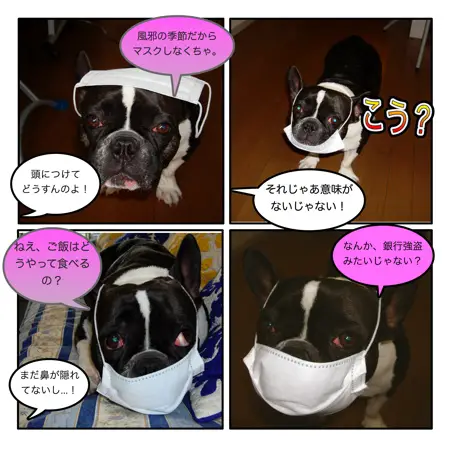
:maggie-small: 「風邪の季節だからマスクをしなくっちゃ…」
=Kaze no kisetu dakara masuku wo shinakuccha
= “It is cold season so I think I should wear a mask.”
 「頭につけてどうするのよ!」
= Atama ni tsukete dousuru no yo!
= “What’s the point of wearing that on top of your head?”
:maggie-small: 「こう?」
= Kou?
= “Like this?”
 「それじゃ、意味がないじゃない!」
= Soreja, imi ga naijanai!
= It is meaningless. “What is the point of wearing the mask that way?”
:maggie-small: 「ねえ、ご飯はどうやって食べるの?」
=Nee gohan wa douyatet taberu no?
= “How am I supposed to eat with this?”
「まだ鼻が隠れてないし…」
=Mada hana ga kakurete nai shi..
= “You haven’t covered your nose yet!”
:maggie-small: 「銀行強盗みたいじゃない?」
= Ginkou goutou mitai janai?
= “Don’t I look like a bank robber?”
:u:
It’s winter and is getting very cold in Japan.
We hear a lot of people talk about 風邪 ( = kaze), cold, in our daily conversations.
Japanese people often talk about weather as a conversation starter.
Ex. 「今日は暑いですね。」
=Kyouwa atsui desune.
= “It’s hot today, isn’t it?”
「寒くなって来ましたね。」
= Samuku natte kimashitane.
= “It is getting colder, isn’t it?”
In winter, we often mention 風邪 ( = kaze), cold, when we say good-bye. How? We’ll see in today’s lesson!
We are going to check the KANJIS first!!
風 かぜ・かざ・ふう (= kaze/ kaza / fuu)
Ex. 今日は風が強い
= Kyou wa kaze ga tsuyoi
= It’s windy today.
Ex. 風向きが変わる
= Kaza muki ga kawaru
= change the direction of wind
Ex. 風速50 m
= fuusoku gojuu meetoru
= wind speed of 50 m/s
Ex. 風紀が乱れる
= fuuki ga midareru.
= corrupting public morals
邪 じゃ ( ぜ)・や ( =ja (ze) / ya)
• 邪魔 ( = jama) obstacles 〜する (~ ~suru) to bother someone/something)
Ex.「お邪魔します。」
= Ojama shimasu!
(We say this when we come into someone’s house or office.) means ” Allow me to let myself into your house/office, etc.”
Related lesson : お邪魔します ( = ojama shimasu.)
Ex.「邪魔をしないで下さい。」
=Jama wo shinai de kudasai.
= “Don’t bother me!”
•無邪気 ( = mujaki) =innocent
風 + 邪

風邪 ( = kaze) cold
The main verb to get/catch cold is ひく(引く) ( = hiku)
Ex. 風邪を引く
= kaze wo hiku
= to have a cold, to catch a cold
:kkk: Culture Note :
In English you say “Keep warm!” to people in winter. Meanwhile, in Japan it is very common to say
「風邪を引かないで下さいね。」
= Kaze wo hikanai de kudasai ne.
= “Don’t catch a cold!”
「風邪ひかないでね!」(more casual)
= Kaze wo hikanai de ne.
or
風邪に気をつけて(下さい。)
= Kaze ni ki wo tsukete (kudasai.)
= “Please be careful to not catch a cold!”
to people when you say good-bye (or finish the email or letter.)
• 風邪を引きかける ( = kaze wo hikikakeru) getting a cold, to be experiencing the beginning stages of a cold
Ex. 風邪の引きかけに薬を飲んで治す。
= Kaze no hikika ni kusuri wo nonde naosu.
= to cure the cold with medicine in its early stages.
• 風邪がうつる
= kaze ga utsuru
= to get a cold from someone
Ex. 1) 風邪をうつしたらいけないから今日は家にいます。
= Kaze wo utsushitara ikenai kara kyou wa uchi (ie) ni imasu.
= “I will stay home because I don’t want to give my cold (to anybody).”
Ex. 2) 風邪をうつされるといけないから今日は家にいます。
= Kaze wo utsusareru to ikenai kara kyou wa uchi (ie) ni imasu.
= “I will stay home because I don’t want to get a cold (from anybody).”
Grammar Note :
うつす ( = utsusu) to give, to transmit うつされる ( = utsu sareru) passive form to be given, to pick up
Ex. 誰に風邪をうつされたかわからない。
=Dare ni kaze wo utsusaretaka wakaranai.
or
誰に風邪をもらったかわからない。
= Dare ni kaze wo moratta ka wakaranai.
= I don’t know who gave me a cold.
•風邪が流行る ( = kaze ga hayaru) = 風邪が流行する。 ( = kaze ga ryuukou suru.) cold is prevalent
Ex. 今年の冬は風邪が流行っています。(流行しています。)
= Kotoshi no fuyu wa kaze ga hayatte imasu.) (ryuukou shite imasu.)
= The cold is spreading this year.
:ii: 薬( = kusuri) <Medicine>
• 風邪薬 ( = kaze gusuri) cold medicine
• 薬を飲む。( = kusuri wo nomu.) to take a medicine
Ex.「薬何か、飲んだ?(飲みましたか?)」
= Kusuri nanka nonda? (nomimashitaka?)
= “Did you take any medicine?”
•薬が効く( = kusuri ga kiku) The medicine works.
Ex. 風邪の初期には生姜湯が効きます。
= Kaze no shoki niwa shougayu ga kikimasu.
= Hot ginger drink is effective to cure colds in their early stages.
Culture note : 生姜湯 ( = shougayu) and 卵酒 ( = tamago zake) , hot Japanese sake with eggs and sugar are traditional cold home remedies in Japan.
•うがい薬 ( =ugai gusuri) a liquid medicine to mix with water for gargle
•のど飴 ( = nodoame) throat drop, a candy to ease sorethroat
•マスク ( = masuku) a mask (please check the Maggie’s pictures.)
:s: Culture note :
Those who have never been to Japan might be spooked out to see all the people wearing masks in public. Even before the swine flu emerged, Japanese people have worn these white masks in the winter to prevent from catching cold (or not giving others their colds.)
<風邪の予防 ( = kaze no yobou) How to prevent from catching a cold! >
人混みに出る時はマスクを着用すること。
= Hitogomi ni deru toki wa masuku wo chakuyou suru koto.
= When you go out in a crowded area, be sure to wear a mask.
帰宅したら手洗いとうがいをすること。
= Kitaku shitara tearai to ugai wo suru koto.
= When you come back home, wash your hands and gargle!
We have been taught to wash our hands and gargle in the winter to avoid catching colds at school and at home.
• ワクチン ( = wakuchin) vaccine
• 予防接種 ( = yobou sesshu) vaccine, inoculation
Ex. 予防接種を打つ。
= yobou sesshu wo utsu
= to inoculate
cf. 注射を打つ 。( = chuusha wo utsu) to get a shot
• 薬局 ( = yakkyoku) pharmacy
• 処方箋 ( = shohousen) prescription
• 抗生物質 ( = kousei busshitsu) antibiotic
Related lesson: 薬 ( = kusuri) medicine
:k: <What kind of 風邪 ( = kaze) cold do you have?>
:u:
• 鼻風邪 ( = hanakaze) a head cold
• 胃腸風邪 (=ichou kaze) the stomach flu
• 軽い風邪 (= karui kaze) a light cold, a head cold
• 風邪気味 ( = kaze gimi) a touch of cold
Ex. なんか風邪気味です。
= Nanka kazegimi desu.
= “I think I have a touch of cold.”
• 重い風邪 ( = omoi kaze) a heavy cold
• ひどい風邪 ( = hidoi kaze) a bad cold
•しつこい風邪 ( = shitukoi kaze) a persistent cold
:ee: 症状 ( = shoujou) symptoms
「どんな症状ですか?」
=Donna shoujou desu ka?
= “What are the symptoms?”
「症状を聞かせて下さい。」
=Shoujou wo kikasete kudasai.
= “Let me hear what kind of symptoms you have.”
Here are some cold symptoms!
:u:
• 発熱 ( = hatsunetsu) fever heat
• 熱が出る。 ( = netsu ga deru.) to have a fever
• 高熱が出る。( = kounetsu ga deru.)
or
高い熱が出る。( = takai netsu ga deru.) to have a high fever
•平熱 ( = heinetsu) average/normal a temperature
Ex. 平熱に下がる。
= heinetsu ni sagaru.
= a fever goes down
•熱を計る ( = netsu wo hakaru.) to take temperature
Ex.「(お)熱はありますか?」
= (O)netsu wa arimasuka?
= “Do you have a fever?”
「まだ計っていないのでわかりません。」
=Mada hakatte inaino de wakarimasen.
= “I have’t taken it yet so I don’t know..”
• はい、微熱があります。
= Hai binetsu ga arimasu.
= “Yes, I have a slight fever.”
• 熱が39度も出た。
=Netsu ga sanjuuku do mo deta.
= “I have a fever of 39 degree.“
• 熱にうなされる。
= Netsu ni unasareru.
= to suffer from fever
• 悪寒がする。
= okan ga suru.
= to have shakes, to feel a chill
• 寒気がする。
= Samuke ga suru.
= to have a chill
• 熱っぽい
= netsuppoi
= feverish
• 嘔吐する
= outo suru
= to vomit, throw up
• 吐く
= haku
= to throw up
• 吐き気
= hakike
= nausea
Ex. 吐き気がする。
= hakike ga suru
= to feel nauseous
• 下痢 ( = geri) diarrhea
Ex.下痢になる
= geri ni naru.
= to get diarrhea
Ex.下痢をしている
= geri wo shieiru.
= to have diarrhea
• 咳 ( = seki) cough
Ex.「咳が止まりません。」
= Seki ga tomarimasen.
= “I can’t stop coughing!”
• くしゃみ ( = kushami) a sneeze
Ex.くしゃみが出る
= kushami ga deru.
= to sneeze
Ex.「くしゃみが止まりません。」
= Kushami ga tomarimasen.
= “I can’t stop sneezing!”
•鼻水 ( = hanamizu) a runny nose
Ex. 鼻水が出る。( = hanamizu ga deru.) to have a runny nose
•鼻をかむ ( = hana wo kamu.) to blow one’s nose
•頭痛 ( = zutsuu) a headache
Ex. 頭痛がする(します)
= Zutsuu ga suru (shimasu.)
= My head hurts. / I have a headache.
Ex. 頭が痛い(です)
= Atama ga itai (desu.)
= My head hurts. / I have a headache.
Ex. 頭がずきずきする。
= Atama ga zukizuki suru.
more polite
ずきずきします。
= Zukizuki shimasu.
=My head is throbbing.
Ex. 体中が痛い(です。)
= Karadajuu ga itai (more polite) desu.)
= My whole body hurts.
• 菌 ( = kin) germs
Ex. 菌が入る ( = kin ga hairu) to get germs in one’s body
• 免疫 ( = meneki) immune
• 免疫がある ( = meneki) to be immune to ~
• 免疫がない ( = men eki) not to be immune to ~
• 免疫力 ( = men eki ryoku) immune strength
• 免疫力が低下している ( = meneki ryoku ga teika shiteiru) to have a weakened immune system
• 免疫力が上がる ( = meneki ryoku ga agaru) to improve immunity
• 流感 ( =ryuukan) influenza, flu
•インフルエンザ ( =infuruenza) influenza, flu
• A型インフルエンザ ( = eigata infuruenza) type A influenza
• 新型インフルエンザ ( = shingata infuruenza) new influenza
:r: How do you say to people who have got cold?
「お大事に!」
=”Odaijini!”
= “Take care!”
(more polite)
「お大事にして下さい。」
=”Odaijini shite kudasai!”
= “Please take care!”
(more polite)
「どうか、お大事にして下さい。」
=”Douka odaijini shite kudasai!”
= “Please take care of yourself!”
(more polite)
「どうか、くれぐれもお大事になさって下さい。」
=”Douka kureguremo odaijini nasatte kudasai!”
= “Please take care!”
「早く治してね。」
=”Hayaku naoshite ne!”
= “Get well soon!”
:rrrr:(more polite)
「早く治して下さい。」
=”Hayaku naoshite kudasai!”
= “Please get well soon!”
:rrrr:(more polite)
一日も早い御快 (or 回)復を心からお祈りしております。(written form)
= “Ichinichi mo hayai gokaifuku wo kokoro kara negatte imasu.”)
= I sincerely hope that you get well as soon as possible.
Note : “recovery” has two forms of kanjis.
1) 回復 ( = kaifuku) Recovery from disease and also be used for other things, functions, etc.
Ex. 景気の回復 (= keiki no kaifuku) economic rebound
2) 快復 ( = kaifuku) We use it when we refer the recovery from a long lasting disease.
:kkk: To fix or to cure?
Also there are two kanjis for なおす( = naosu) !
A) 直す
and
B) 治す
We always use B) 治す ( = naosu) to cure disease or body.
治す = なおす ( = naosu) to cure, heal, shake off (transitive verb)
治る = なおる ( = naoru) to be cured (intransitive verb)
Ex. 風邪が治った
= kaze ga naotta.
= I am over my cold.
直す = なおす ( = naosu) to fix (transitive verb)
直る = なおる = ( = naoru) to be fixed (intransitive verb)
 <From the picture above>
Did you get the conversation in the pictures above? This is one of example conversation of 「ボケと ツッコミ」 ( = boke to tsukkomi)
Check my 笑い ( = warai) lesson) I am doing ボケ ( = boke) here.
Let me explain one thing here.
「まだ鼻が隠れてないし…」
= Mada hana ga kakurete nai shi..
= “You haven’t covered your nose yet!”
:ee: Note :
There is a tendency to finish a sentence with し ( = shi) among young people.
(Also there is a dialect to finish the sentence with し ( = shi) like in Kansai area. It is grammatically incorrect but they say that anyway.
Usually し ( = shi) is used as “and” to list things or descriptions.
Ex. 彼女、可愛いし、優しいね。
= Kanojo kawaii shi yasashii ne.
= ”She is cute and sweet.”
:u:
Ex. 「あなた何て好きじゃないし!」(colloquial)
= Anata nante sukija nai shi!
= ”I don’t like you! ”
Ex. 「どれだけ勉強してもわからないし!」
= Doredake benkyou shitemo wakaranai shi!
= ”No matter how much I study, I don’t understand! ”
If you want to study more about the usage of し ( = shi), go check this lesson.
 マギー先生より = Maggie-sensei yori = From Maggie sensei
やっぱりマスクをすると息苦しいです。
= Yappari masuku wo suruto ikigurushii desu.
= As I expected, wearing a mask is suffocating!
風邪を引いている人は、私に近づかないでね。
= Kaze wo hiite iru hito wa watshi ni chikazukanai de ne.
= If you have a cold, stay away from me, OK?
****
!new! Additional Information (2020)
I made the following list in March, 2020. (I already taught you some of the words in this lesson. )
Hope it helps people who live in Japan to understand Japanese news more.
:i: Coronavirus Related Vocabulary
* 新型コロナウイルス = しんがたコロナウイルス = shingata korona uirusu = novel/new coronavirus (COVID-19)
* 肺炎 = はいえん = haien= pneumonia
* 感染 = かんせん = kansen = infection
verb 感染する = かんせんする = kansen suru = to be/ get infected
* 感染者 = かんせんしゃ = kansensha = infected person
* 濃厚接触 = のうこうせっしょく = noukousesshoku = close contact
* 濃厚接触者 = noukousesshokusha = a person who has been in close contact
* 陽性 = ようせい = yousei= positive
* 陰性 = いんせい = insei = negative
* 隔離 = かくり = kakuri = quarantine
* 熱が出る = ねつがでる = netsu ga deru /発熱 = はつねつ = hatsunetsu
= to have/get a fever
* 高熱 = こうねつ = kounetsu = high fever
* 微熱 = びねつ = binetsu = slight fever
* ~度 = ど = do = degree
Ex. 37.5℃以上の発熱が4日以上続く
= さんじゅうななてんごどいじょうのはつねつがよっかいじょうつづく
= sanjuunanatengo-do ijou no hatsunetsu ga yokka ijou tsuzuku
= a fever of over 37.5°C that has persisted for more than four days
* 症状 = しょうじょう = shoujou = symptoms
* 無症状 = むしょうじょう = mushoujou = asymptomatic, not showing any symptoms
* 呼吸器症状 = こきゅうきしょうじょう= kokyuukishoujou= respiratory symptom
* 軽症 = けいしょう = keishou = light symptoms
* 重症 = じゅうしょう = juushou= serious condition
* 咳 = せき = seki = cough ( + が出る = がでる = ga deru = to cough)
* くしゃみ = kushami = sneeze ( + が出る = がでる = ga deru = to sneeze)
* 痰 = たん = tan = phlegm (+ が絡む = がからむ = ga deru = to have phlegm in one’s throat )
* 喉が痛い = のどがいたい = nodo ga itai = to have a sore throat
* 息切れ = いきぎれ = ikigire = shortness of breath
* 胸の痛み = むねのいたみ = mune no itami = chest pain
* 倦怠感 = けんたいかん = kentaikan = feeling of fatigue/tiredness
* PCR検査 = PCRけんさ = PCR kensa = PCR test
* 基礎疾患 = きそしっかん = kisoshikkan = underlying illness
* 回復/快復 = かいふく= kaifuku = recovery, getting better
* 完治 = かんち = kanchi = complete recovery
* 予防策 = よぼうさく= yobousaku = precautionary measure
* 手洗い = てあらい = tearai = washing hands
* 石鹸 = せっけん = sekken = soap
* うがい = ugai = gargle
* マスク = masuku = surgical mask
Ex. マスクをする = masuku wo suru = to wear a surgical mask
* 消毒 = しょうどく = shoudoku = sterilization, disinfectant
* 人混みを避ける = ひとごみをさける = hitogomi wo sakeru = to avoid crowds
:: (From the News)
* 緊急措置 = きんきゅうそち = kinkyuusochi = emergency measures.
* 自粛する = じしゅくする = jishuku suru = to refrain
* 渡航自粛勧告 = とこうじしゅくかんこく= tokoujishuku kankoku
= travel advisory
* デマ = dema = false rumor
* 買い占め = かいしめ = kaishime = hoarding 🙅
From Maggie Sensei
みなさん、手をよく洗いましょうね。
= Minasan, te wo yoku araimashou ne.
= Wash your hands thoroughly, everyone!
Stay safe and healthy, everyone!
***
Will you be my Patron?
I appreciate your support! サポートありがとう!

19 Comments
Hi,
Why do we use wo in kaze wo hiku but ga in zutsuu ga suru? Is it right to say kaze ga hiku? And if possible, could you make a lesson on the difference between ha, ga, and wa?
Thanks in advance
@A
I think someone else has just asked me the usage of ~ga suru.
Sometimes we use ~ ga suru to express one’s feelings or symptoms.
zutsuu ga suru = to have a headache
Ki a suru = to feel like ~
memai ga suru = to feel dizzy
And the difference between “wa” and “ga” is on the request list. Please wait patiently. It will take a lot of time to make that lesson.
The legendary は VS が lesson…
It’s like a Holy Grail…
I really cannot wait to check it! ^ ^
Give your best, Maggie!
@天人
I know SOOOOO MANY people have asked me to make a lesson on that subject but I have been procrastinating.
It used to be my final goal…but I have started to work on it. :D
Hi!
Instead of saying “kaze wo hiku”. Is it okay to say “kaze desu”. and what is the difference?
thank you
@Josefin
Hello Josefin,
When you translate them, it could the same but the difference is
Kaze wo hiku = to catch a cold, to have a cold (You are talking about the process of getting a cold)
Kaze desu. = What I (you) have is a cold.(you are talking about the symptoms or the name of the disease you have.)
But when you translate them, it’s the same.
Great “illness” lesson Maggie! Very useful! どうもありがとうございました。
Debbie
@デビー
Glad to hear this lesson is useful.
風邪ひかないように気をつけてね! !happyface!
Great one!
Isn’t the し used to explain reasons when there are several? And I’ve heard it also when the speaker only mentions one.
このレストランが好き!安いし、サービスはいいだし。
@Cygnus
Yes, as I mentioned in the lesson, し is usualy use when you list up something.
安いし、サービスはいいだし。→安いしサービスはいいし
Dear Yukari-sensei and Maggie-sensei,
Your lessons are so great! I have learnt a lot of colloquial Japanese from them already, and best of all they are fun to read! You are doing a great service to the Japanese-learning community. Please keep up the good work, and I look forward to your next lesson!
(p.s. I just donated, please make sure Maggie gets a nice new toy for Christmas from me!)
Robuta-san,
Thank you so much for your nice comment and your donation! We really appreciate your support and yes! I will get a new bone for sure!
Yukari and I are now making a new lesson. Please visit here again!
Arigatou!!!
This, along with all the other lessons posted, are great. Thank for you for posting them!
ありがとう ございます。
Leo-san,
こちらこそ、ありがとうございます!
This site is pure genius! Please keep it up :)
Delenir-san,
Arigatou!!!! Ganbarimasu!
私は今軽い風邪を引いてしまいました。風邪を引きかけてすぐ薬を飲んでいるから、だんだん治っています。^^;
Maggieさん、風邪を引かないでください!
あっ、質問があります。
「風邪を引く人は馬鹿だ」という諺がありますね?よく覚えっていませんが、面白いと思いました。^^;
Harin-san,
いつも日本語でコメントしてくれてありがとう!
Harinさんの日本語もう上級ですが、も〜っと上手くなって欲しいのでまたちょっとだけ、直しますね。
私は今軽い風邪を引いてしまいました。
->”今”を入れる時は 「私は今軽い風邪を引いています。」の方が自然です。
それか
”今”をいれないで「私は軽い風邪を引いてしまいました。」だったらOK!!
覚えっていませんがー>覚えていませんが
さて、御質問に答えます!
正しくは、「馬鹿は風邪を引かない。」です。
だから、私は風邪ひかないかも… :D
Harinさんも早く風邪を治してね!