
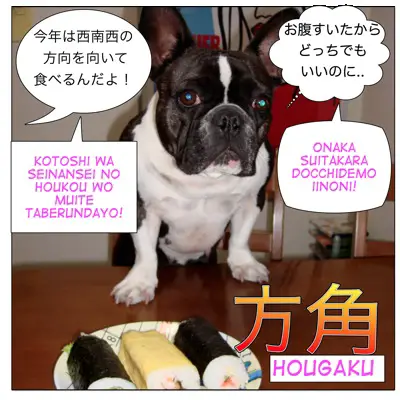
🐶 「今年は西南西の方向を向いて食べるんだよ!」
= Kotoshi wa seinansei no houkou wo muite taberundayo!
= “This year, you have to eat it facing west-south-west!”
🐶「お腹すいたからどっちでもいいのに…」
= Onaka suitakara docchi demo ii noni…
= “I don’t care which direction I face… I am hungry…”
Today’s lesson is about 節分 ( = setsubun) and 方角 ( = hougaku)!
★ 節 分 = setsubun
February 3rd* is called 節分 ( = setsubun) in Japan.
(Special Note: In 2021, we celebrate it on February 2nd for the first time in 124 years.)
節分 ( = Setsubun) originally means “to divide seasons”. It’s the day before the first day of each season. But it only indicates February 3rd now.
February 3rd or 4th is called 立春 ( = risshun) and it is the day when spring starts and also it’s a beginning of a new year in Japanese lunar calendar.
⭐️ What do we do on 節分 ( = setsubun)?
We throw roasted soybeans 大豆 ( = daizu) that is called, 豆まき ( = mamemaki.)
We throw beans inside the house or around the house with the windows and doors open and shout
「鬼は外!福は内!」
= Oni wa soto! Fuku wa uchi!
= “Demons out! Good luck in!”
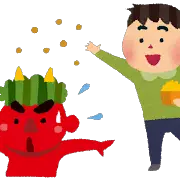
This will get rid of bad luck and invite in good luck. One person, usually a father, wears the 鬼 ( = oni) demon mask and the rest throw beans at that person. It’s customary to pick up the beans off the floor and eat the number equal to your age in the hope that this will get you good health and good luck.
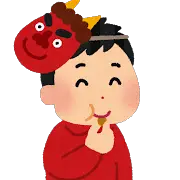
A lot of shrines or temples hold a 豆まき ( = mamemaki) throwing soybeans event.
Some of the big shrines or temples have celebrities as guests to throw beans to crowds.
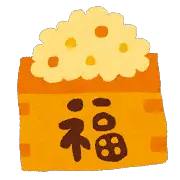
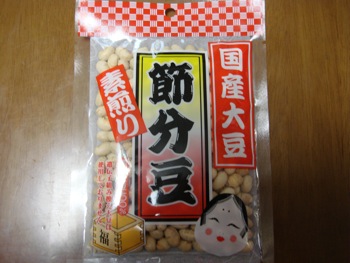
↑The above picture is 節分豆 ( = setsubun mame) You can buy these roasted soybeans before Feb.3rd.
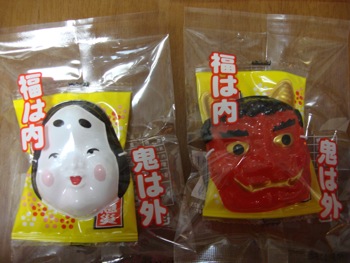
↑Some of the packages contains masks of 鬼 ( = oni) demons.
The one on the left is おかめ ( = okame) which represents 福 ( = fuku) good luck.
You can see that the packages say 鬼は外、福は内 ( = Oniwa soto, fuku wa uchi) Demons out, Good luck in.
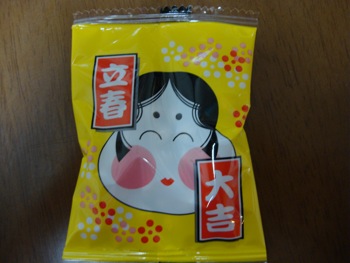
↑ Also in this picture you can see the kanji
立春 ( = risshun) the day when spring starts in Japanese lunar calendar.
大吉 ( = Daikichi) means good luck.
We eat 恵方巻き ( = ehoumaki) on 節分 ( = setsubun) which is a thick sushi roll.
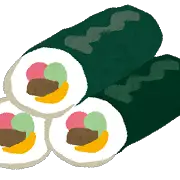
This custom is mainly from
近畿地方 ( = kinki chihou) = Kinki area (in the West part of Japan).
The sushi roll has to have seven ingredients such as
干瓢 ( = kanpyou)dried gourd shavings
胡瓜 ( = kyuuri) cucumber
人参 ( = ninjin) carrots
椎茸 ( = shiitake) shiitake mushrooms
出し巻き卵 ( = dashimakitamago) sweeten egg omelette
鰻 ( = unagi) eel
海老 ( = ebi) shrimp
鮭 ( = sake)/ サーモン ( = saamon) salmon
でんぷ ( = denpu) (pink colored) fish powder), etc.
There is no specific rule for the ingredients but they represent the 七福神 ( = shichifukujin) Seven Deities of Good Fortune.
Every year has a different good luck direction called 恵方 ( = ehou).
Cf. We also use 吉方(位) ( = kippou(i)) for good luck direction.
This year 恵方 ( = ehou) is 南南東 ( = nannantou) south-southeast
(⚠️ Updated information : For the year 2026, 恵方 ( = ehou) is 南南東 ( = nannantou) south‐southeast. )
You are supposed to eat the sushi roll on the night of Feb. 3rd but you are not supposed to cut it. This is supposed to help you not “cut” the good relationships = 縁を切らない ( = en wo kiranai).
While eating you should face 恵方 ( = ehou)good luck direction and concentrate on wishing for happiness. Don’t talk until you finish the roll! (I have no problem doing this!)
Now, I will teach you directions.
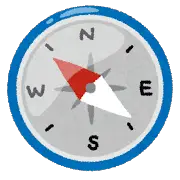
方角 ( = hougaku) directions, bearing
Ex. 霧で何も見えなくなり方角がわからなくなった。
= Kiri de nanimo mienaku nari hougaku ga wakaranaku natta.
= I couldn’t see anything for the fog and lost my bearings.
Ex. 私は風水を信じているので今年は東の方角には旅行に行かない。
= Watashi wa fuusui wo shinjite iru node kotoshi wa higashi no hougaku niwa ryokou ni ikanai.
= Since I believe Feng Shui, I won’t travel in the direction of east this year.
↓
方 = hou/kata/gata
• 方法 ( = houhou) method, way
• 日本語を学ぶよい方法はありませんか?
= Nihongo wo manabu yoi houhou wa arimasenka?
= Is there any good way to study Japanese?
•方向 ( = houkou) direction, trend, stream and etc.
•方向音痴 ( = houkou onchi) a person who is bad at directions
Note : 方向 ( = houkou) is a synonym of 方角 ( = hougaku) , direction or bearing, such as North, East,West, South, etc.
(Ex. 西の方向 ( = nishi nohoukou) = 西の方角 ( = nishi no hougaku) = in the direction of west)
It also has a meaning of a direction that people or project proceeds.
• この計画は方向性がない
= Kono keikaku wa houkousei ga nai
= This project lacks direction
• 正しい方向に進む
= Tadashii houkou ni susumu.
= to proceed in the right direction.
角 = tsuno/kado/kaku/gaku = corner, angle, horn
Ex.そこの角に薬局があります。
= Soko no kado ni yakkyoku ga arimasu.
= There is a pharmacy on the corner.
↓
東西南北 ( = touzainanboku) East West South North (We say the four directions in this order in Japanese.)
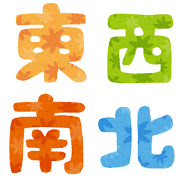
東 ( = higashi/tou) east
• 東京 ( = toukyou) Tokyo
• 関東地方 ( = kantou chihou) Kanto district
西 ( = nishi/sei) west
• 関西弁 ( = kansaiben) Kansai area accent.
南 ( = minami/nan) south
• 南向きの部屋 ( = minami muki no heya) The room facing south.
北 ( = kita/hoku) north
• 北枕 ( = kitamakura) to put the pillow toward north.
 Culture note : Some Japanese people avoid 北枕 ( = kitamakura) because of the old custom of putting the deceased person’s body facing north.
Ex. 彼は東京に来たばかりで西も東もわからない。
= Kare wa toukyou ni kitabakari de nishi mo higashi mo wakaranai.
= He has just come to Tokyo so he has no idea where anything is.
🩷From the first Maggie’s picture:
「今年は西南西の方向を向いて食べるんだよ!」
= Kotoshi wa seinansei no houkou wo muite taberundayo!
= “This year, you have to eat it facing west-south-west!”
•〜の方向を向く ( = ~no houkou wo muku) to face/turn to the direction of ~
•食べるんだよ ( = taberundayo) You are supposed to eat/You should eat (casual command or suggestion)
「お腹すいたからどっちでもいいのに…」
= Onaka suitakara docchi demo ii noni…
= “I don’t care which direction I face… I am hungry…”
• お腹すいた ( = Onaka suita) to be hungry (casual)
• ~から ( = ~kara) Because ~
• どっちでも ( = docchi demo ) (casual)
→(Formal どちらでも( = dochirademo))whichever, whatever
どっちでもいいのに ( = docchicemo iinoni ) I don’t care whichever/whatever it is.
(→In this case Whatever direction it is.)
(のに ( = noni) in the end emphasizes the meaning.)
 マギー先生より = Maggie sensei yori = From Maggie-sense,
皆は、今年は豆まきをしましたか?私は、ジャーキーを投げてもらった方が嬉しいんだけど…
= Mina wa kotoshi wa mamemaki wo shimashitaka? Watashi wa jaakii wo nagete moratta houga ureshiindakedo..
= Did you throw beans this year? I prefer you throw doggie treats!
***
****
I appreciate your support! サポートありがとう! !
My supporters can access tons of audio files, PDF files, and special lessons on my Patreon page.
❤️ありがとう x 2: Mini lessons, PDF files with audio for all the lessons here from 2018
❤️ありがとう x 5 In addition to the previous benefit + Daily Japanese
Check the index of Daily Japanese Series →Index
❤️ありがとう x 10 In addition to the previous benefit + PDF file of all my Twitter lessons for a month (average 10 ~ 18 pages) with an audio file. Please check the details here

One-time support ↓ ありがとう!

32 Comments
七福神 !koujichuu! (=Hichifukujin)[shichifukujin]
関東地方(=kantou !koujichuu! )+ [chihou]——–> Kanto district
•どっちでも !koujichuu! (=docchicemo ) (casual) [docchidemo]
どっちでもいいのに !koujichuu! (=docchicemo iinoni ) [docchidemo]
皆は、今年は豆まきをしましたか?私は、ジャーキーを
 [nagete][投げて]もらった方が嬉しいんだけど…(=Mina wa kotoshi wa mamemaki wo shimashitaka? Watashi wa
 jaakii wo !koujichuu! !koujichuu! [maite]
  [nagete] moratta houga ureshiindakedo..)
jaakii= ?? wakarimasen is it jerky[lean meat]
@zoheb
Thank you, zoheb for checking the spelling as always. Really appreciate it!
ジャーキー= jaakii is a dog treat which came from beef(or chicken/pork) jerky for dogs. :)
GOOD LUCK GOOD HEALTH EVERYONE
@afterefex
afterefexにも福がいっぱいきます様に!
恵方巻き wa… oishisou ^O^ maggie sensei is lucky :)
Setsubun is such a cool tradition^^ I admit I m chotto 方向音痴 .__.
日本語を学ぶよい方法はありませんか?
HAAAAAI Maggie Sensei no saito <3 ^O^
oh and "fuku" kanji from "oni wa soto fuku wa uchi" is the same as in fukubukuro ne~ ^^ (recognized it from your fukubukuro lesson :)
otsukaresama!!
@Aki
Haha, I am VERY 方向音痴 as well!
Ohhhh you are learning!! That’s right. 福 is the same kanji as 福袋!
Hope a lot of 福 comes to you!
u too ^~^ lots and lots of 福 to u too^^
and I already feel SUPER lucky to have u as my sensei, Maggie <3
itsumo tasukete kurete arigatou :)(maybe it doesn't make sense but I wanted to say: thanks for always helping us^^)
@Aki
itsumo tasukete kurete arigatou : Thank you! And it’s a perfect sentence!
You are my favorite student!!
I loved the video, and would love to win one of the masks.
very interesting stuff, thanks for all the great info. Another brilliant lesson.
鬼は外 福は内 interesting tradition. i actually had to translate an article talking about that in my Japanese class the other day
What fun! This lesson was extremely helpful!
Also, I’ll have to teach the Pugs to have a taste for Sushi too! Hehe!
I thought I’d add my youtube address for the drawing. Sorry for the multiple comments, well if that could help I’d comment more too lol.
In the following sentence has demons missing an n:
“You can see that the packages say 鬼は外、福は内 (=Oniwa soto, fuku wa uchi) Demos out, Good luck in.”
It should read:
“You can see that the packages say 鬼は外、福は内 (=Oniwa soto, fuku wa uchi) Demons out, Good luck in.”
I wonder what the next lesson will be (^ω^)
Ido-san
Thank you for the correction!
I fixed it. Arigatou!!
This is something I’d wish I didn’t miss, well thanks for sharing though with this awesome lesson as ever~
Thank you for all your nice comments! 有り難うございます!
Hope you come visit me more often here!
If you have a request or questions, please feel free to ask me!
Next year I’m going to share a sushi roll with my dog Loki in honor of this video!
Thank you for the lesson!
鬼は外、福は内!
Gimmeaflakemanさんの節分についた動画を見てこのサイトに来ました。
本当にいいサイトですね~
よかったらちょっと質問がありますが。
方向音痴はわかりますが、他には音痴がついた言葉がありませんか?ファッション音痴とか?(笑)
よろしくお願いします!
roosterswild-san,
コメント有り難うございます!
ファッション音痴も使えます!あと、よく使うのは、
*メカ音痴=機械音痴 (a person who is not good at machines.)
*味音痴(Who can’t taste)
とかです。
自分たちでいろいろな言葉を作ることもありますよ。
Ex.芸能音痴(a person who is not familiar with entertainment world.)
Thanks for this lesson. This is a really interesting tradition.
I saw the video you made on gimmeaflakeman channel! Maggie stole your ehomaki! More luck for Maggie ahhaha! ^_^ Please enter me in the random draw for the setsubun prizes. Thanks!
-Maki-
Sugoi!
Totemo suki desu.
Doumo arigatou.
:) :) : ) : ) : ) : ) : ) : ) : ) wwwww
Maggie really wanted your food. I could see the greed in her eyes. She ate it so fast I doubt she even tasted it. But I guess that’s not important.lol
What happens if there’s not enough beans left on the floor to equal your age? Do you end up with bad luck for the year?
Thanks for the lesson and making me hungry.
Squash-san,
Usually we throw loooots of beans so there we don’t need to worry about that.
But if there are not enough…just throw more beans!
Nice one really like to learn more about the Japanese culture, and of courses learning new words is always excelent, so thank you maggie, my favorite sensei. ありがとうご座います
Thank you for the great lesson Maggie-sensei!!
Haha, this is actually a really great way of learning. It is not designed towards beginners however it does break down the sentences and information very well for studdy. After finding this page after your youtube advertisment, im sure i will keep poping back to try and educate myself alittle bit more. ^^ – Jay.
Great video on Setsubun! Please send me the Setsubun pack! Onegaishimasu!