
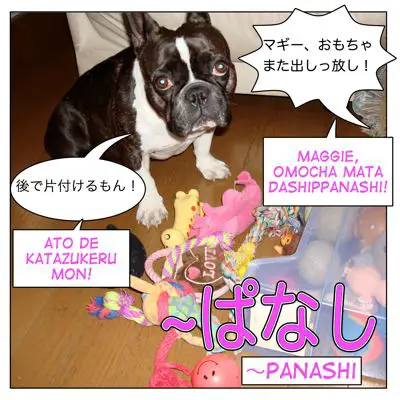
「マギー、おもちゃ、また出しっ放し!」
= Maggie, omocha mata dashippanashi!
=“Maggie, you left out your toys again!”
🐶「後で片付けるもん!」
= Ato de katazukeru mon!
= “I will put these away later!”
皆さん、今日は! ( = Minasan konnichi wa!) Hello everyone!
Today we will learn how to use 〜ぱなし ( = ~ panashi )!!
Take a look at the picture above.
Maggie NEVER puts her toys back after she plays with them.
First she takes out all the toys from the toy box.
→おもちゃを出す ( = omocha wo dasu.)
Then she leaves the toys just like that.
→おもちゃを出しっぱなしにする。
= Oomocha wo dashippanashini suru.
ぱなし ( = panashi) has come from a verb 放す ( = hanasu)
出しっぱなし = 出しっ放し ( = dashippanashi)
Since the verb coming in front of はなし ( = hanashi) should end with small っ ( = tsu), we pronounce ぱ ( = pa) instead of は ( = ha)
By adding ぱなし ( = panashi) to a verb, you can describe something that has been left in a certain condition for some time. (Usually, this is done unintentionally unless you say わざと/敢えて〜っぱなしにしておく。 ( = Wazato / Aete ~ ppanashi ni shiteoku.) Leave them —– on purpose.
Maggie took off her coat and left it on the floor.
The verb “to take off” is 脱ぐ ( = nugu).
Its ます ( = masu) form is 脱ぎます.
Eliminate ます ( = masu) and add っぱなし ( = ppanashi)
OK, let’s try another one!
Maggie ate some food and left the bowl without putting away.
The verb for ”to eat” is
食べる(=taberu)
→食べます ( = tabemasu) →Eliminate ます ( = masu) and add っぱなし (= ppanashi)
•あの人はなんでもやりっぱなしだ。
= Anohito wa nandemo yarippanashi da.
= He always leaves things unfinished.
Also, it adds the meaning “all the way” or “all the time”
•(新幹線で)東京から名古屋まで立ちっぱなしだった。
= (Shinkansen de) Tokyo kara Nagoya made tachippanashi datta.
= I had to stand the whole way from Tokyo to Nagoya on the bullet train.
•誰かの傘が置きっぱなしになっている。
= Genkan ni dareka no kasa ga okippanashi ni natteiru.
= Somebody left their umbrella at the entrance for a while (and forgot to take it with them).
•彼はずっとしゃべりっぱなしだ。
= Kare wa zutto shaberippanashi da.
= He just keeps talking without stopping.
🐶 From the picture above :
「後で片付けるもん!」
= Ato de katazukeru mon!
= “I will put these away later!”
Note :もん ( = mon) This suffix sounds a little childish. Children use this suffix when they talk back to their parents.
出来ます! ( = dekimasu)→出来るもん! ( = dekirumon) I can do that!
やる ( = yaru) →やるもん! ( = yarumon) I’ll do that!
Here’s a commercial promoting エコ ( = eko) ecology — convserving ene
•出しっぱなし = だしっぱなし ( = dashippanashi) to leave (water) running
• 差しっぱなし =さしっぱなし ( = sashipanashi) to leave something plugged in
•あけっぱなし = 開けっぱなし = ( = akeppanashi) to leave something open
•流しっぱなし =ながしっぱなし ( = nagashippanashi) to leave the water running
•かけっぱなし ( = kakeppanashi) to leave it turned on
• 付けっぱなし = つけっぱなし ( = tsukeppanashi) to leave the light on
📝 Note: Colloquial Japanese
Sometimes young people skip the last なし ( = nashi) .
Ex. やりっぱなし ( = yarippanashi) →やりっぱ, ヤリッパ ( = yarippa) colloquial
 マギー先生より ( = Maggie sensei yori) From Maggie-sensei
食べっぱなし、遊びっぱなし、笑いっぱなし、寝っぱなしの人生を送りたいです。
(=Tabeppanashi, asobippanashi, waraippanashi, neppanashi no jinsei wo okuritai desu.)
I just want to spend my life keep eating, playing, laughing, and sleeping all the time!
***
Will you be my Patron?
I appreciate your support! サポートありがとう!
37 Comments
What an awesome site you have … it has seriously helped me have a deeper understanding of the language.
Hello DD,
I’m happy to hear this lesson helped you! ☺️
Maggie-sensei,
I have one more question related to っぱなし
Is there any category of verb which is not OK for っぱなし?
As I review your lesson, I find 降りますis not OK.
But still I can not have an overview image of this type of verb which is not OK.
Could you help me this point?
Thanks Maggie sensei.
Ah, you must have seen my reply to someone who asked me if we can say 降りっぱなし below.
(My reply: It is one of the example sentences in a published textbook and people do say that in conversation. (However, I might say 最近は雨が降ってばかりいる.)
The most common verbs are the ones with physical actions or state.
開ける
つける
行く
立つ
座る
食べる, etc.
Sensei,
Sorry, I just have a small question.
The most common verbs that Maggie sense taught me like 開ける、つける、etc are the verb normally impossible to go with っぱなし、are n’t hey?
Thanks Maggie sensei so much :)
The verbs that I listed 開ける, つける etc. are the common ones “with” っぱなし.
ありがとうございました!
Maggie sensei, you know at first I think ppanashi is easy to understand. But after thinking it over, I find it’s quite hard for me. Want to share it with you.
About the verb like 脱ぎます、食べます, I find it’s still hard for me to imagine the situation when those verbs go with っぱなし。
(1)靴を脱ぎっぱなし.
~っぱなし is leave something ~(in a certain state) .
So when reading this sentence, the first thing coming into my mind is
“Some one leaves the state of not wearing for a while”
= He does not wear shoes for a while @@
The meaning “Some one takes off shoes and leaves it on the floor”, especially “to leave it on the floor’ is hard to imagine (to me).
(2) 食べっぱなし
Similarly, I apply the meaning of っぱなし to this sentence, and it comes as”
” I keep eating eating without stopping”
It’s hard for me to reach the meaning of “Maggie ate some food and left the bowl without putting away” .
Please do some magic to my case, Maggie sensei !!!!
OK, let me explain again.
ぱなし is not quite keep doing some actions. After doing something, you leave the way it is.
(1)靴を脱ぎっぱなし.
You take off your shoes and leave them without putting them away. (You know you have to take off your shoes when you enter the house, right?)
(2) 食べっぱなし
After you finish eating, you don’t put the plates away, wash the dishes leaving the mess on the table.
Hello Maggie sensei,
Thank you for ppanashi lesson. Really useful
I am making a sentence by myself. Could you check if I am abusing ppanashi :)
君のことが思い出しっぱなし。
I want to say I keep missing you (can not stop).
Is it OK to use っぱなし?
Besides,
Is っぱんし here replaceable with まま?
君のことが思い出しまま。
Thanks Maggie sensei for always helping us.
Hello,
First the particle is を
君のことを思い出す
Though some people say 思い出しっぱなし in very casual conversation, you don’t usually use ぱなし or まま with 思い出す。
思い出してばかり is more natural.
ありがとうございました!!!
🐶❤️
マギー先生
先ず、レッスンを教えるのはありがとうございます。
いつも、便利です。
疑問があります、ネガティヴ+っぱなしできますか?
たとえば。。。
野菜を食べないっぱなし(に)出かけないで下さい。
野菜を食べないっぱなし(で)でかけないでください。
It is like “please, don’t leave without eating your vegetables”
I am not sure about particles either, so i apologize for any mistake in my japanese
I know I can use “zu”
野菜を食べずに出かけないで下さい, I am just wondering if above are correct.
Thank you so much
こんにちは、Suany
No, you don’t say 食べないっぱなしで〜
I guess 食べないで (or 食べずに) 出かけないでください。is grammatically correct but I would say
野菜を食べて出かけてください is more natural.
Hello Maggie Sensei! Is there any other grammar with a similar meaning to panashi? Like for the example “to leave the light on”, are there other ways to say that?
Thank you!
Hi Chre
電気をつけたままにしておく You leave the light on
Check my まま lesson.
Thank you Maggie sensei, you are my saviour,because I study japanese myself, your instructions are a bunch of help
I am very happy to hear that! Thank you for your nice comment!
これからも日本語がんばってくださいね。:)
Hi 先生!
Thank you for this lesson. It was really helpful! May I know if I can say “最近は雨が降りっぱなしだな。”as in, “it has been raining for quite a while/kept on raining these days”?
Thank you in advance! ><
It is one of the example sentences in a published textbook and people do say that in conversation. (However, I might say 最近は雨が降ってばかりいる.)
Hi sensei,
I find the song in this lesson really amazing and can’t get it out of my head :)
Could you please write the lyrics and the translation of it starting from “chiisana you de…”? I would really like to understand it to the end :) Thanks!!
@Alina
Here you go!
小さなようで大きな話
= Chiisana you de ookina hanashi
= It seems a trivial thing but actually it is a important thing .
「ぱなし」ばかしじゃ地球も悲しい
= “panashi” bakashi ja chikyuu mo kanashii
= If you just doing “panashi” (leaving something on/running,etc) , the earth will feel sad
「ぱなし」はなしって話です。
= “panashi” wa nashi tte hanashi desu.
= This is a story that we shouldn’t do “panashi”
Thanks!!! :)
But isn’t hanashi “to talk”? How does it work in 小さなようで大きな話? In my head it’s “big talk”…
Same with 「ぱなし」はなしって話です -> for me it’s “without panashi it’s talk”
Also, what is tte?
@Alina
話 means “talk/story/topic/issue/matter…etc.”
大きな話 = big thing (= big deal / big issue) / big business…(You have to change the translation depending on the context)
「ぱなし」はなしって話です
= “「ぱなし」はなし ” という話です。
って is a casual contraction of という
~ はなし = You use this form when you want to wrap up the conversation. No more~ / I had enough with ~ / You shouldn’t ~ anymore.
Ah I get it now! Thank you so much for your explanation! I always learn so much from you <3
You’re very welcome, Alina! :)
How does っぱなし differ from まま?
@Amber
They are very similar. But there is a slight difference.
I explained the difference in this lesson →How to use まま
can you please explain the に before する as in だしっぱなし に する。i can’t wrap my head around it at all.
@ghost buster
Hello, ghost buster,
に has many functions.
だしっぱなし+に+する
The に is “as/like” and describe how you leave the state/ condition .
難しい文法だとおもいます
まだうまく分かりません
@Belajar Bahasa Jepang
いつでもコメントのところで練習をして下さい。
マギーちゃん、ダメだ!おもちゃを片付けなきゃ!(笑)
Nice lesson!今、「おく」と「~ぱなし」のことが知るよね~!ありがとう先生!!
@Aki
は〜い!片付けます!!
(今〜知るよね〜 →これで〜を習った/習いました or わかった/わかりました)
そっか、そっか。分かった^^
つぎのレッスンは?
ぱなしのはなしって最高です!
こんなビデオを見ると、ポイントが忘れられないですよね。
メディアの力!
紹介してもらってありがとうございます^^
笑いは止まりませんw
roosterswildさん
このビデオ可愛いですよね!また使えるビデオがあれば紹介しますね。
(Note : 笑いは止まりません->笑いが止まりません。)