
Yukari
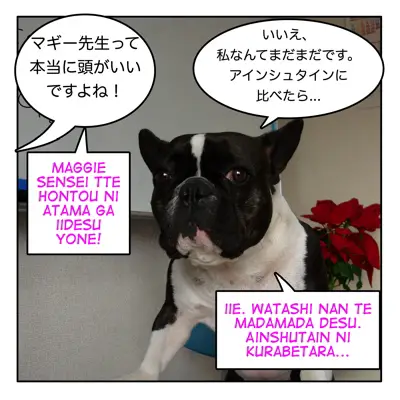
「マギー先生って本当に頭がいいですよね。」
= Maggie sensei tte hontou ni atama ga ii desu yone!
= “Miss Maggie, I think you are really smart.”
🐶「いいえ、私なんてまだまだです。アインシュタインに比べたら…」
= Iie watashinante madamada desu. Ainshutain ni kurabetara…
=“No way! Far from it. I mean, compared to Einstein….”
Today’s lesson is about “being modest or humble”.
It is called 「謙遜する」( = kenson suru) in Japanese.
When you talk to someone, you have to refer to yourself as being at a much lower level[=控えめに( = hikaemeni) to be modest than your actual ability or value.
From the picture above:
「マギー先生って本当に頭がいいですよね。」
= Maggie sensei tte hontou ni atama ga ii desu yone!
= “Miss Maggie, I think you are really smart.”
🐶「いいえ、私なんてまだまだです。アインシュタインに比べたら…」
= Iie watashinante madamada desu. Ainshutain ni kurabetara…
= “No way! Far from it. I mean, compared to Einstein….”
It is a typical conversation. (except the “Einstein” part!!)
When someone gives you a compliment, you aren’t supposed to say “That’s right! I am great! :o ” in Japan. Instead, you should say,
•そんなことありません
= Sonna koto arimasen.
= That’s not true
•そんなことないです。
= Sonna koto nai desu.
= That’s not true
•いいえ ( = Iie) No,
•いえいえ ( = Ieie) No, no…
•とんでもない
= Tondemo nai
= No way! stronger
And you lower yourself
•私なんて ( = Watashi nante) I am not that…
•まだまだです。( = Madamada desu.) I still have far to go.
Or sometimes you can compare to the person.
•お宅(様)に比べたらもう全然..
= Otaku(sama) ni kurabetara mou zenzen..
= Compared to your family, we are nothing like you…
•〜さんの足下にも及びません。
= ~san no ashimoto ni mo oyobimasen.
The literal meaning is
“I can’t even reach to your foot. “– which means I am not in your league.
•〜とは比べものになりません。
( = ~san towa kurabemono ni narimasen.)
There is no comparison with you.
 奥ゆかしい ( = okuyukashisa) modest, refined, reserved. 腰が低い ( = koshiga hikui) modest ( 腰 ( = koshi) is your waist, lower back.
 We tend to underestimate our ability or value in front of others. Some of the expressions are extreme. We don’t actually literally think what we say, but we say it just to be humble.
I want you to learn how Japanese people respond to each compliment in the following examples.
Also, I hope it helps you to learn how to compliment others in Japanese.
1)「新しい家を買ったんですって?ご主人がんばりましたね。」
= Atarashii ie wo kattan desutte? Goshujin ganbarimashita ne.
= “I’ve heard you bought a new house! Your husband must have worked so hard!
「大した家でないんですよ。猫の額ほどの庭がついてるだけで、もうローンが大変ですよ。」
= Taishita ie de naindesu yo. Neko no hitai hodo no niwa ga tsuiteiru dake de, mou roon ga taihen desuyo.
= “No, it is not that great a house. It has a tiny garden, and now we have the burden of having to pay back a big loan!”
Note: 猫の額 ( = neko no hitai), cat’s forehead →We use this expression to describe a small or narrow space
2)「お嬢さん、ご結婚が決まったそうですね。おめでとうございます。」
= Ojou san gokekkon ga kimatta sou desune. Omedetou gozaimasu.
=“I’ve heard your daughter is going to get married. Congratulations!”
「有り難うございます。なかなか決まらなくって、やっと片付きました。」
= Arigatou gozaimasu. Nakanaka kimaranakutte yatto katazukimashita.
= “Thank you so much. It took a long time finalize this. I can finally get rid of her.
Note: 片付ける ( = katazukeru), to straighten up, to get rid of, to clean up, is usually used for things.
Ex. 部屋を片付ける (= heya wo katazukeru ) to clean up a room
So it is OK to refer yourself or your family but avoid using it for someone else.
3)「いいお召し物ですね。」
= Ii omeshimono desune.
= “You’ve dressed very nicely.” (You look nice in the clothes.)
「いいえ、大したものではありません。」
= Iie taishita mono dewa arimasen.
= “Oh no, it’s nothing special.” (Not that expensive.)
Note: お召し物 ( = omeshimono) is an honorific way to refer to someone’s clothes.
4)「お宅のお坊ちゃん、学校では大変お出来になるとお聞きしましたよ。」
= Otaku no obocchan, gakkou dewa taihen odeki ni naru to okiki shimashita yo.
= “I’ve heard your son is an excellent student at school.”
「とんでもありません。出来が悪くて困ります。」
= Tondemo arimasen. Deki ga waruku te komarimasu.
=“No way. I’m afraid he is terrible.”
5)「英検1級受かったんですって?すごいですねえ。」
= Eiken ikkyu ukattan desu tte? Sugoi desu ne.
= “You have passed STEP 1st grade! That’s really something!”
「いえいえ、まだまだです。」
= Iie madamada desu.
= “Oh, I still have a long way to go.”
Note : 英検 = STEP test, English proficiency test in Japan. (STEP : Society for Testing English Proficiency)
6)「ご主人、昇進したんですって?よかったですね。」
= Goshujin shoushin shitan desutte? Yokatta desune.
= “Your husband got promoted, right? I’m very happy for you.”
「いいえ~…肩書きだけですよ。お給料は何にも変わらないんですから…」
= Iiee katagaki dake desuyo. Okyuuryou wa nanimo kawaranain desu kara…
= “Well… it is just a title. His salary won’t change at all so…”
7)「先日は、美味しいお土産をありがとうございました。」
= Senjitsu wa oishii omiyage wo arigatougozaimashita
= “Thank you so much for the delicious souvenir the other day.”
「いいえ、ちょっとばかりでごめんなさい。」
= Iie chotto bakari de gomennasai.
= “Oh, that was nothing.”
8)「お嬢さん、元気がいいですね。今が一番可愛い時ですね。」
= Ojyousan genki ga iidesu ne. Imaga ichiban kawaii toki desune.
= “Your (little) daughter is very energetic! Isn’t this when they are cutest?”
「もう本当に手がかかって、目が離せませんよ。」
= Mou hontou ni tega kakatte me ga hanasemasen.
=“Oh no, she is a handful. I always have to keep my eyes on her.”
9)「英語の発音がお上手ですね。」
= Eigo no hatsuon ga ojouzu desu ne.
= “Your English pronunciation is great!”
「そんなことありません。全然だめです。まだ勉強しないと…」
= Sonna koto arimasen. Zenzen dame desu. Mada benkyou shinaito.
= “No way! Not at all! I still need to study more…”
10)「奥さん、いい車を買ったんですって?」
= Okusan ii kuruma wo kattan desutte?
= “Your wife got a nice car, right?”
「いやあ〜、乗りもしないのに、もう何を考えてるんだか…」
= Iyaaa nori mo shinai noni mou nani wo kangaeterundaka..
= “Well, she doesn’t even use a car so often. I have no idea what she is thinking about. “
11)「息子さん、本当に立派になられましたね。」
= Musuko san hontou ni rippa ni nararemashita ne.
= “Your son has became admirable.” / “He has grown up?”
「いえいえ、これからが大変ですよ。」
= Ieie korekara ga taihen desuyo.
= “No…it is going to be tough from now.”
Note : 立派な ( = rippana) valuable, respectable, admirable,
立派な人 ( = rippana hito) a fine person
12)「リカちゃん、綺麗になってお母様も鼻が高いですね。」
= Rika-chan kirei ni natte okaasama mo hanaga takai desune.
= “Rika has became very pretty. You must be very proud of her as her mother.”
「いいえ、もうわがままで…
= Iie mou wagamama de…
= “Not at a ll. She is such a pain.”
Note : 鼻が高い ( = hanaga takai) the literal meaning is “to have a high nose“. It means to be proud of someone.
わがまま/我が儘 ( = wagamama) selfish, spoiled
13)「なんか、高そうなバッグ持ってるね。」(casual)
= Nanka takasou na gaggu dane.
= ” Hey, your bag looks very expensive!”
「そんなことないよ。安物だよ!」(casual)
= Sonna koto naiyo. Yasumono dayo!
= “That’s not true. It’s very cheap!”
14)「お前んとこの妹って可愛いな。」(casual/ male speech)
= Omaen toko no imoutotte kawaiina.
= “Your sis is cute!”
「んな、ことないよ、全然可愛くないよ。」(casual/male speech/ rough)
= Nna koto naiyo. Zenzen kawaiku nai yo…)
= “What are you saying? She is cute at all.”
Note:
んな、ことないよ ( = Nna koto naiyo.) very casual
←そんなことないです( = Sonna koto nai desu.) That’s not true.
15)「英語話せますか?」
= Eigo hanasemasu ka?
= “Do you speak English?”
「いいえ、ちょっとだけ。」
= Ie, chotto dake.
= “Just a little!”
「いいえ、全然話せません。」
=Iie, zenzden hanasemasen.
= “Oh no. Not at all!”
Note: Of course, some people say this when they really can’t speak English.
「山田さんって本当に人間が出来ていますね。」
= Yamada san tte hontou ni ningen ga dekite imasu ne.
=“Mr. Yamada, you are really a man of character!”
「いえ、私なんてまだまだ修行が足りません。」
= Iie watashi nante madamada shugyou ga tarimasen.
=“Oh, no! I still have a long way to go.”
Note : 修行( = shugyou) training, apprenticeship, religious austerities
<What are you supposed to say if someone responds like that?>
And after hearing a humble response, they say:
•「ご謙遜を!」
= Gokenson wo
= “You are just trying to be modest” or “You are very humble!”
• 「またまたそんなことおっしゃって!」(female speech)
= Matamata sonna koto osshatte
= ”Oh, you really don’t mean that! You are so humble!”
•「またまた〜!謙遜しちゃって!」(casual/jokingly)
= Matamataaa Kenson shichatte!
= “Come on! You don’t mean that. You are so humble!”
Note : So… If someone says your house is big, you have to say “No, it is small!”. And if someone says something you own is beautiful, you have to say “It’s not so beautiful!” And you have to list negative reasons why you don’t think it is that great. If someone compliments your family, you also have to immediately deny it and try to find their faults and point them out in front of them.
Sounds like Japanese are negative people, doesn’t it?
It is all formality. Even if we don’t hug, kiss, or use the endearments that Westerners use, we still love our family and respect them. We are very happy to be complimented and have someone acknowledge our achievements and ability. Some of you might think…
“I want to improve my Japanese but I don’t want to do that!” or “I really think I am great and my family is great and I am proud of them! Plus my house is biiiig!”
Don’t worry. You don’t need to be humble like Japanese but just don’t be too surprised when you hear the above-mentioned conversation in Japan. I know Japanese people lack confidence, but we don’t necessarily think we suck that much!
⭐️ <Other humble examples>
1) When we hand out a gift, we say,
•「これつまらないものですが、どうぞ!」
= Kore tsumaranai mono deuga, douzo!
= “This is just a little thing but… here.”
•「これささやかですが、気持だけ…」
= Kore sasayaka desuga, kimochi dake…
= “This is just a small token of my appreciation.”
•「全然、大したものではないのですが…」
= Zenzen taishita mono dewa nai no desu ga..
= “It’s nothing fancy but…”
Note : Stores or companies hand out a small giveaway with a label,
粗品 ( = soshina) a little gift (the literal meaning is a “ shabby gift”)
3) When you invite someone to your place,
•「何もありませんが、どうぞ」
= Nanimo arimasen ga douzo.
= We don’t really have anything (to serve) but…
•「何のお構いもできませんがどうぞ」
=Nanno okamai mo dekimasen ga douzo.
= We don’t really have anything worth serving you but…
•「汚いところですが、どうぞ」
= Kitanai tokoro desu ga douzo
= This place is a mess (literally: dirty) but…
•「狭い所ですが、どうぞ」
= Semai tokoro desu ga douzo
= (Literally This is a small house but please come in.) Welcome to our humble abode.
•「どうぞ、散らかっていますが..」
=Douzo chirakatte imasu ga
= It is messy inside but…
+遊びにいらして下さい。
= Asobini irashite kudasai.
= Please come visit me/us!
(When you invite someone to your house.)
+ お入り下さい。
= ohairi kudasai.
お上がり下さい。
= Oagari kudasai.
= Please come in!
(When you are welcoming a guest into your house.)
Note : お上がりください。
= oagari kudasai.
When we take off our shoes at the 玄関 ( = genkan) entrance there is usually a step leading to a house. That is why we say 家に上がる。 ( = Ie ni agaru)
A person who comes into other people’s homes is supposed to say,
•「それではちょっとだけ上がらせて頂きます。」
= Soredewa chottodake agarasete itadakimasu.
= Then let me come in just a little bit.
•「それではお邪魔します。」
= Soredewa ojama shimasu.
= Then allow me to come in.
4) When you serve food at your house,
•「お口に合うかどうかわかりませんが…」
= Okuchi ni au ka douka wakarimasen ga…
= “I’m not sure if this tastes all right with you but..”
Note : Poor food/simple food is called 粗食 ( = soshoku)
•「何もありませんが、どうぞ!」
= Nanimo arimasen ga douzo!
= “This is nothing special but please help yourself! “
(The literal meaning is “We don’t have any food, but please help yourself!)
When you serve tea,
•「粗茶ですが、どうぞ!」
= Socha desu ga douzo!
= “This is poor quality of tea but please help yourself.”
(→Of course they don’t really mean that the tea is of poor quality!)
5) When you see off your guests,
•「何もお構いできなくて…(すみません。)」
=Nanimo okamai dekinakute…(sumimasen)
= “I am sorry that we didn’t serve you enough.”
You can say this even if you actually did serve “enough”.
If you just serve a cup of tea, you say
•お茶だけで申し訳ありません。
= Ocha dake de moushiwake arimasen.
= “I am sorry that all we served you was tea.”
And if you don’t even serve tea because it was a short visit, say,
•お茶も出さないで申し訳ございません。
= Ochamo dasanai de moushiwake gozaimasen.
=“I am sorry that we didn’t even serve you a cup of tea.”
6) When you offer someone help
• 何のお役にも立てないかもしれませんが
= Nanno oyaku ni mo tatenai kamo shiremasennga..
= I may be useless but…
•お力になれるかわかりませんが..
= Ochikara ni nareru ka wakariamsenga..
= I am not sure if I could be a big help to you but
Please check more expressions in 労る = Itawaru) caring experssion lesson
7) When someone asks you to do something or appoints you to a position and you accept it,
•こんな私でよければ/よろしければ
= Konna watashi de yokereba/yoroshikereba
= If you really think someone like me… (would be desirable then, yes I accept.)
Note : We also hear this when someone pops a question or go steady.
•(こんな)私(僕)でいいの?いいんですか?
=(Konna) watashi(boku) de iino?/ Iindesuka?
Note: 私 ( = watashi) for women or men. 僕 ( = boku) is for men. いいの?( =I ino?) is casual
こんな ( = konna) like this, such そんな ( = sonna) like that, such あんな(=anna) like that, such
(When the distance from a speaker is close, we use こんな ( = konna), when the distance is further, we use そんな ( = sonna) and something far away from the speaker and listener is あんな ( = anna).
When we use it with:
+ 人( = hito) person+物 ( = hito) object
sometimes we use this pattern to refer to things or people we look down on or have a bad feeling about. HOWEVER, it is also used in the opposite direction — to refer to the speaker in a way that is self-deprecatory.
•まだまだ力不足ですが、お願い致します。
= Madamada chikara busoku desu ga onegai itashimasu.
= I am not good enough yet, but I would appreciate your support in advance.
•まだまだ勉強不足ですが、努力します。
= Madamada benkou busoku desuga , doryoku shimasu
= “I still have much to learn, but I will do my best!”
8) Referring to our family members,
Unless you are a small child or are talking with your friends, you should refer to your own family members this way
•お父さん ( = Otousan) father →父 ( = chichi)
•お母さん ( = okaasan) mother →母( = haha)
•お兄さん ( =oniisan)/お兄ちゃん( = oniichan) brother →兄( = ani)
•お姉さん ( = onisan)/ お姉ちゃん ( = oneechan) sister → 姉 ( = ane)
•叔父さん ( = ojisan )/叔父ちゃん( = ojichan) uncle → 叔父 ( = oji)
•叔母さん ( = obasan)/叔母ちゃん( = obachan) aunt→叔母 ( = oba)
•おばあさん (=obaasan)/おばあちゃん(=obaachan) grandmother → 祖母 ( = sobo)
•おじいさん (=ojiisan)/ おじいちゃん(=ojiichan) grandfather→祖父( = sofu)
In addition, your wife should be referred to as 妻(=tsuma)/家内 ( = kanai) and your husband as 主人 ( = shujin) or 夫 ( = otto)
Note : When you refer other people’s family members, you have to add 〜さん ( = san) or〜様 ( = sama) in the end.
Ex. (あなたの)お父様は… ( = (Anata) no otousama wa…) Your father is…
Don’t call someone’s wife or husband as 妻/家内/夫 or 主人 ( = tsuma / kanai / otto or shujin)
Instead you have to call them 奥様 ( = Okusama)/ 奥さん ( = Okusan) / 御主人様 ( = goshujin sama)/ 御主人( = goshujin)
These are very old fashioned expressions and we rarely use them in a daily conversation but for your information, we have these expressions as well.
•愚息 ( =gusoku) refers to your own son
•愚女 ( = gujo) refers to your own daughter
•愚妻 ( = gudai) refers to your own wife
•愚夫 ( = gufu) refers to your own husband
愚 ( = gu) means 愚か ( = oroka) which means “stupid“/”idiot“/and of course “moron“
What!? “Moron”??? It gets worse! Are you ready?
•豚息 ( = tonsoku) refers to your own son
•豚児 ( = tonji) refers to your own child
豚( = ton) is from 豚 ( = buta) which means “pig“ 🐷
Oh my… 💦
This is just the tip of the iceberg!
I will make a lesson about more 謙遜語 ( = Kensongo) or 謙譲語 ( = kenjou go) humble words some other time including verb forms.
→Link 謙譲語 ( = けんじょうご= kenjougo) lesson. Click here
 マギー先生より =Maggie sensei yori= From Maggie sensei
今、誰か私が、可愛くて、頭がよくって、性格もいいって言いましたか?
= Ima, dareka watashiga kawaikute atamaga yokutte seikaku mo iitte iimashitaka?
= Someone has just said I am pretty, smart and have a nice personality?
いえいえ、それほどでも…
=Ieie, sorehodo demo…
= Oh no…I am not that great.
嬉し〜い!
=Ureshiiiii!!
= I am so happy!!!
やっぱり私は「褒められて育つ」タイプみたいです。
= Yappari watashi wa “homerarete sodatsu” taipu mitai desu.
= I think I am the type of person who improves more the more they’re praised.
Note:
褒められて育つ/伸びるタイプ ( = Homerarete sodatsu/nobiru taipu) We often bring up this phrase in daily conversation as a joke.
intransitive verb ↔ transitive verb
•育つ( = sodatsu) to grow ↔ 育てる ( = sodateru) to raise
•伸びる ( = nobiru) to improve ↔ 伸ばす ( = nobasu) to help improve
•褒める( = homeru) to praise, to compliment ↔ 褒められる ( = homerareru) to be praised/complimented
•褒められて育つ( = homerarete sodatsu) to grow by being praised
↔褒めて育てる ( = homete sodateru) to raise or train someone by finding their good aspects and telling them.
•褒められて伸びる ( = homerarete nobiru) to improve someone by being praised
↔褒めて伸ばす ( = homete nobasu) to help improve someone by finding their good aspects and telling them.
Some people learn and grow or improve by being criticized strictly or having their faults pointed out to them.
On the contrary, 褒められて育つ (or 伸びる)タイプ ( = Homerarete sodatsu/nobiru taipu) is the type of person (not just children but also athletes, students or people who work etc.) who can improve themselves by being praised.
So when someone gives you a compliment about your ability, we jokingly say
ありがとう!私、褒められて育つ(or 伸びる)タイプだから..
= Arigatou! Watashi homerarete sodatsu(or nobiru) taipu dakara…
= Thank you! I am the type who improves the more they’re complimented!
***
Will you be my Patron?
I appreciate your support! サポートありがとう!

28 Comments
I understand this lesson but I don’t like this. I don’t think people should lower themselves or self-deprecate. People should be proud of who they are and what they can do and have self-confidence. People shouldn’t brag, but they shouldn’t lower themselves or speak badly of their friends/family either.
For example, if I created something nice and someone tells me: Luna-san jouzu desu ne! I will reply: Arigatou! Sugoku ganbatta!
Because I put a lot of effort in it and I don’t want to deny my efforts, you know? I think you can accept a compliment politely without bragging or being arrogant.
粗茶ですが、どうぞ!
If the tea is not really bad, why say that? To me, it sounds impolite and unrespectful to tell your friends you’re serving them bad tea. If I like my friends I want to give them the best tea and I want them to know I’m giving them good things because I love them.
Also, if a rich person has a really big house and a really cool car and they say: “no it’s not that big/good, this is nothing.” isn’t that arrogant? Like he’s so rich and cool that something like that is nothing to him because he can buy an even better one? Or: your bag looks really nice! “No, it’s not that great!” To me, saying that this super expensive and beautiful bag is not great actually sounds more like bragging because it’s like you’re saying: nah, to someone like me, this is nothing (I’m worth so much more than you). I know that’s not what they mean but it kinda sounds like that?
I’m sorry, I don’t mean to critique! I know it’s a cultural thing but this might be the thing about Japan that I dislike the most. Everyone shouldn’t be afraid to show they are proud or happy about something/someone.
I totally understand you. It is very natural that you feel that way.
It is probably my fault if you misunderstand Japanese culture from this lesson.
The old customs remain in our modern language.
Using the humble expression doesn’t really mean we feel very low.
However, I don’t deny that being humble/modest is still considered to be virtue in Japan and being too proud or brag what you have in public may make others uncomfortable in certain situations.
In a lot of cases, it is just formality and show the respects to others.
I understand, thank you for replying!
It still feels a little weird to do it since everyone knows that you are being humble/modest on purpose. But when you say it’s just a formality, it actually makes more sense to me like this. Thanks!
No problem.
I hope you get what I meant. :)
マギー先生、いつも日本語を教えて下さってありがとうございます!
Your posts are always easy to understand and very relevant. I learn so much about Japanese as a language as well as the culture.
I feel okay with deprecating myself and my own achievements etc, but I feel a bit uncomfortable saying that my family members are no good. I always feel so awkward in those situations – I don’t brag about my family but I also don’t want to put them down (even if they’re not there to hear the conversation).
In Australia we tend to be self-deprecating and don’t like people who brag, but even so I occasionally find the Japanese level of humbleness to be challenging! It is hard to know what people are really thinking sometimes :O
もし何か失礼なことと言ったら、申し訳ございません!
こちらこそ、このサイトで勉強してくれてありがとう、Sally!!
Sallyは、なにも失礼なことを言っていませんよ。
It is very interesting to know other countries’ culture. I didn’t know Australian people tend to be self-deprecating.
As I wrote in the note in the lesson, you don’t have to change anything.
The thing is what you say and what you think are not always the same and listeners do know what you really mean.
Also things are changing in Japan and you see a lot of parents who brag about their children, too.
Thank you very much for this! It was very helpful for my production training.
@risu
You’re very welcome! !niconico!
Good stuff Maggie-Sensei, けど please use the ひらがな of kanji for those of us who are reading 日本語 (にほんご) but have yet to thoroughly master kanji, however; don’t like reading things in romanji as it clutters ones pronunciation and comprehension of the more easily followed words in ひらがな, ね。 ありがとう。
@chase
Hello Chase!
Hmmm you are the second person who told me about romaji today.
I know many of you who already know hiragana and kanji feel the same way. However, it is really hard for me to add hiragana at the moment. As you can see all my lessons are very long and I can’t spend more time adding hiragana. And also many people who don’t read hiragana and kanji visit this site so I can’t delete romaji either.
But when I make a lesson targeting upper level learners, I will give it a try not including romaji in future. Thank you for your feedback! :)
先生、レッソンのことで何か助けが必要でしたら、私が喜んでお手伝いしますよ。
@天人
いつもありがとう!!天人さんは本当に頼りになりますね。そうやって言ってくれるだけでもとてもうれしいです。
SSorry maybe this is an old post, but I’m wondering how do you respond when someone compliments you by saying something like “Your hand writting is better than mine!”
@JEss
The most basic response will be
そんなことないですよ。(polite)
そんなことないよ。(Between friends)
You may want to just say ありがとう but since this person is comparing your handwriting and his/hers, if you say ありがとう you give the person impression that you agree that their handwriting is not good.
One question,
I was under the impression that “yakubusoku” actually meant that you think your current task is “too easy” for you. Could you please clarify.
Here it seems to mean “maybe to hard for me but I will do my best” as in “yukitodokanu tokoro ga arimasu kamoshirenai goyousha no
hodo…”
Thanks!
@MArik
You are absolutely right! I’m so sorry for the confusion. I deleted the line. !nemui!
yeah, Japanese are very humble so it was hard for me at first cause I always had to remember to say “いえいえ、そんなことじゃないよ^^;” when I was told I was cute or nicely dressed or that my Japanese is improving and all… always had to remember to be more 奥ゆかしい….
but you know sensei, now I have a reverse problem-now I talk like a Japanese when I m with the Western people here… hahaha it’s driving my friends nuts! when someone tells me “oh cute skirt” I m like “oh no it’s not that great…” and when people say “you look cute” I tend to say “oh no no no I am just average^^;” instead of saying “thank you!” or “I know right!” like “normal” people here do. So yeah some of my friends are wondering what’s wrong with me :)
oh well, しょうがないね~!and I think modesty can go long ways with people, especially when they don’t expect it ^^
@Aki
Your comments are always VERY interesting to read!
As we say,
能ある鷹は爪を隠す。=Nou aru taka wa tsume wo kakusu.) = A clever falcon hides his claws. =Still waters run deep./ He who knows most speaks least.
or
謙遜は美徳= kenson wa bitoku = modesty be a virtue
How do your friend usually react when you give them compliments?
本当なの?I thought my comments were bothersome ^^; I tend to talk too much hehe I am quite, as Japanese would say, キャピキャピギャル^~^
so すみません for talking so much m(_ _)m
My friends reactions are something like this:
“You look cute today!”
“thank you! of course I do!” or “Oh yeah, m gonna make all the boys turn around” or “you know me^_~”(=something like of course I do…)
“Your skirt is cute!”
“I know! that’s why I bought it!” or “I figured it would look good on me so I bought it”
“Your kid is really cute/smart”
“Yeah I know right! He/she is the cutest thing! He/she always does well in classes. She’s an excellent student./She is in sports, plays piano, does drama. He is the best in his class at (something).”なんとけなんとけ stuff along those lines^^
“Wow, your house is so nice!”
“I decorated it myself. I got good tastes so I figured I’d do it” or “Yeah my husband/son decorated it/built it. They are so talented and got a great taste when it comes to layouts. They did a great job”
and really, everybody replies like this… yes, I do agree that 謙遜は美徳 ^.^
but I am the annoying one here>.< cause of my answers…. o_o
Maggie, how would you say "patience is a virtue"?
@Aki
What are you saying? I always enjoy reading your comments!
Hahahaha!!! I love it!! Reading your friends reaction made me laugh so much. You are right. They are so different. Very confident and positive.
Showing how happy we are when we hear nice compliments is sort of important, huh? We should learn from them reactions.
“patience is a virtue”=忍耐(にんたい)は美徳(びとく)or 何事(なにごと)にも忍耐(にんたい)は必要(ひつよう)である。
敬語って、あたしにとって本当に複雑で紛らわしい(Confusing?)ですね。
そして、私の場合には普通の日本語さえもうよく使えません、
敬語のほうはもっと使えません、だから覚えにくいです…
(I can’t even use the usual Nihongo often、What more with Keigo…)
でもまだ習いたいです。
このサイトがあって、本当によかったです。
先生はすごい。 =)
LadySapphireさん
もう自然に丁寧な日本語使っていますよ!自信持って続けて下さいね。 !Vsain!
今日はMaggie先生
又いろいろを習いました ^_^
あのう、ちょっと質問がありますが、下の例文章について:
11)「息子さん、本当に立派になられましたね。」
”~になられました”の部分を、”~になりました”に使ってもいいかな?。。
あ、まず、どうして”~になられました”になりますか
(私の質問はちゃんと書けなかったかも。。ーI may not have worded my question properly..ごめんなさい)
又いいレッスンを教えてくれてあろがとう
LadySapphireさん
今日は!!!
”~になられましたね”の部分を、”~になりましたね”にしても大丈夫です。<なられる>の方が丁寧です。
「立派になられる」の基本形=「立派になる」
“なる”の敬語は受け身形の作り方と一緒の”なられる” また”おなりになる”という言い方もあります。
ただ”ご立派におなりになる”は二重敬語です。でもよく耳にします。
敬語は二重敬語とか”さ”入れ言葉や”れ”足す言葉などだんだん変化してきていますね。このサイトでは日常的によく使う表現を敢えていろいろ取り入れて紹介していきますね!
Yes, thanks!
In this sentence:
お前んとこの妹って可愛いな
What does んとこ mean? I don’t think I’ve seen that before.
jeremy-san
It is very very colloquial.
お前”んとこ”(=Omae n toko) is an abbreviation form of お前の”ところの” (ところ=所=tokoro=place) referring one’s family, place, home, company where ever you belong to.
あなたのところ(=Anata no tokoro)->more casual あんたのところ(=anna no tokoro) -> あんたんとこ(=antan toko) the place or group you belong to
あいつのところ(=aitsu no tokoro) -> あいつんとこ(=aitsuntoko) the place or group he belongs to
Also we use お前んちの(=Omaenchi) and it came from お前のうちの(=Omae no uchi no) うち=uchi=home and it refers your family or home.
Ex. お前んちのお父さんってどこで働いていたっけ?(=Omaenchi no otousan tet doko de hataraite itakke?) Where does your father work again?
Did I answer your question?