
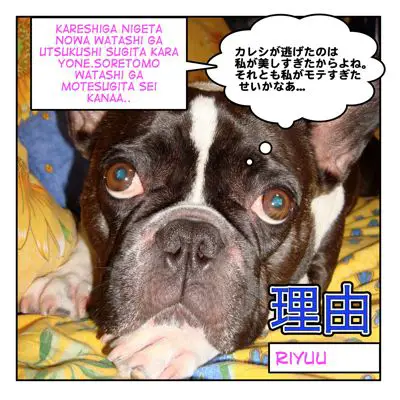
「カレシが逃げたのは私が美しすぎたからよね。」
=Kareshi ga nigeta no wa watashi ga utsukushi sugita kara yone.
=The reason why he left me was because I was too beautiful…
「それとも私がモテすぎたせいかなあ。」
=Sore tomo watashi ga motesugita sei kanaa.
=Or maybe it is because I was too popular with the boys…
Cześć! 皆さん、今日は!= Minasan Konnichiwa!, Hello everyone!
This lesson is for my lovely blog student + Twitter follower, D-san from Poland!
*How to make excuses using せいで ( = seide), のために ( = no tame ni) or から ( = kara) etc.
Is it going to be a long lesson? We’ll see. Let’s start!
さあ始めましょう!= Saa hajimemashou! Let’s get started!!!
First, how do we say “an excuse” in Japanese?
*言い訳 ( = iiwake) = an excuse
verb form : 言い訳する ( = iiwake suru) to make excuses, to defend oneself with excuses
Ex. もう言い訳ばかりしないで!
=Mou iiwake bakari shinaide! (for women)
=Enough excuses!
Ex. 言い訳ばかりしないで下さい。
= Iiwake bakari shinai de kudasai.
= Please stop making excuses!
or
*弁解 = benkai = excuse (more formal or literal)
verb form : 弁解する ( = benkai suru ) to make excuses, to defend, to plead, to rationalize
These two are excuses.
But if you have a real reason, we call it
 理由 ( = riyuu ) reason, cause
*********************
☆How to excuse or give a reason in Japanese.
1) 〜のせいで ( = ~ no seide ) because of ~, caused by ~, to indicate, one’s fault + negative result
Usually to blame on someone/something for some negative result. (emotion involved.)
Basic pattern : reason/cause + (の)せいで ( = no seide) + result (what happened)
(Noun + のせいで ( = no sei de) / verb + せいで ( = seide)/ i-adjective + せいで ( = seide) / na-adjective な ( = na) +せいで (= seide) )
Ex. reason: 渋滞 ( = juutai) traffic → caused...→ 遅刻 ( = chikoku) being late
渋滞のせいで遅刻した。
= Juutai no sei de chikoku shita.
= I was late because the traffic was bad. (Literally: Due to a traffic jam I was late.)
(more examples)
Ex. マギーのせいで転んだ。
= Maggieno sei de koronda.
= Maggie made me fall down./It was Maggie’s fault that I fell down. (True story…. from Yukari)
Ex. ストのせいで飛行機がキャンセルになった。
= Sutono sei de hikouki ga kyanseru ni natta.
= My flight was canceled because of the strike.
When you accuse someone, you can also use せい ( = sei) (emotion involved)
Basic pattern : result + は ( = wa) + cause (someone,action, event) + (の)せい ( = no sei)+です/だ。( = desu/da.)
Ex. 僕が頭が悪いのはお父さんのせいだよ!
= Boku ga atama ga warui no wa otousan no sei dayo!
= I am stupid because of my dad. / It’s my dad’s fault that I am stupid.
Ex. これは、あたなのせいです!
= Kore wa anata no sei desu!
= This is your fault!
Do you want stronger language? Try the following!
Ex. みんな、あんたのせいだ!(rough)
= Minna Anta no sei da!
= Everything is your fault.
Ex. お前のせいだ! stronger. rough (male speech)
= Omae no sei da!
= It’s your fault!
2) 〜のお陰で = ~ no okage de ~ + result
= because of ~, caused by~, to indicate whose fault something is, thanks to~ + result (emotion involved.)
(Noun + のお陰で ( = no okage de) / verb + お陰で ( = no okage de) / i-adjective + お陰で ( = no okage de) / na-adjective な ( = na) お陰で ( = no okage de)
Ex. 猛暑のお陰で野菜が高くなった。
= Mousho no okage de yasai ga takaku natta.
= Because of the heat wave, the price of vegetables has gone up.
Ex. 風邪をひいたお陰で一日寝てるはめになった。
= Kaze wo hiita okage de ichinichi neteru hame ni natta.
= Because I caught a cold, I ended up staying in bed all day long.
Note : You can switch お陰で ( = okage de) and せいで ( = seide) in the above examples.
* 猛暑のせいで…
= mousho no seide
= Because of heat wave
* 風邪をひいたせいで..
= Kaze wo hiita sei de
= Because I had a cold,
Note : Remember 〜のお陰で ( = ~ no okage de) can be used for grateful feelings as well.
*Ex. マギー先生のお陰で 日本語が上手になった。
= Maggie sensei no okage de nihongo ga jouzu ni natta.
= Thanks to Maggie, my Japanese has improved.
variation : お陰様で ( = Okage sama de)
* お陰様ですっかりよくなりました。
= Okage sama de sukkari yoku narimashita.
= Thanks to you/God, I feel much better now.
3) (noun) で ( = de) because of, due to~ +result
* 渋滞で遅れました。
= Juutai de okuremashita.
= I was late because of the traffic.
* 風邪でクラスを休みました。
= Kaze de kurasu wo yasumimashita.
= Because I had a cold, I skipped the class.
Compared to 1) & 2) there is no emotional blaming here. Just implying an inevitable factual cause.
The same thing with a verb.
4) (verb/adjective) + ので ( = ~ node) : Because ~ + result
Ex. 雨が降ったので今日はサッカーの練習はありません。
= Amega futta node kyouwa sakka no renshuu wa arimasen.
= Because it rained today, there is no soccer practice.
Ex. 忙しかったので宿題ができませんでした。
= Isogashikatta node shukudai ga dekimasen deshita.
= I was busy so I couldn’t do the homework.
Ex. 今日は頭が痛いのでクラスを休みます。
= Kyou wa atama ga itai node kurasu wo yasumimasu.
= I have a headache so I will skip class today.
↓(past tense)
Ex. 昨日、頭が痛かったのでクラスを休みました。
= Kinou atama ga itakatta node kurasu wo yasumimashita.
= Because I had a headache I skipped class yesterday.
Ex. 頭が悪いのでわかりません。
= Atama ga warui node wakarimasen.
= I don’t understand because I am stupid.
Note: Usually we give the reason for something, and then continue on with the sentence and explain the result.
However, sometimes — as I wrote in my ちょっと+ 曖昧 = Chotto& Aimai lesson — we don’t finish the sentence because the result is negative. So if a sentence is unfinished we can safely assume the result is negative.
For example:
「どうして遅刻したの?」
= Doushite chikoku shitano?
= How come you are late?
「雨が降っていたので…(遅れました。)
= Ame ga futte ita node..(okuremashita)
=It rained so … (I was late.)
「バスが来なかったので…(遅れました。)
= Basu ga konakatta node..(okuremashita)
= Because the bus didn’t come so… (I was late.)
5) Also we say,
ものですから = monodesu kara
↓
もので = monode
or
もんで = monde (more casual)
are used to explain the reason as well.
*雨が降っていたものですから…(遅れました。)
= Ame ga futte ita monodesukara..(okuremashita)
= Because it was raining so… (I was late.)
*雨が降っていたもので…(遅れました。)
= Ame ga futte ita monode..(okuremashita)
= Because it was raining so… (I was late.)
* 雨が降っていたもんで…(遅れました。)(more casual.)
= Ame ga futte ita monde... (okuremashita)
= ‘Cause it was raining so… (I was late.)
6) ~から ( = ~kara) : because ….(reason) When you explain the reason
Ex. やることがなかったから先に帰った。
= Yarukoto ga nakatta kara saki ni kaetta.
= Because there was nothing to do, I left earlier.
Ex. 1) 今、忙しいから出来ません。
= Ima isogashii kara dekimasen.
= I am busy now so I can’t do it.
When you compare this phrase with
Ex. 2) 今、忙しいので出来ません。
= Ima isogashii node dekimasen.
= I am busy now so I can’t do it.
Which one do you think is more polite?
They mean the same but Ex. 2) sounds more polite and mature because から ( = kara )is for a subjective reason and could be emotional while ので ( = node) is more objective and sounds logical cause sounds inevitable.
The same thing here:
Ex.1) お金もっていないから買えません。
= Okane motte inai kara kaemasen.
= I don’t have money with me, so I can’t buy it.
Ex.2) お金を持っていないので買えません。
= Okane wo motte inai node kaemasen,
= Since I don’t have money with me, I can’t buy it.
Ex.2) with ので ( = node) sounds more polite and mature because it is more factual reason.
7) ~の為(に) = のため(に) ( = ~no tame (ni) ) = because of ~, due to~
Ex. 台風の為、今日は全てのクラスは休講です。
= Taifuu no tame kyou wa subete no kurasu wa kyuukou desu.
= Due to the typhoon, all the classes are canceled today.
Ex. 雨の為、バスが遅れた。
=Ame no tame basu ga okureta.
= Because of the rain, the bus came late.
Note :
What is the difference between 雨のせいで ( = ame no seide), 雨のお陰で ( = Ame no okage de) and 雨の為 ( = Ame no tame)
In this case, 雨の為に ( = Ame no tameni) is just a statement and sounds flat or formal while せいで ( = seide) and お陰で ( = okagede) involve more feelings.
Ex.子供が病気の為、今日は早引きをさせて下さい。
= Kodomo ga byouki no tame kyou wa hayabiki wo sasete kudasai.
= Since my child is sick, please let me leave earlier today.
You can also say,
* 子供が病気なので
= Kodomo ga byouki nanode
* 子供が病気なもんで
= Kodomo ga byoukina monde (This is very casual. It is also a dialect in certain regions in Japan)
<How do you say “because”>
If you look it up in a dictionary you will find
because = 何故ならば ( = nazenaraba)
Actually, so many Japanese students will translate “because” into 何故ならば( =nazenaraba) in English class.
For example, your brother saw you eat his snack.
「どうして私のお菓子を食べたの?」
= Doushite watashi no okasi wo tabeta no?
= Why did you eat my snack?
And you want to tell him
“Because I was hungry.”
If we see this phrase, we would translate
⬇️
「何故ならばお腹がすいていたからです。」
=Naze naraba onakaga suite ita kara desu.
But NOBODY says that in conversation.
In casual conversation, we use だって ( = datte) +もん ( = mon) or もの ( = mono) between family or friends.
(It is mainly used by girls or kids. Mature people don’t use it.)
Ex. だってお腹がすいて(い)たんだもん。
= Datte onakaga suite(i)tan damon.
Ex. だってあなたのこと好きなんだもの。(female speech)
= Datte anata no koto sukinan da mono.
=Because I like you.
Let’s look at a more formal situation.
どうしてその株を買ったのですか?
=Doushite sono kabu wo katta no desu ka?
=Why did you buy the stock?
⬇️
You want to say,
“Because I heard the company has been making a lot of profit.”
何故ならばその会社が利益をかなり出していると聞いたからです。
= Naze naraba sono kaisha ga rieki wo kanari dashite iruto kiita kara desu.
It’s fine to use 何故ならば ( = nazenaraba) in this situation because it is formal. There are people who might say this and we actually hear this kind of line not just in TV dramas but also in formal situations in real life.
However, a lot of time, we skip 何故ならば ( = nazenaraba) and express the reason with the ending から( = kara.)
We also use というのは ( = to iu no wa) when we explain the reason. It is not necessary to use this if someone asks you a reason for something. We use it when we explain our own actions.
★と言(い)うのは + reason + からです。
= toiu nowa+ reason+ kara desu.
= It is because + reason
★と言(い)いますのは+ reason + からです。
= to iimasu nowa+ reason + kara desu. (more polite)
= It is because + reason
Ex. 昨日、A社の株を買いました。と言(い)いますのはその会社が利益をかなり出していると聞いたからです。
= Sakujitsu A sha no kabu wo kaimashita. To ii masu no wa sono kaisha ga rieki wo kanari dashite iruto kiita kara desu.
= I bought stock in Company “A”. Because I heard that company has been making a lot of profit.
*それは ( = sore wa) + reason+ だからです/だ。( = dakara desu/da.)
= It’s (or That’s) because + reason
Ex. 「彼はどうしてそんなに私に意地悪するのかしら?」
= Karewa doushite sonnani watashi ni ijiwaru suru no kashira? (female talk)
= I wonder how come he is so mean to me?
「それはあなた/君が好きだからだよ。」(君 ( = kimi) =mainly used by men.)
= Sore wa anata /kimi ga suki dakara dayo.
= That’s because he likes you.
(more casual situation)
*(っ)て言(い)うのは +reason+から/もん and etc.
= (t)te iu nowa+reason+kara/mon and etc.
= It’s because + reason
Ex. もうあの店には行かない!って言(い)うのはちょっとこの間、あそこでもめたからなんだ。
= Mou ano mise ni wa ikanai! Tte iu nowa chotto kono aida asoko de mometa kara nan da.
= I’m not going to go back to the store (restaurant, bar..). ‘Cause I had some fight (trouble) there the other day.
 <Other techniques to make an excuse or explain a reason.>
•だから ( = dakara) =That’s why, So, anyway, therefore
Patterns :
1) だから ( = dakara) + reason+result + (なん)です。( = (nan)desu.)
2) だから ( = dakara) + reason+result + (なん)だ。( =(nan)da.) (colloquial)
3) だから ( = dakara) + reason+result + だって。( =datte) (colloquial)
4) だから ( = dakara) + reason+result + なの。( = nano) (colloquial/for girls)
Ex. 1) 医者から煙草を注意されました。だからもう2週間も吸ってないん( or の)です。
= Isha kara tabako wo chuui saremashita. Dakara mou nishuukan mo sutte inain (or no) desu.
= My doctor warned me not to smoke. That’s why I haven’t smoked for two whole weeks.
Ex.2) 彼、別れたんだって。だから今がチャンスなんだ。
= Kare wakaretan datte. Dakara ima ga chansu nanda.
= I heard he broke up (with her). So I have a good chance now!
Ex.3) 「どうして彼と別れたの?」
= Doushite kare to wakareta no?
= How come you broke up with him?
「だから、もう一緒にいても楽しくなかったからだって(言ってるでしょ)!」
= Dakara mou issho ni ite mo tanoshiku nakatta kara datte(itteru desho)!
= (I told you already) ‘Cause being with him was no longer fun!
Ex. 4) だからあなたと買い物に行くのは嫌なの! (female talk)
= Dakara anata to kaimono ni iku nowa iya nano!
= That is why I don’t want to go shopping with you!
*****
Practice time!!!
OK, now it is your turn! Try to explain the reasons or make excuses, OK?
When someone asks you for a reason, we don’t always use causative particles. But try to use some for your practice. The answer is not just one. If you want me to correct your sentences, leave them in the comment section below.
(Let me repeat this one last time. When you give an unfavorable reason to people, you don’t finish the sentence and make it sound vague so that you don’t repeat the negative result.)
Q1「どうして昨日、来なかったの?」
= Doushite kinou konakatta no?
= How come you didn’t come yesterday?
Because you had a date.
デートがあったから( 行けけなかったの。)
= Deito ga atta kara (ikenakatta no.)
Q.2.「明日、どこかにドライブしない?」
= Ashita tokoka ni doraibu shinai?
= Do you wanna go for a drive tomorrow?
No! Because you are busy.
Ex. 明日は忙しいので/から…(行けません。)
= Ashita wa isogashii node/kara…(ikemasen)
Q.3「僕の携帯(の中)どうして見たの?」
= Boku no keitai (no naka) doushite mita no?
= Why did you look to see what was on my cell phone?
You can’t explain why exactly but you felt uneasy.
Ex. なんか不安だったから(見ちゃった。)
= Nanka fuan dattakara (michatta.)
Q.4「何故、遊んでくれないの?」
= Naze asonde kurenaino?
= How come you don’t play with me?
Because you have been busy with exams lately.
Ex.最近試験で忙しいので/から…(遊んであげられない。)
= Saikin shiken de isogashii node/kara….(asonde agerarenai.)
Ex. だって、最近試験で忙しいんだもん/もの。
= Datte saikin shiken de isogashiin da mon/mono.
Q.5「どうして遅刻したんですか?」
= Doushite chikoku shitan desu ka?
=How come you were late?
Due to the traffic.
Ex.渋滞の為、遅刻しました。
= Juutai no tame chikoku shimashita.
Ex. 渋滞していたから/ので…(遅刻しました。)
= Juutai shiteita kara/node…(chikoku shimashita.)
Q.6「結婚式の招待状の返事がまだなんだけど…」
= Kekkonshiki no shoutaijyou no henji ga mada nandakedo…
= I haven’t got your reply to the wedding invitation yet…
Because you don’t know your schedule yet.
Ex.まだスケジュールがわかっていないので..(返事が出せませんでした。)
= Mada sukejuuru ga wakatte inai node (henji ga dasemasen deshita.)
Ex. まだスケジュールがわからないもので…
=Mada sukejuuru ga wakaranai monode..
Ex. まだスケジュールがわからないから…(返事が出せませんでした。)
=Mada sukejuuru ga wakaranai kara (henji ga dasemasen deshita.)
Q.7 「この間貸したお金まだ返してもらってないんだけど…」
= Kono aida kashita okane mada kaeshite moratte nain dakedo.
=You haven’t returned the money I loaned you the other day yet.
Because you haven’t got paid yet.
Ex.まだ給料が出ていないので…(返せません(でした)。)
=Mada kyuuryou ga dete inai node (kaesemasen (deshita)).
Ex.まだ給料が出ていない為、返せません(でした)。
= Mada kyuuryou ga dete inai tame kaesemasen (deshita).
Ex.まだ給料が出ていないもので…(返せません(でした)。)
= Mada kyuuryou ga dete inai monode…
Ex.まだ給料が出ていないから…(返せない。)
= Mada kyuuryou ga dete inai kara… (kaesenai).
Q.8 「この間、頼んだ件、どうなりましたか?」
= Kono aida tanonda ken dounarimashita ka?
= What happened to the matter I asked you about the other day?
:rrrr: You haven’t done it yet because you are still waiting for the client’s answer.
Ex. 取引先の返事がまだないので…(まだやっていません。)
= Torihikisaki no henji ga mada nai node... (mada yatte imasen.)
Ex. 取引先の返事がまだないから..(まだやっていません。)
= Torihikisaki no henji ga mada nai kara… mada yatte imasen.)
Ex. 取引先の返事がまだないものですから… (まだやっていません。)
= Torihikisaki no henji ga mada nai mono desu kara…mada yatte imasen.
Q.9 「どうしたの? 顔色が悪いけど。」
= Doushita no? Kaoiro ga warui kedo.
= What’s wrong? You look pale.
:rrrr: You drank too much last night.
Ex. 昨日飲み過ぎたから/ので/の。
= Kinou nomisugita kara/node/no.
= I drank too much yesterday.
Q.10 「今日、車で来なかったの?」
= Kyou kuruma de konakatta no?
=You didn’t come by car today?
Because your brother took the car when you were asleep.
Ex. 寝ている間に兄が先に(車に)乗っていってしまったので/から、(車で来れませんでした)。
= Nete iru aida ni ani ga saki ni (kuruma ni) notte itte shimatta node/kara (kurumade koremasen deshita.)
Ex. 寝てる間に、兄貴が先に(車に)乗ってちゃったからさあ。(very casual)
= Nete iru aida ni aniki ga saki ni (kuruma ni) nottechatta kara saa..
Q.11. 「どうしてそんなことをしたの?」
= Doushite sonna koto wo shitano?
=Why did you do such a thing?
“It’s your fault!”
Ex. あなた/あんた/君/お前のせいだ/です!
= Anata/anta/kimi/omae no sei da/desu!
Q 12. 「どうしてマギーが好きじゃないの?」
= Doushite maggie ga sukija nai no?
= How come you don’t like Maggie?
There is no good excuse!
Q.12. 「どうしてそんなにマギーのことが好きなの?」
= Doushite sonnani Maggie no koto ga suki nano?
= How come you like Maggie so much?
Just because!!
= どうしても!
= doushitemo!
********
⭐️ Extra information:
When someone points out your faults and you accept them totally,
• 返す言葉もありません。
= Kaesu kotoba mo arimasen.
= I have nothing to say. I can’t make any excuses. (When you accept what other people said.)
• おっしゃる通りです。
= Ossharu toori desu.
= You are quite right.
And if you really did something bad, go check my apology lesson!  ごめんなさい+許して下さい。
Related Lesson: How to use から ( = kara)
***********
 マギー先生より = Maggie Sensei yori = From Maggie-Sensei
このサイトに毎日来ない言い訳は何も受け付けませんから。
= Kono saito ni mainichi konai iiwake wa nanimo uketsukemasen kara.
I won’t allow ANY EXCUSES for not coming to visit this site every day!
Excerpt
***
Will you be my Patron?
I appreciate your support! サポートありがとう!
49 Comments
Hello Maggie,
Sorry for spamming, I’m on a rampage of questions haha!
You said in your lesson “to give a reason” is のせいで but here it’s なせいで
でもわたしが自分勝手なせいで……
どれほど酷い人間なのかを見せてしまった
I noticed several times that な is replacing の. Is it the same case here? When do I know when to use な or の after a noun?
Thank you Maggie!
Hello Gaspatcher
Good question. I have been thinking about making more detailed lesson on せいで and おかげで.
I mainly introduced the usage of Noun + の + せいで in this lesson.
But you can use せいで with verbs and adjectives as well.
verb (present/past tense, etc.) + せいで
i-adjective + せいで (→past tense i-adjective 〜かった+せいで)
na-adjective + せいで (→past tense na-adjective + だったせいで)
noun + の + せいで (→past tense noun + だったせいで)
自分勝手/勝手 is actually na-adjective 自分勝手な(人・人間)
→自分勝手なせいで
Oh thank you! I thought 自分勝手 was a noun! Makes more sense now!
Thank you!
Anytime! ☺️
Hello Maggie Sensei,
In my book the question is:
今日は______早く家に帰りたい
a.疲れたせいで b. 疲れたのでは c. 疲れたら
So according to the book, the correct answer is c, so my question is why is it c?
According to my book, から and ことから cannot have any hope or intention, but the above sentence say 帰りたい so that means hope right?
Is the から part of のだから instead? Definitions are below:
Here are the definitions of my book:
~から。。。~ことから・・・ : Because of something factual~, … results. or I conclude that…. Not used when a speaker is expressing hope or intention or trying to induce another person to an action. XことからY X=原因 cause/理由reason/根拠basisになって, Y(結果) Because of~; From the fact that~ Often used in writing/Business presentations/News/News papers… 名 + から 普通形(ナ形だ-な/-である・名だ-である) + ことから
~の だから。。。 : のだから is used to express the speaker’s strong opinion. …is the natural consequence of ~. Means that one fact naturally follows from another, and the other person is assumed to know this. …is the speaker expressing a judgement, hope or intention, or trying to induce another person to an action. AのだからB Aだから,当然B 話す人も聞く人も理由を知っている。 Since~;Because of~; Used in casual conversation 普通形(ナ形だ-な・名だ-な) + の だから
?? Before I answer your question (c) is 疲れたら? or 疲れたから?
Sorry, its c:疲れたから
You are correct
The explanation of ~から。。。~ことから/のだから in your textbook is fine.
As you know, から has different functions but there are cases that you can use から to express the reason for your desire.
喉が渇いたから何か飲みたい。 I’m getting thirsty so I want to drink something.
眠いからもう寝たい。 I’m sleepy so I want to go to bed already
疲れたから帰りたい。 I’m tired so I want to go home.
Hello Maggie sensei,
for からだ, I do not know what the からだ is for in this sentence:
資源が少ないことは、国にとってはマイナスであるように見えるが、必ずしもそうとは言えない。日本においで、少ない資源のおかげで真面目な国民性が生まれ、高い技術力が育ったとも言えるからだ。
In your explanation above you said:
” Usually we give the reason for something, and then continue on with the sentence and explain the result.”
What is the reason in the above sentence and what is the result?
Thx in advance.
Hi again
から gives a reason why
As I wrote in the lesson, からだ in the second sentence explain the reason for the first sentence.
The write thinks 資源が少ないことは必ずしもマイナスではない why? Because 日本において〜育ったとも
いえるから
Sensei:
How is から working here in からに:
ジョーはその包みを開き好いように両膝を突いて、幾つも幾つもの結び目を解いてからに、大きな重そうな巻き物になった何だか黒っぽい布片きれを引き摺り出した。
Is it working as after.
So far I have not seen から accompanied by に。
Please Sensei, help.
I think it is an old style of Japanese.
In old writings, you add に to から to give a reason.
But you don’t use that form in current conversational Japanese.
Añaychayki, 先生。
こんにちはマーギー先生!
色んな例文で詳しく説明していただいてありがとうございます!
こちからちょっと質問あるんですが、
何か理由を表現したければ、「による」も「によって」も「により」も使えますよね?
あまりその使い方法わからないから、ちょっと教えていただかないのですか?
こんにちは、RevSanic
あとにくる品詞が違いますよ。
〜による+名詞(noun)
〜によって+動詞(verb) / またはどうなったか文章で説明
〜により+動詞 (「よって」と同じ使い方ですが、「よって」よりも堅い言い方(more formal than よって) です。)
ですね。
事故による渋滞(じゅうたい) traffic jam caused by an accident
事故によって渋滞した。 There was a heavy traffic jam due to an accident
事故により渋滞した。 There was a heavy traffic jam due to an accident
(Note for you:ちょっと教えていただかないのですか? →いただきたいのですが)
Maggie Sensei:
I need help with this sentence. It has から in it. Usually it helps me when I break japanese sentences down, but in this example I don’t know how から is working here.
この辺りは治安も悪くないけど、あの辺りは治安が良くないからね。
This area doesn’t have bad public safety, but that area does. (translation given)
this+neighborhoodはpublic safety+ not bad + but that neighborhoodはp.s.+not good+ から (why?)
助けてくれてありがとうございます!
Hello david,
for better understanding of part. から, which implies the reason:
この辺りは治安も悪くないけど、あの辺りは治安が良くないからね。
This area is quite safe, cuz the other one is not safe, you know.
(The unsafeness of one area makes that the other one is safe)
治安がいい=safe (ex. country, area) / good (ex. neighborhood)
治安が悪い=not safe/dangerous (ex. country, area) / bad (ex. neighborhood)
ヨロシク
Hi David
(Thank you for helping him, 天人)
It depends on the previous sentence or context but for example if someone is telling you that he/she just moved from “that area” to “this area” or wants to move from “that area” to “this area”.
And you, as a listener, respond to that person.
I understand why you moved/want to move because this area is relatively safe but that area is dangerous.
So this から gives a reason why the writer/speakers agrees with the previous sentence.
haha, I tried translating “There are no good excuses (to not like Maggie)!” in my head and then was like “huh, it just continues on to the next question…” before it hit me haha.
Also, thank you for indicating which sentences are male/female speech! It’s still a little exhausting for me to translate anime so it’s really handy to have an idea about who would be saying that kind of a sentence :)
Hi Brett!
Good to see you keep studying here. :)
Hello Maggie sensei,
As for ために、 my textbook says that never use ために to try to induce another person to an action. It means I can not use tameni to end a sentence with ください。
Is it a rule without exception sensei?
Thanks Maggie sensei
Write some sentences. I will check them.
Hello Maggie sensei,
Could you help me this sentence
先生、すみません。風をひいて()、今日は休ませてください
1.しまったので
2.しまったんですから
3.しまって
My text book say (1) is correct.
But I dont know why (2) and (3) are not correct.
Could you please explain it to me, my Lady ?
Thanks Maggie sensei
Hello, 元気?
(There is a typo 風→風邪)
Yes, the correct answer is 1.
しまったんですから works for example when someones accuses you, “Why didn’t/don’t you come to school?”
Then you say 風邪をひいてしまったんですからしかたがありません。/どうしようもありません。(You sound a little angry.)
I had/have a cold. It cannot be helped./ How could I go. I have no choice, right?”
You explain the reason showing your irritating feelings so it sounds rude towards the teacher.
しまって is used when you talk about the consequence in the following sentence.
風邪をひいてしまって学校を休みました。
風邪をひいてしまって3日寝込みました。etc.
Thanks my Lady,
I understand that point now.
I just have another question that can I use から、ので with some form like てくだい、or たい。
Ex
運転免許をとれたから、車をかいたい
and
運転免許をとれたので、車を買っていくダサい。
Thanks Maggie sensei
You’re welcome!
I think your second sentence has a typo. (てくだい and いくダサい: ダサい is slang for “lame/dorky” lol )
Can you check the original sentences first before I answer?
Hello Maggie sensei,
Woman are always right !!!
You are right for (2), that is a typo. The correct one is ください。
Thanks Maggie sensei
Haha I wonder if it includes female doggies.
車の免許が取れたから/ので車を買いたい。
車の免許が取れたから/ので車を買ってください。
Yes, they both work.
(I changed 車の免許を to 免許が because 取れた is a potential form so が will be a little more natural.)
Hello Maggie sensei,
I have a question regarding によって and ため when they express the reason.
Are they interchangeable?
To be more specific,
(1) うちの工場では、材料不足によってたたみの生産はもうできなくなった。
(2) うちの工場では、材料不足のため、たたみの生産はもうできなくなった。
Are (1) and (2) interchangable
Thank you Maggie sensei
Hello,
Yes (1) and (2) are interchangeable but I personally use 材料不足により or 材料不足のため
Hello, 先生. I’m trying to understand something in the sentence 「とっても強い家であったため建つまでに長い時間がかかりました。」
I don’t really understand why they use 「であった」here just before ため. I’d also asked on a different post why a sentence had left out the particle に after よう and I’m wondering if the same thing applies here — you can leave out the に after ため and it still holds the same meaning.
Hello Forest,
であった implies here the past tense (=the house was).
ため implies the reason (=therefore).
It was a very solid house. Therefore it took a long time to build it (lit. before it was built).
And yes, the に part. in ために emphasizes the meaning and sounds more polite. There is a rule in Japanese. The longer the sentence, the more polite it is.
ヨロシク
@天人
Thank you for helping @Forest! :)
Maggie sensei✋How would i come about saying”the reason why I___is___”
Using 理由?
@Shehab Eldin
You can either use the following patterns.
(consequence/decision) (な)のはreason (だ)からです。
(reason) (だ)から〜+consequences, decision
私があまり食べないのはダイエットをしているからです。
私はダイエットをしているからあまり食べません。
more explanatory
私はダイエットをしているからあまり食べないのです。
Hello Shehab Eldin,
you can also use follow pattern: ~(という)理由は~(だ)からです in order to describe / show the reason, why something is like it is.
1. 彼は、なぜ一人でその取り憑かれた部屋に入っていたかという理由は未だに明らかではない。
2. 人が彼女のことを「不思議ちゃん」と呼ばれる理由は~からである。
Most natural / common pattern implying why ! I ! did something is, as Maggie said,(な)のはreason (だ)からです。
ヨロシク
“Juutai shitei ita kara/nod”e “shite”
It’s so great, everytime I have a problem, I look at your site and you already made a lesson about it. I’m still having some questions though…
1. Today I got into some quarrel with my real life Sensei. I do that from time to time, 石頭 だから:P . Have a look at this sentence: 男性が亡くなっていた場所の近くにはスズメバチの巣があったため、警察は蜂に刺されて亡くなったと考えています。
First, does スズメバチ really just mean “wasp” or couldn’t it also mean “hornet”?
Second, she says that this “ため” cannot ever be exchanged with “から”. I did not quite understand why. Since the sentence is from a newspaper, から surely is to casual for that occasion, but if used in a normal conversation, would から still be totally wrong?
2. The difference between から and ので – we agree that node is more polite and objective. I learned from other sites, that から emphasizes the reason and indicates, that the given reason is the only reason (this and only this is why…), while ので emphasizes the result and states just one reason among possible others. My teacher could not confirm this, so whats your opinon about that?
3. Concerning sentences like: お金もっていないから買えません。 I found this site that says, you cannot use から in sentences like this, because Japanese people would never talk like that. http://www.learn-japanese-adventure.com/te-form-cause-reason.html According to this site, you have to use the te-form if the result is a state or a potential form. However, you use から all the time under exactly those conditions, so I’m quite puzzled who is right.
4. Another lesson on that site says, that noun + で can only be used if the result is inevitable. So 雨天でびしょぬれになった。 would be correct, while 雨天で一晩中古い映画を見ました。 would be wrong, because that would be a choice. Do you agree with that?
5. Is なぜなら as formal as なぜならば? Because in the Tanaka Corpus, which holds many example sentences, there are a lot of quite casual sentences with なせなら, so I thought you could use it in normal conversations, i.E. あいつのことを好きなやつは誰もいない。なぜなら奴はいつも自分のことを自画自賛ばかりしているからだ。
I hope this isn’t too much… よろしくお願いいたします
@Zetsuboumanadeshi
Hi, Thank you for spotting the typo as always. I fixed it.
1. スズメバチ means either “wasp” or “hornet”.
For that particular sentence, I think ため is more natural. Maybe it is because as you said it is news and also the verb, 考えられています is objective
The main idea of this sentence is,
(reason) ため〜と考えられています。
=It is considered to be ~~~ because ~~~~
But in daily conversation, if someone interviews the police man,
「どうしてその人はスズメバチに刺されて亡くなったと思いますか?」
The police man would say
「近くにスズメバチの巣があったからです。」
↓
The police man: 近くにスズメバチの巣があったからその人はスズメバチに刺されて死んだと思いました。 (subjective opinion based on the fact.)
2. Yes and No.
I agree the most to the information you wrote but at the same time, there are cases you just switch から with ので to add the politeness.
3. Actually we do talk like that in conversation.
The pattern お金もっていないから買えません。, お金がないから買えない。携帯が壊れているから電話をかけられませんでした。instead of saying お金を持っていなくて買えません/お金がなくて買えない/携帯が壊れていて電話をかけられませんでした。
4.
* 雨天でびしょぬれになった。(cause)
* 体育祭は、雨天で中止になった。(cause)
Because of ~, it resulted ~
雨天で一晩中古い映画を見ました。 Because it rained you deiced to watch a movie all night long?
It is not natural.
The action, watching old movies all night long is not caused by the rainy weather. It was your choice.
5. As I mentioned in the lesson, we do use なぜなら in literal form and it is not so common to use it in conversation.
OK, in a movie or drama, you may hear that.
Ex. 私がどうして君にその事実を隠していたかわかるかね?なぜならば君が犯人だからだ!
It sounds too dramatic to use in daily conversation.
*****
I think you should talk to your Japanese teacher to discuss the 1 and 2 questions more. Please be nice to her.
And ask the site owner about No. 3, 4.
I can try to answer questions if it is something from my site but I am not so comfortable answering for other sites. They are all great and they know much more than I. :)
お返事ありがとうございます。さすが、マギー先生はいつも奥ゆかしすぎですね。それでも何でも知ってるといっても過言ではないんですよ。日本語が話せて高度な教育を受けていた犬だお陰で天下一番の日本語の先生だといってきかない。ですからあなたの見解より大切なものがありませんね。!JYANE!
@Zetsuboumanadeshi
いえいえ、犬の先生、まだまだです。。。 :maggie-small:
それにしてもコメントの日本語が上手でびっくりしましたよ。
例えば:
どうして宿題をしなかったの?
外で、いい天気から。(遊んだ)
どうして彼のことが好きないよ?あいつはいい人だ!
それは、亀くんはあたしの一つの恋だからだよ。>.>
:)
どう?
@Aki
Nice try! OK, I will correct you a little.
外で、いい天気から。(遊んだ)
→いい天気だったから外で遊んだ(の)。
どうして彼のことが好きないよ?
You mean “Why do you like him?” if so
→どうして彼のことが好きなの?
あいつはいい人だ!
When you give a reason,
→(あいつは)いい人だから。
(Remember あいつ is for male speech and it sounds a bit rough. If you use あいつ, いい奴(やつ)だから is more adequate than 人.
the safer way is : (彼は)いい人だから。)
それは、亀くんはあたしの一つの恋だからだよ。
→??? 一つの恋だから? Can you rephrase it?
for the second one, I meant:
Why don’t you like this guy? he’s a good guy! (and yeah I put あいつ cause I meant it as a reproach from an older brother/friend or something…) and then the answer was supposed to be:
That’s because Kamekun is my only love.
うん!へへへ <3
だから、たぶん、「一つの恋だから?」ー>「亀くんのことをばかり好かれるの。」
@Aki
OK, then how about
亀君のことだけ好きだから
Someone is in looooove! boucingheart!
うふ<3
そうだよね~!うふふふ
はい!先生!ありがとうございます。
これから練習しますね^_^
@Top-san
Thank you for spotting the mistake. I fixed it.
“neteru hame ni natta” is correct. I must have thought “Um…this sentence is too difficult. I should change it to 寝ていた=neteita. ” and just forgot about fixing the text.
Thank you so much for your nice comment and letting me know your interests. It is very important for me to know what you are interested in. I think studying Japanese from many different sources is a good idea. We don’t always talk formal Japanese which you learn in a textbook (we skip particles, we don’t finish the sentence properly,etc.) and at the same time we don’t always talk like manga characters either. Kansaiben is so much fun to learn. If there is a chance, I would like to make a lesson,too.
As for forming sentences, you have to keep practicing and make lots of mistakes. I can always help you here. Use any comment section. ね!
Maggie sensei, I have a question about this sentence.
Ex. 風邪をひいたお陰で一日寝てるはめになった。
=Kaze wo hiita okage de ichinichi nete ita.
I notice the difference between the romanji and the actual sentence. Which one should I follow?
-寝てるはめになった or
-nete ita
Hi Maggie sensei^^
thank you for all your wonderful lessons. I have no idea what level I’m in, but I can read all hiragana and katakana and a couple hundreds of Kanji. Not a lot though. My problems are forming sentences especially complex sentences and having no clue which words to use in a sentence. I would also love to be able to read comics with ease, but the problem is when I study Japanese in regular books, they don’t tell me what real Japanese speak. So your website is truly a gem for me because you make it so fun to learn Japanese.
My goal is to learn a lot of Kanji, to know a lot of useful expressions and slangs (especially in maga^^), to be able to understand complex sentences, to learn Kansai-ben too because a lot of entertainment people on TV shows seem to speak that way.
Sorry for going on and on, but thank you and thank God for your website^^