
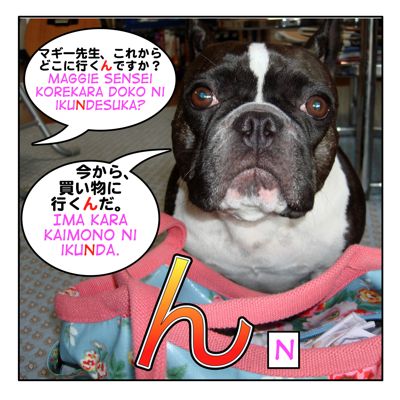
「マギー先生、これからどこに行くんですか?」
= Maggie Sensei korekara dokoni ikun desu ka?
= Where are you going now, Maggie Sensei?
「今から買い物に行くんだ。」
= Ima kara kaimono ni ikunda.
= I’m going shopping now.
This lesson is for you, Saki! ;-)
She said she had a trouble understanding how and when to use ん ( = n).
In order to understand how to use ん ( = ), you have to know the form of ** のです ( = ** no desu. ) or **のだ ( = **noda) because * *んです ( = **n desu) and **んだ ( = **n da) are spoken language of **のです ( = ** no desu.) or **のだ ( =**noda.).
Let’s get started!
Can you tell the difference between 1) and 2)?
1) 寒いです。= samui desu.
2) 寒いのです。= samui no desu.
While 1) is just a factual thing, It’s cold. 2) sounds more explanatory indicating a reason for something.
「一杯、着込んでどうしたの?」
= Ippai kikonde doushita no?
= How come you are bundled up?
「寒いのです。」
= Samui no desu.
= Because it’s cold.
OK, now let’s change の ( = no) to ん ( = n) here.
↓
•「寒いんです。」
=Samuin desu.
=Because it’s cold.
↓(more casual)
•「寒いんだ。」
= Samuin da.
= ‘Cause it’s cold.
It has the same meaning but using ん ( = n) makes it sound more casual.
Basic form
adjective (na-adjective and i-adjective) and verb (dictionary form) + のです = nodesu → んです = n desu
or のだ = noda→んだ = nda
• 暑いです。
= Atsui desu.
= It’s hot. (Just a fact.)
↓ (giving a reason.)
• 暑いのです。
= Atsui no desu.
=Because it’s hot.
↓ (conversational)
• 暑いんです。
= Atsuin desu.
= Because it’s hot.
↓(more casual)
• 暑いんだ。
= Atsuin da.
= ‘Cause it’s hot.
*********************************
• 恐いです
= Kowai desu.
= I am scared
↓ (giving a reason)
Because I am scared.
• 恐いのです。
= Kowai no desu.
↓
• 恐いんです。
= Kowain desu.
When you want to explain something, giving reasons or stress the meaning:
• 困ります。
= Komarimasu.
=I will be in trouble.
↓ (Explain the reason or stress the meaning)
• 困るのです
=Komaru no desu.
=Because/ I said / You know I will be in trouble.
↓(conversational)
• 困るんです。
= Komarun desu.
= Because/ I said / You know I will be in trouble.
*********************************
• お金がないです。(Just a fact)
= Okane ga nai desu.
= I don’t have money.
↓
• お金がないのです。
= Okane ga nai no desu.
= Because/ I said / You know I don’t have money.
↓(conversational)
• お金がないんです。
= Okane ga nain desu.
= Because/ I said / You know I don’t have money.
↓ (conversational)
• お金がないんだ。
= Okane ga nain da.
*********************************
Why will you be late?
•「どうして遅れるの? 」
= Doushite okureru no?
Because there was a traffic jam.
•「道が混んでいるので(遅れます。) 」
= Michi ga konde iru node (okuremasu.)
↓ (conversational)
•「道が混んでるんで(遅れます。) 」
= Michi ga konderun de (okuremasu.)
*********************************
Doctor: 「どうしましたか?」
=Dou shimashitaka?
=What is wrong?
Patient: I have a stomachache.
• お腹が痛いです。
= Onaka ga itai desu.
↓ (more explanatory)
• お腹が痛いのです。
= Onaka ga itai no desu.
↓ (conversational)
• お腹が痛いんです。
= Onaka ga itain desu.
Explain what is happening now as a reason for something
• 今、食べています。
= Ima tabete imasu.
= I am eating
↓ (emphasize, more explanatory)
• 今、食べているのです。
= Ima tabete iru nodesu.
= (Explaining what you are doing now.)I am eating now. (So, I can’t go out now, I can’t talk to you now, etc.)
= Ima tabete iru no desu.
↓ (conversational)
• 今、食べてるんです。
= Ima tabeterun desu.
Question forms :
Have you already finished your homework?
• 宿題はもうやりましたか?
= Shukudai wa mou yarimashita ka?
↓(a bit stronger and sometimes it sounds accusing or challenging.)
• 宿題はもうやったのですか?
= Shukudai wa mou yatta no desu ka?
• 宿題はもうやったんですか?
=Shukudai wa mou yatttan desu ka?
*********************************
What are you doing now?
• 今、何をやっていますか?
= Ima nani wo yatte imasu ka?
↓ (emphasizing/stronger…It may sound more accusing)
• 今、何をやっているのですか?
= Ima nani wo yatte iru no desu ka?
↓ (conversational)
• 今、何をやってるんですか?
= Ima nani wo yatterun desu ka?
*********************************
What is wrong? What’s the matter?
• どうしましたか?
= Dou shimashita ka?
↓ (stronger than the previous sentence, seeking explanation)
• どうしたのですか?
= Doushita no desuka?
↓
•どうしたんですか?
= Dou shitandesuka?
*********************************
What are you eating now?
• 何を食べていますか?
= Nani wo tabete imasu ka?
↓ (emphasizing/stronger/more curious)
• 何を食べているのですか?
= Nani wo tabete iru no desu ka?
↓ (conversational)
•何を食べてるんですか?
= Nani wo tabeterun desuka?
*********************************
Where are you going?
• どこへ ( or に)行きますか?
= Doko e (or ni) ikimasu ka?
↓ (emphasizing/stronger/More curious/it sounds accusing)
• どこへ(or に)行くのですか?
= Doko e (ni) ikuno desuka?
↓ (conversational)
• どこへ(or に)行くんですか?
= Doko e (ni) ikun desu ka?
*********************************
Why do you go to Japan?
• 何故日本に行きますか?
= Naze niho ni ikimasu ka?
↓ (stronger/more curious/to show more interests)
何故日本に行くのですか?
= Naze nihon ni ikuno desuka?
↓ (conversational)
何故日本に行くんですか?
= Naze nihon ni ikun desu ka?
*********************************
What should I do?
• どうしたらいいですか?
= Doushitara ii desu ka?
↓ (stronger/seeking the answer)
•どうしたらいいのですか?
= Doushitara ii no desu ka?
↓ (conversational)
•どうしたらいいんですか?
= Doushitara iin desu ka?
*********************************
Are you studying Japanese?/ Do you study Japanese?
• 日本語を勉強していますか?
= Nihongo wa benkyou shite imasuka?
↓ (emphasizing/ showing more interest or surprised feeling)
• 日本語を勉強しているのですか?
= Nihongo wo benkyou shiteiru no desuka?
= So, you are studying Japanese?
↓ (conversational)
• 日本語を勉強してるんですか?
= Nihongo wo benkyou shiterun desuka?
To complain:
(どうしてこんなことを私がしますか?)
= (Doushite watashi ga konna koto wo shimasuka?)
= (Why do I do this such a thing?)
(This sentence is grammatically correct but it doesn’t sound natural. )
↓ (stronger/ complain more)
Why should I do such a thing?
どうしてこんなことを私がするのですか?
= Doushite konna koto wo watashi ga suru no desuka?
↓ (conversational)
どうしてこんなことを私がするんですか?
= Doushite konna koto wo watashi ga surun desu ka?
When you introduce some topics,
Something funny (interesting) happened yesterday.
• 昨日、面白いことがありました。
= Kinou, omoshiroi koto ga arimashita.
↓ (Sounds more intriguing)
• 昨日、面白いことがあったのです。
=Kinou, omoshiroi koto ga attano desu.
↓ (conversational)
• 昨日、面白いことがあったんです。
= Kinou, omorshiroi koto ga attan desu.
Your listener will ask,
•「何があったの?」
= Nani ga atta no?
= What happened?
*********************************
I got movie tickets. Do you want to go with me?
• 映画のチケットをもらいましたが、一緒に行きませんか?
=Eiga no chiketto wo moraimashita ga issho ni ikimasen ka?
↓ (emphasizing the fact you got a ticket more)
• 映画のチケットをもらったのですが、一緒に行きませんか?
= Eiga no chiketto wo moratta no desu ga issho ni ikimasen ka?
↓ (conversational)
• 映画のチケットをもらったんですが、一緒に行きせんか?
= Eiga no chiketto wo morattan desu ga issho ni ikimasen ka?
↓ (more casual)
• 映画のチケット(を)もらったんだけど、一緒に行かない?
=Eiga no chiketto(wo) morattan dakedo, issho ni ikanai?
*********************************
I will go to Japan next week. What should I take?
• 来週、日本に行きますが、 何を持っていったらいいですか?
= Raishuu nihon ni ikimasu ga nani wo motteittara ii desuka?
↓ (showing more enthusiasm for the trip)
• 来週、日本に行くのですが、何を持っていったらいいですか?
= Raishuu nihon ni iku no desu ga nani wo motteittara ii desuka?
↓ (conversational)
• 来週、日本に行くんですが、何を持っていったらいいですか?
=Raishuu nihon ni ikun desu ga nani wo motte ittara ii desu ka?
↓ (conversational)
• 来週、日本に行くんだけど、何を持っていったらいい?
= Raishuu nihon ni ikun dakedo nani wo motte ittara ii?
*********************************
Don’t you need/want this?
•これいりませんか?
=Kore irimasen ka?
↓(emphasizing/showing surprise)
• これいらないのですか?
=Kore iranai no desuka?
↓(conversational)
•これいらないんですか?
=Kore iranain desu ka?
When you state your opinion clearly or bring up something important,
I don’t need it anymore.
•「もういらないのです。」
=Mou iranai no desu.
↓ (conversational)
•「もういらないんです。」
=Mou iranain desu.
*********************************
I broke up with him!
• 彼と別れたのです。
=Kare to wakaretano desu.
↓ (conversational)
• 彼と別れたんです。
=Kare to wakaretan desu.
*********************************
He is great!
彼はすごいです。
=Kare wa sugoi desu.
↓ (showing more emotion/emphasizing)
• 彼は、すごいのです。
=Karette sugoi no desu ne.
↓ (conversational)
• 彼ってすごいんです。
=Karette sugoin da.
↓ (more casual)
• 彼ってすごいんだ。
=Karette sugoin da.
*********************************
You don’t need to know that.
• そんなこと知らなくてもいいです。
= Sonnna koto shiranakute mo ii no desu.
↓(emphasizing/stronger)
•そんなこと知らなくてもいいのです。
= Sonnna koto shiranakute mo ii no desu.
↓(conversational)
•そんなこと知らなくてもいいんです。
=Sonna koto shiranakute mo iin desu.
↓ (more casual)
• そんなこと知らなくてもいいんだ。
= Sonna koto shiranakute mo iin da.
*********************************
That’s why I don’t want to do this.
だからこんなことしたくないです。
= Dakara konna koto shitaku nai desu.
↓ (emphasizing)
だからこんなことしたくないのです。
= Dakara konna koto shitaku nai nodesu.
↓ (conversational)
• だからこんなことしたくないんです。
= Dakara konna koto shitaku nain desu.
↓ (more casual)
•だからこんなことしたくないんだ。
=Dakara konna koto shitaku nain da.
*********************************
You (or I) can do whatever things you like.
好きなことをやればいいです。
= Sukina koto wo yareba ii desu.
↓ (more opinionated)
好きなことをやればいいのです。
= Sukina koto wo yareba ii nodesu.
↓ (stronger opinion)
• 好きなことをやればいいんです。
= Sukina koto wo yareba iin desu.
↓ (more casual)
• 好きなことをやればいいんだ。
= Sukina koto wo yareba iin da.
Emphasize or to show more surprise,
• 彼がやりました。
= Kare ga yarimashita.
↓ (emphasizing, showing more surprise, revealing a secret)
• 彼がやったのです。
= Kare ga yatta no desu.
↓ (conversational)
• 彼がやったんです。
= Kare ga yattan desu.
*********************************
Oh, I see…/ Is that so? / Is that right?
そうですか。
= Soudesuka.
↓ (showing more surprise)
そうなのですか。
= Sou nano desuka.
↓ (conversational)
そうなんですか。
= Sou nan desu ka.
Negative form :
He didn’t do it.
• 彼がそれをやったのではありません。/ない。
= Kare ga sore wo yatta nodewa arimasen./ nai
↓ (conversational)
• 彼がそれをやったんではありません。/ない
= Kare ga sore wo yattan dewa arimasen./nai
*********************************
This is not mine!
•これは僕のじゃない! (Note : じゃ ( = ja) is a colloquial form of では ( = dewa), 僕 ( = boku) = for boys)
=Kore wa boku no ja nai.
↓ (conversational/very colloquial)
• これは僕んじゃない!
= Kore wa bokun ja nai!
*********************************
That’s not right.
• そうではないです。/ (more casual) そうじゃないです。
= Sou dewa nai desu./ Souja nai desu.
↓ (stronger)
•そうではないのです。 / (more casual) そうじゃないのです。
= Sou dewa nai no desu./ Souja nai no desu.
↓ (conversational)
• そうではないんです。 / (more casual) そうじゃないんです。
= Soudewa nain desu. / Souja nain desu.
Command form :
Go now!
• 早く行きなさい! (stronger : 早く行け!= hayaku ike!)
= Hayaku ikinasai!
↓(more dramatic/more literal)
• 早く行くのです!!
= Hayaku iku no desu!
↓(stronger)
•早く行くのだ!
=Hayaku iku no da!
↓(conversational)
•早く行くんだ!
=Hayaku ikun da!
*********************************
Eat!
• 食べなさい!(stronger : 食べろ = Tabero!)
= Tabenasai!
↓ (more dramatic/more literal)
• 食べるのです!
= Taberu no desu!
↓ (conversational)
• 食べるんです!
= Taberun desu!
↓ (stronger)
•食べるんだ!
= Taberun da!
Asking someone for a favor or requesting something:
Excuse me, I would like to go to Ueno…(→How can I get to Ueno?)
すみません、上野に行きたいのですが..。
= Sumimasen, Ueno ni ikitai no desuga..
↓ (conversational→ very common)
すみません、上野に行きたいんですが..。
=Sumimasen Ueno ni ikitain desuga..
***********************
I would like to study Japanese. What website do you recommend?
日本語を勉強したいのですが、どのサイトがいいですか?
= Nihongo wa benkou shitaino desu ga dono saito ga iidesu ka?
↓ (conversational→ very common)
日本語を勉強したいんですが、どのサイトがいいですか?
=Nihongo wa benkou shitain desu ga dono saito ga iidesu ka?
Note : ものか→もんか ものだ→もんだ go check my 「もんか、もんだ、だなんて lesson」
From the picture above.
「マギー先生、これからどこに行くんですか?」
=Maggie Sensei korekara dokoni ikun desu ka?
=Where are you going now, Maggie Sensei?
行くんですか?
=ikun desuka?
The original form is
行くのですか?
=Dokoni iku no desuka?
* 行くの ( = ikuno) changes to 行くん = ikun
「今から買い物に行くんだ。」
=Ima kara kaimono ni ikunda.
=I’m going shopping now.
行くんだ。
=ikunda.
The original form is
行くのです。
=iku no desu.
行くの = ikuno →行くん= ikun
 マギー先生より=Maggie Sensei yori = From Maggie Sensei
Look at that! I simple one-letter ん lesson turned into this epic monster lesson!
I am sure there are lots more examples, but that’s enough for now. But I will add more examples to this lesson in the future as I think of them.
⭐️ Si hablas español, vete a chequear mi pagina de Facebook. Nuestra amiga, Laura, ha traducido esta leccion en español.
If you are a Spanish speaker, our friend, Laura translated this lesson. Go check my FB page.
***
Will you be my Patron?
I appreciate your support! サポートありがとう!
137 Comments
こんにちは!元気でしたか、マギー先生?
の is a tough one… I’m still getting the hang of it.
My question: What feeling does の/ん have in a conditional statement?
Such as…
〜のでしたら・のだったら
I’ve seen it a few times, but I only have one example sentence on hand.
「あんなアクセサリーを買うことでハッピーになれるのでしたら世の中の人皆がとっくに買っていますよ。」
I want to say it’s like “because if” but I feel like in that case you’d put の at the end of the sentence and not after the condition.
Terry! 久しぶりですね。元気でしたか?
「あんなアクセサリーを買うことでハッピーになれるのでしたら世の中の人皆がとっくに買っていますよ。」
→(more casual) あんなアクセサリーを買うことでハッピーになるんだったら~
You can rephrase it with なら
→あんなアクセサリーを買うことでハッピーになるのなら
→(more casual) あんなアクセサリーを買うことでハッピーになるんなら~
Compared to simply using たら or なら (ハッピーになったら/ハッピーになるなら)
the speaker expresses stronger disbelief with のでしたら/んだったら/のなら/んなら, saying that there is no way buying accessories can make someone truly happy.
Let me give you other examples/
When you simply give suggestion/advice
大阪に行ったらたこ焼きを食べてみて。
If you go to Osaka, try eating takoyaki.
(I don’t know if you go to Osaka but, if you do, try takoyaki)
大阪に行くんだったらたこ焼きを食べてみて。(reacting to information you just heard)
Oh, you are going to Osaka? In that case, try eating takoyaki./ Since you’re going to Osaka anyway, you should try takoyaki.
| also explained the usage of のなら / のだったら / んだったら in conditional sentences a little in my なら lesson, so please check it out.
How to use なら
~when you respond to the information
Ah, I understand it better now. 例と説明ありがとうございます😊
どういたしまして、Terry☺️
Hello, this is very helpful but i’m a little confused over the explanatory function of ndesu and how it differs from kara, for example:
なんでそんなに厚い上着を着てる?
“寒いんです” vs “寒いから”
What are the difference between the two? Thxx
Hello again, Relaxchou
Both 寒いんです and 寒いから(です) express a reason for wearing the jacket but there’s a subtle difference in nuance.
寒いから is more straightforward. It just gives a reason, with no extra emotion.
寒いんです adds a bit of feeling. It sounds more like you’re explaining your situation and want the listener to understand or empathize.
Are both んですか? and んあんですか?
Accusatory?
Hi Mark
Yes, んですか? could have an accusing tone or emphasize your surprised feelings.
Ex. 違いますか?
→違うんですか?
(んあんですか→???I think it’s a typo )
Hello Maggie sensei! I was reading a book and came across this sentence: “ぼうっと、その場に立ちすくんだ” and I can’t figure out what the use of んだ is for here! I hope you can help me understand.
Hi 暇!
OK, the main verb is 立ちすくむ and the past tense is 立ちすくんだ.
(The verb which ends with む →(the past tense) んだ. Ex. 産む(うむ)→産んだ)
マギー先生、
Thank you for your explanation, but for this sentence:
一生懸命がんばります
What is the emotion expressing here by adding ん after が?
Hello iwawee
This ん is a part of a verb.
がんばります is a verb which means “to do one’s best, to try hard”.
FYI if you want to add ん like I explained in this lesson, it will be
がんばります→dictionary form がんばる
→がんばるんです
マギー先生、
I hope you can help me clear up some of my confusion. In this article you use the following example
「これは僕んじゃない」
This makes sense to me but I’ve seen some Japanese people use something like
「これは私のものではありません」which I think could be made more casual by writing 「これは僕のものじゃない。」Is that right? Maybe you could help me write it more casually but my main confusion is what purpose 「もの」is serving in this sentence? It seems to pop up in ways that I don’t really expect it to and it is always confusing to me. Any help you could give me would be much appreciated.
Thanks for all your hard work on this site!
Hello Neil,
これは私のものではありません。This is not mine.
(もの = thing/object/stuff/item: It refers to the thing in front of you. Instead of saying what it is, you can rephrase it with もの)
For example, you are looking at a bag.
You can say either
これは私・僕のバッグではありません。
or
これは私・僕のものではありません。
Casual speech
→Drop もの
これは私・僕のではありません。This is not mine.
→More casual
これは私・僕んではありません。
Ah! I was confused as I thought もの was being used as a particle somehow and not as the noun “thing”. The order it appears in the sentence was very confusing to me.
Do これは僕のものではありません and これは僕んじゃない have the exact same sort of meaning besides the first one being more formal? Does もの add additional emphasis on the object?
ありがとうございます!
Does もの add additional emphasis on the object?
→Right but I think the idea is the same in English
これは僕のかばんではありません。”This is not my bag.”
これは僕のものではありません。”This is not my stuff.”
これは僕のではありません。/(Casual) これは、僕んではない “This is not mine.”
マギー先生、
I’m hoping you can help me with this. In this lesson, you use the example:
「これは僕んじゃない」
I’ve seen other Japanese people write something like
「これは私のものではありません」which I THINK could be written more casually as something like 「これは僕のものじゃない」。Is that right? Or maybe you could show me a proper way to write it less formally, but my main issue is that I don’t know what the purpose of もの is in this sentence. I’m having a hard time understanding it and it seems to confuse me whenever it pops up because it is not used how I expect it to be.
Thanks for all your hard work on the site.
こんにちは、マギー先生!
Thank you for this lesson it really helped a lot, but I’m confused in how んです and のです work. Is it that I must first be questioned to use it and can’t use it to explain a statement I made?
例えば: お腹すいた〜
今日は早起きのです。
でも、朝ご飯を作るのが面倒くさいです。
I’m hungry.
(because) I woke up early today.
but I can’t be bothered to make breakfast.
Would be incorrect? As It was corrected to 「今日は早起きです」
Hello Young
I am not sure if I understand your question well but you don’t have to use のです/んです in your example sentence. You can just say
今日は早起きしました。
今日は朝早く起きました。
If you want to emphasize the fact you got up early or add some explanatory tone (You got up early + So/That is why~/Then something happened..etc. ) you use のです/んです
今日は早起きしたのです。/今日は早起きしたんです。
今日は朝早く起きたのです。/今日は朝早く起きたんです。
Hi Maggie,
I’ve just seen のだ used in a short phrase:
「ナナはどうだったのだ」
I’ve always thought of どうだった as a question (“how was it?”), but the のだ has thrown me a bit because it tends to be used as a statement of fact.
Is the phrase saying “That’s how Nana was…” or am I completely misunderstanding?
Many thanks as always!
Peter.
P.S. Or does it mean “Is that how Nana was?” :D
Hi Peter,
How have you been?
ナナはどうだったのだ means “How was Nana?”
ナナはどうだった?・(polite) どうでしたか? = How was Nana?
↓ (stronger, seeking explanation)
ナナはどうだったの? (casual speech) / どうだったのですか? (polite speech)
↓
Male speech
ナナはどうだったのだ
It sounds bossy and a bit dramatic.
Hi Maggie,
I’ve been good, thanks for asking.
Hope everything is good your end :)
Thanks for the explanation. Could I ask something else…?
I read ages ago that ~のだ can be used a kind of command form (usually used in films and books for dramatic uses), but I forgot until you said “a bit dramatic” above. Is that what ~のだ means here…?
And is 「勝手に何言ってんだよ、悟!」 similar?
In English we’d say “What are you saying Satoru!?” – grammatically it’s a question, but we don’t really mean it as a question. By saying this, we would really mean “Don’t say that Satoru!” – a kind of dramatic command.
Thanks again!
Peter.
Hi Peter,
I’m glad to hear you are 元気! :)
「勝手に何言ってんだよ、悟!」 is not a command. As you said,
What are you saying Satoru!
何Vてんだよ (male speech) /何Vてんの(both men and women use) / 何 Vてんのよ(female speech) express the speaker’s feelings such as frustration or annoyed feelings. You usually use this pattern when you complain or talk back.
The usage of command with のだ/んだ is like
Ex. もうやめるのだ! Stop it already!
Sometimes you attach ぞ
Ex. がんばって勉強するんだぞ。 Study hard, OK?
And yes, it is a rough male speech and it’s for dramatic uses.
Thank you Maggie Sensei! You answered my question well. (◍•ᴗ•◍) I understand better now.
よかった〜 :)
Maggie Sensei,
If we want to ask a yes/no question, does it make sense to use n-desu?
たとえば、
もう食べたんですか。 VS もう食べましたか。
ありがとうございます!
Hello アミーリア
Yes you can say both
もう食べたんですか。
もう食べましたか。
The nuance difference: もう食べたんですか。 sounds a bit more surprised.
Hi Maggie先生,
I had a question about this connected to the Japanese course I’m taking right now. The instructor had us watch a video which said that while the format for this is generally “short form + んです,” for nouns and な adjectives it is instead “なんです.” The video also may have implied that this was only for when these things are in present affirmative tense, but I was unsure. Could you help clear this up?
(Sorry if you mentioned it in your article, I tried to read it as best as I could but I may have missed something.)
Hi Eli
Ah, OK,
when you want to use it in past tense, you say
だったんです
Ex. 美味しかったんです。= Oishikattandesu. = It was actually delicious.
Ex. 実は、それは犬だったんです。= Jitsu wa sore wa inu dattandesu.= Actually it was a dog.
When you want to use a negative form you say
~ではないんです/(more casual) じゃないんです
犬ではないんです。= Inu dewa nain desu. = It is not a dog.
adjective ないんです
高くないんです。= Takakunain desu. = It is not expensive.
Ex.
これは、私の本じゃないんです
Hi Maggie
Sorry for the question being out of this context but I came across a sentence pattern I am confused about.
S(plain form)+ [という]こと+ case particle
田中さんが結婚したことを知っていますか。
How it is different from
田中さんが結婚したのを知っていますか。
Also,
二十歳になれば誰でも結婚できることを知っていますか。
二十歳になれば誰でも結婚できるのを知っていますか。
Please enlighten me.
Hello Kirti,
こと・の are both used for nominalization.
Though there are cases they are not interchangeable, your example sentences mean the same and they are interchangeable.
田中さんが結婚したことを知っていますか。= 田中さんが結婚したのを知っていますか。
二十歳になれば誰でも結婚できることを知っていますか。=二十歳になれば誰でも結婚できるのを知っていますか。
の is slightly more conversational.
手伝ってくれて、ありがとうございます。
どういたしまして💕
Hi,
First, thank you very much for your lessons, it’s helped me a lot to understand japanese.
So, I have a question: for reply at 「~のですか」,「~のです」is used.
And「~からです」is used too, but why choose 「~からです」instead「~のです」?
I suppose「~ので、…」can be used as well.
Thanks you
Hello HnK!
Ex. Q: どうして今年は日本に行かないの? = Why don’t you go to Japan this year?
1) 忙しいからです。focusing on the reason why you don’t go to Japan.
2) 忙しいのです / (casual) 忙しいんだ。 focusing on your feelings more.
3) 忙しいので (polite) You leave the sentence unfinished on purpose (忙しいので(行けません。)) to make it sound softer. Compared to 2), ので sounds more polite.
Hi,
I read that 「~ので」is more objective,「~から」is more subjective.
So, can I say 「~のだ」is more subjective than「~から」?
Subjective >「~のだ」>「~から」>「~ので」>Objective
Maybe, it’s too reductive.
「~ので」is more objective,「~から」is more subjective.
忙しいから遅れました。
忙しいので遅れました。
the translation and the situation are the same so it might be a little hard to judge whether it is subjective or objective.
As I said から make the reason clearer so it sounds stronger.
Ok, thank you for the clarification. ^^
You’re very welcome! :)
How to use んです with います
いるん
Negotive
Past
Past negotive
Hi Danushka
You conjugate the dictionary form
Ex. 食べる
Present negative 食べない+んです /行かない+んです
Past tense 食べた+んです /行った+んです
Negative past tense 食べなかった+です/行かなかった+んです
is it okay to say it like this?
sensei, what do u think this sounds like?
さき何が言ったのですか?
Hi mie
You wanted to say “What did you say before?” Then さっき、なんて言ったのですか? → (If you want to use ん) さっきなんて言ったんですか?
Hello Maggie Sensei,
I’m still a bit confused as to the difference between んです、のです and から。I kind of get that んです either adds a bit more explanation to the question and that から is more direct. Unless that’s all it is? I think my confusion lies with when someone asks a question like (this is an example in my textbook): どうして彼と別れたんでか。and the answer is: 彼、ぜんぜんおふろに入らないんです。Couldn’t the response be “ぜんぜんおふろにはりませんでしたから”?
ありがとうございます。
Hello Alexa,
1) どうして彼と別れましたか? No emotion
2) どうして彼と別れたんですか? It involves the speaker’s feelings. (curiosity, accusing tone, etc)
全然お風呂に入らないです。 Just a fact (No emotion)
全然お風呂に入らないんです。It involves the speaker’s feelings. (I don’t know what to do, I am puzzled. What can I do for this situation, etc.)
Hello,
Thank you! I never realized you replied and came back to read the lesson again, lol! So could the usage of んです be up to the speaker? Or is it common courtesy to always use it? Thank you once again.
Hi Alexa,
Sorry. This comment section doesn’t have a notification function.
Yes, it is up to the speaker. If you want to add some explanatory tone, you use んです for your statement.
忙しかったんです。giving a reason why
忙しかったです。simple statement
But since it sometimes involves accusation tone, it might sound impolite to use んですか
どうして会社にきませんか?
どうして会社にこないんですか?(sounds stronger)
とても有益があります!マギー先生、ありがとうごさいました!
それはよかったです!😌
( Note for you: 有益がある→I think what you meant is とても役に立ちます )
Hello Maggie-Sensei,
thank you for this awesome lesson! Now what exactly would be the difference in meaning between なんとよむんですか and なんとよみますか? And is one of them more common? I already understand that ん often indicates reason, assumption (when asking) or emphasis, but I don’t quite see why it would be neccessary when asking how to read something.
Thank you!
Hi Elli
They are both pretty common.
なんとよみますか sounds softer than なんとよむんですか?
んですか? sounds a bit stronger than Vますか
First page of yours that I’ve read. Took a while, since I’m a beginner. SUPERB article, awesome wealth of examples! So I must say thanks!
You’re awesome! I love the power of suggestion… so many elaborations of how to use particles are demonstrated here, too.
Warm regards from CT, USA.
Hi Grey,
Welcome to my site!
Hope you come back here again and again. :)
Hi Maggie
I get that adding の indicates the reason for something but then what would be the difference between のだ and のだから? When would you use the latter over the former?
Thanks
から gives a reason clearly. You use のだ to stress the meaning or explain the reason in more subtle way.
And you finish the sentence with のだ・んだ but you don’t with のだから・んだから
So you give a reason with のだから for the following sentence.
せっかく東京に来たのだから観光していこう。
Since we are in Tokyo (reason) let’s do some sightseeing.
先生は忙しいのです。The teacher is busy. (explain the current state of the teacher.)
先生は忙しいのだからじゃまをしてはいけません。Since the teacher is busy, you shouldn’t bother him/her.
So you never finish a sentence with のだから・んだから?
What’s the reason for this? I remember writing a sentence that ended in んだから but it got corrected to のだ and I didn’t understand why.
On second thought, you do finish a sentence with のだから when you make your point, show your frustration
From my previous example sentence, if someone keeps bugging the teacher, they say
先生は、忙しいんだから
The difference is,
It sounds stronger than 先生は、今忙しいのです。and though you finish the sentence with から, the listener can read between the lines. 先生は、忙しいんだから(今はだめですよ。・あとにしてください。)
Hello, Maggie Sensei.
I wanted to try a sentence using のです. Is this correct?
人の多いところはあまり好きじゃないんです。 だから食べたい時は いつも近くの寿司屋に行きます。人も少なくて、かなり静かなんです。
このままでいい? Thank you in advance.
Sorry, forgot to say what It was supposed to mean.
“I don’t like crowded places very much. So when I want to eat I always go to the nearby Sushi place. There’s few people and its very quiet.
Hi Hexelis
Your sentences are all good!
If you want to make it sound more natural, you could add more information to だから食べたい時は
Ex. だから外食するときは / だから外で食べたいときは (When I want to eat out) because you assume that you could eat at home when you want to eat. 😉
Other than that, they are all very natural.
Hi Maggie 先生!
I understand how to use のだ、but I find it hard to understand the nuances when it’s だけどvsんだけど and でしょう(か)vsんでしょう(か)。Can you help me?
1 行きたいんだけど今日は忙しい。= (It’s that) I want to go, but I’m busy today ←?
2 行きたいけど今日は忙しい。= I want to go, but I’m busy today
3 このうち、好きなものはないんだけど、選ぼうとしたらあれ。= ?
4 このうち、好きなものはないけど、選ぼうとしたらあれ。= Even though I don’t like anything here, if I had to pick, I would pick that one.
5 AとBは違うでしょう?=A and B are probably different, right?/Yes, A and B are different, aren’t they? (a little like 「だよね?」?)
6 AとBは違うんでしょう?=A and B are two different things, right? ←?
7 AとBは違うでしょうか?=Could/might A and B be different? ←?
8 AとBは違うんでしょうか?= Could it be that A and B are different? ←?
Hi Lorrie,
んだけど/んでしょう(か) sounds stronger so that you can emphasize your feelings more with “ん”
1) & 2) →行きたいんだけど shows your desire more. 行きたいけど is just a statement.
3) & 4) →ないんだけど emphasizes the part 好きなものはない. NOTHING I like here BUT
5) & 6) 6) expresses more accusing tone. So you have to be careful when you ask a question like this with ん. The person who you asked might feel you are angry.
7 & 8) 8) express your surprised feelings. This is something unexpected. I thought A and B were different but is is possible that I am wrong????
Can I use んです with 好き or 好きじゃない?As in: あめをたべないんですか。(Why don’t you eat candy?) すきじゃないんです。(Because I don’t like it.)
Hello Laurie,
Yes, you can say that.
Thank you! Is 好きんです correct, or should it be すきなんです?
Hello,
It should be 好きなんです=すきなんです。
Can I use んです with すき? As in, あめがすきじゃないんですか。(Why don’t you like candy?) あまいんです。
Hi Maggie Sensei,
Thank you for your wonderful instruction. I’ve been struggling with this ん sound forever but this lesson has helped me a lot.
I have questions that need further explain: In a manga I read the main character said this:
“待って 覚えらんね” (after he’s been nagged by his friends to go buy them drinks: “I want Coke”, “I want orange juice” v.v…). I think this sentence meaning is: “Wait, I can’t remember all the types of drinks you guys want” (Because after that he had to write down the name of those drinks then went to buy them) . But does this mean られ changes to らん?I don’t see this type of change mentioned in this lesson.
And then there is this sentence:
“女が絡まれてんのを見てとっとととんずらか?”
What’s the meaning/function of this ん in 絡まれてんの? Is it shortened from ている ? If so, what is the rule for these ん’s changes, because I thought ん is only the shortened form of の.
Again, thanks a lot for all the efforts you’ve put in these lessons.
Hi Sara,
“待って 覚えらんね”
OK, I didn’t explain this because it is for a rough male speech pattern.
覚えられない→(rough/male speech)覚えられねえ→れ changes to ん 覚えらんねえ→Drop the last え→ 覚えらんね
Ex. やってられない (I can’t take this anymore./ I can’t keep going anymore.) →(rough/male speech) やってられねえ→やってらんねえ
Note: Besides rough male speech, there is a dialect in Tohoku area which uses the same pattern.
1) I think the last part is とっととずらかるのか or something but anyway
女が絡まれているの→ Drop い and add ん →女が絡まれてんの
Check this lesson: Casual contraction ている→てん
Hi Maggie sensei,
I came across this lesson while looking for an explanation for why the main character 藤沼悟 of Erased said “ほら やっぱり…関わるんじゃなかった…” when he crashed into something after he said earlier “関わりたくないけど…探すしかない”. In the English subtitles, it showed the translation as “I shouldn’t have gotten involved” but the sentence actually looks like it says “I didn’t get involved” or based on this lesson “Because I didn’t get involved.” Either translation confuses me because I don’t know how it means “I shouldn’t have”
So I’m guessing it’s the past tense of the command form? But I didn’t see it included in the lesson, and since you cant command someone not to do something in the past tense I guess it instead becomes you shouldn’t have like the character is scolding himself? Your clarification would really help me, thank you.
Hi Gabriel
関わるんじゃなかった…
The translation is correct. I shouldn’t have gotten involved.
“I didn’t get involved” would be 関わらなかった
There are a few ways to express one’s regret.
Vのではなかった / Vんではなかった is one of them.
Note: You also can use ~なければよかった to express your regrets.
Ex. 関わらなければよかった
Another example, when you say “I shouldn’t have said anything.”
You can say
何も言わなければよかった
or
何も言うのではなかった。
This clears things up completely. And the examples really helped too. Thank’s so much Maggie sensei!
Great!! :)
Wow I didn’t think you would reply so quick!I really appreciate your answer, sensei.
You’re very welcome, Sara!
Maggie Sensei you are wonderful. You explained a difficult topic with very ease.
I am VERY happy to hear that! ありがとう!
Hello sensei,
I have a question:
彼ってすごいんです。
Is there a lesson about って? It is really confusing… I often meet a word with tte in the end. What does it mean and how to use it? Thank you!
Hello Alina,
this 「って」is an emphatic and colloquial equivalent of 「は」; it is used as a topic marker.
EX. あの人って、どう見ても、怪しいじゃん。 That guy is strange, no matter how you look at it. Don’t you think so?
ヨロシク
Thank you @天人 for helping Alina!
@Alina
Check this lesson.
How to use って
thank you guys! That will be my next lesson :)
Hey,
just wanted to say thank you for all your lessons. Almost every time I looks for something that I don’t understand one of the first results on Google is your page where I always find an answer.
ありがとうございました
Hello, Hitokage!
I’m happy to hear you come visit here many times! :)
Good evening. I just found this site because I was so frustrated that I could never understand this concept.
Your explanation was wonderful and now I’m just frustrated that I didn’t find it sooner! Thank you!
@Ben
Hi Ben,
Welcome to our site. I’m glad you found us!! :)
There is one place I always in into when I need to understand japanese grammar. That’s Maggie sensei’s site. Maggie sensei’s is awesome Sensitive makes a great effort to make manyxampke sentences. Couldn’t Thank enough!
@Rajkumar
Awww how nice of you!!
Your message made my day! ありがとう!
こんにちはマギー先生
I have confusing doubts about the usage of ん to substitute the ない negative form
I have come across some cases that I identified it was the negative version only using ん:
ボクは学生じゃん。。。/ instead of じゃない
わからん。。。/instead of わからない
I have also came across a phrase where I can’t tell if it is negative or not:
お前に捕まえられんのか?。I guess it is the る becoming ん, so would you (japanes人) translate it as “to be captured by you” or “not to be captured by you”?
Thanks a lot!!!
@Lucas
こんにちは、Lucas,
Though we hear じゃん a lot in conversation, (especially younger generation) it is originally from Kanto area’s dialect.It is a suffix that you use instead of じゃない. (As じゃない, it is used to make your point or express your opinion)
これ、おいしいね。This is delicious, isn’t it?
これ、おいしくない? Isn’t it delicious?
これ、おいしいじゃない。This is delicious, isn’t it?
→これ、おいしいじゃん。(casual)
So as わからん/しらん/〜られん are all from dialect. (These are use among older generations as well.)
ない→ん
わからない→わからん
しらない→しらん
できない→dできん
ちわっす, マギー先生。
聞きたいことがあります。
1 と 2 違っているのは何でしょ?
1. 「んだ
(Substitute 「の」 or 「のだ」 for 「んだ」)
Noun/Na-Adj Verb/I-Adj
Plain 学生なんだ 飲むんだ
Negative 学生じゃないんだ 飲まないんだ
Past 学生だったんだ 飲んだんだ
Past-Neg 学生じゃなかっ たんだ 飲まなかっ たんだ
2. 「んだ」
Noun/Na-Adj Verb/I-Adj
Plain 学生なんだ 飲むんだ
Negative 学生なんじゃな い 飲むんじゃな い
Past 学生なんだった 飲むんだった
Past-Neg 学生なんじゃな かった 飲むんじゃな かった
@Sally
こんにちは、Sally
It’s depends on the subject so I will give you two possibilities.
Negative
a) 学生じゃないんだ
(To tell you the truth) I am not a student. (Telling a secret)
Oh, so you are not a student. (showing your surprised feelings)
Oh, so he/she is (or they are) not a student(s) (showing your surprised feelings)
b) 学生なんじゃない
He/She is a student, isn’t he/she? / They are students, aren’t they?
I guess he/she (they) is (are) student. (when you assume something) showing your uncertain feelings.
Past
c) 学生だったんだ
(To tell you the truth) I was a student. (Telling a secret or new information)
Oh, so you were a student. (showing your surprised feelings)
Oh, so he/she was (or they were) a student(s) (showing your surprised feelings)
d) 学生なんだった
??
I wouldn’t use noun+なんだった
Past-negative
e)学生じゃなかったんだ
(To tell you the truth) I was not a student. (Telling a secret or new information)
Oh, so you were not a student. (showing your surprised feelings)
Oh, so he/she was (or they were) not a student(s) . (showing your surprised feelings)
f) 学生なんじゃなかった
??
I would say 学生じゃなかった。
*******
Negative
a) 飲まないんだ
(To tell you the truth) I don’t drink. (Telling a secret or new information)
Oh, so you don’t drink (showing your surprised feelings)
Oh, so he/she doesn’t (or they don’t ) drink. (showing your surprised feelings)
b) 飲むんじゃない
He/She drinks, doesn’t he/she? / They drink, don’t they?
I guess he/she drinks (they drink) (when you assume something) showing your uncertain feelings.
Past
c) 飲んだんだ
(To tell you the truth) I drank. (Telling a secret or new information)
Oh, so you drank. (showing your surprised feelings)
Oh, so he/she/they drank. (showing your surprised feelings)
d) 飲むんだった
I should have drunk (showing your regret feelings)
Past-negative
e) 飲まなかったんだ
(To tell you the truth) I didn’t drink. (Telling a secret or new information)
Oh, so you/ he/she/they didn’t drink (showing your surprised feelings)
f) 飲むんじゃな かった
I shouldn’t have drunk. (showing your regret feelings.)
Hello, Maggie-sensei!
In some novel MC comes to a shop hoping to sell some remnants of a monster. He stays in a queque and sees another guest selling the same thing. Now it’s his turn.
‘おう。魔物の素材を持ってきたんだが買い取ってくれ。’
1) What が means here? Could it be interpreted like ‘though’? So it’d be something like:
‘Hi. I’ve brought some monster parts (=even though you probably don’t need them anymore, I made efforts to come here, so…), but buy them, will you?’
2) Is there some general rule how んだ interacts with が?
Thanks in advance!
Hello Maggie Sensei;
is it true that: “Na No Ka?” (casual) = “Na (No Desu) Ka?” (formal)
*could You please tell me the difference between: “Na No Ka?” “Na No?” “Na No Desu Ka?” and when do we use them anyway
Also, The final particle “Sa”, when Do we use it ?
_Onegaishimasu =)
@Ōsama
Hello, Ōsama!
OK, here is the difference
〜なのですか(nano desu ka)? polite/formal
〜なの (= nano)? casual (It is safe to use between friends.)
〜なのか(nano ka) ? casual/rough/male speech (Since it sounds very strong, you have to be careful who you use it with.)
**
さ(=sa)・さあ(=saa) is a casual suffix.
1) Just fill the time when you think what to say
あのさあ、この間借りた本さあ、持ってくるの忘れちゃった。
= Ano saa, kono aida karita hon saa, motte kuru no wasurechatta.
= You know…the book I borrowed from you the other day? I forgot to bring it today.
2) to express your opinion./ to make your point.
まあ、いいさ。(male speech)
Maa, iisa.
= Never mind.
You may hear this usage a lot in anime, manga or drama but it could sound snobbish.
こんにちは~
質問があります。「~ですね」と「んですね」の違いと、「~ですよね」と「~んですよね」の違いが分からないので、教えて下さい。
@Lollo
こんにちは、 Lollo,
★noun/ i-adj + です+ね・よね
★verb/ na-adj +んです+ね・よね
(It is possible to use it with a noun when you make a question but you have to add な
noun+ な + んです+ね・よね)
******
「~ですね」vs「んですね」
Ex. 1) 彼はいい人ですね。
Ex. 2) 彼はいい人なんですね。
Difference
They both express your opinion but you emphasize your surprised feeling more with Ex.2) or when you just find out the fact that he is nice.
「~ですよね」vs「~んですよね」
Ex. 3) マギーは犬ですよね。
Ex. 4) マギーは犬なんですよね。
(Maggie is a dog, isn’t she?/You are a dog, Maggie, aren’t you?)
While 3) is just checking, 4) sounds stronger and shows your feelings more.
Konnichiwa, sensei ^^
sensei, what is だと in 訓練場だと、結界が張ってあって高さが足りないんだ! mean?
@just a novel lover’s
Konnichiwa!
In this case だと is a casual way of saying “(location) では” = in / at ~ (showing the contrast) but it has conditional nuance.
Ex. I can relax at home but I can’t relax outside of my house.
= 家ではリラックスことができるけど、家の外ではリラックスすることができないんだ。
= 家だとリラックスことができるけど、家の外ではリラックスすることができないんだ。
thanks, sensei ^^
now the sentence become much more understandable hehehe….
@just a novel lover’s
どういたしまして!
Konbanwa, Maggie-sensei ^^
sensei, what is なので means?
@just a novel lover’s
こんばんは!
It means “because””so” and you use it when you give a reason.
Ex. 明日は雨なので出かけたくありません。
= Ashita wa ame nanode dekaketaku arimasen.
= Because it is going to rain tomorrow, I don’t want to go out.
Ex. マギーは犬なのでレストランには入れません。
= Maggie wa inu nanode resutoran niwa hairemasen.
na-adjective ~ な+ので
Ex. ひまなのでどこかに行きたい。
= Hima nanode dokoka ni ikitai.
= I am free so I want to go out.
Ex.
thank you sensei ^^
Konbanwa Maggie-sensei ^^
it’s me asking for my understanding again ehehehe
sensei, is どんな夢を見てるんでしょうか。 mean “I wonder what kind of dream you see?” or just plain “What kind of dream you see?
@just a novel lover’s
こんばんは!
どんな夢を見てるんでしょうか。= What kind of dream are you having? / I wonder what kind of you are having. / What are you dreaming about?
見ているのでしょうか
(の→ん) 見ているんでしょうか?
yes sensei
I understand the (の→ん) because you have explained it to me before
I just wondering on the function of でしょう in that sentence ^^
@just a novel lover’s
でしょう(だろう)is used when you assume something.
Ex. そちらは寒いでしょうか?
= Is it cold there? / I wonder if it is cold there.
Ex. 日本語は難しいでしょう。
= I bet Japanese is difficult. / I think Japanese is difficult. Is that true?
waiii !DANCING!
sankyuu sensei !niconico!
Un GRAND merci! I really could not understand that from the Minna Nihongo… Especially since the -のです had not being covered yet.
@Liana
Hello Liana!!
Good to hear this lesson helps you. :)
質問があります。「~ます」「~です」の後に「の」がついたら、どんな意味になるでしょうか?
例:「おはようございますの」「時差ですの……」 (これは https://twitter.com/hanedaSK/status/509117545907908608 で見ました)
@Toshiaki
「おはようございますの」「時差ですの……」
ツイッターを見ましたが、普通はこういうところに”の”は使いません。この人の独特な話し方だと思います。
ただ、ちょっと気取った女性が(実生活よりも漫画やドラマの中で)語尾(です・ます)に「の」を使うことはあります。
Ex. うちは毎日、ステーキですの。
Ex. いつも車でそのお店に行きますの。
でも「おはようございます」「時差です」に”の”をつけるのは正直言って、変わった使い方だと思いますの。(笑)
2年間独学で日本語を勉強しています。このサイトを見つけたすっごく嬉しいんです!ゆかりさんのレッスンは、わかりやすくてとても役に立ちます。レッスンをしてくれてどうもありがとうございます^^
@Rachel
Hi Rachel!!
コメントありがとう!2年間独学でそこまで日本語が書けるなんてすごい!!これからもがんばってね! !JYANE!
Maggie-sensei,
There is something I found out and I was wondering if you could correct me. のです since it’s explanatory…it sounds more, how can I say it?
Ok, example:
暑いです (fact) This sounds kinda cold (no pun intended) it sounds short and abrupt.
暑いのです (explaining) this sounds better and it sounds kind of inviting. Sorry, I really dont know how to explain. There is an ambiguity that can only be felt in the Japanese language that cannot translate well into English.
I once heard the following conversation among two Japanese student when my friends and I were playing tennis with them:
Student 1: 何したの?
Student 2: ボールと行ったんだ。
My friend took the ball and ran away with it. So the 行ったんだ was like, obvious and explanatory, no? ボールと行った sounds just…a bit cold.
Sensei, I would greatly appreciate your insight :) どうもありがとう
@Zebra-kun
I know many Japanese expressions are hard to translate.
It’s not 暑いのです。(or 暑いんです)sounds better or warmer than 暑いです。
When you just state today’s weather, you usually say
今日は暑いです。(It’s your opinion.)
If you want to make it sound more friendly and ask listener’s agreement, you say
今日は暑いですね。
You can’t start a conversation with 今日は暑いのです。It sounds strange.
If you explain why it’s hot, you can use 暑いのです。
For example,
ここは砂漠(さばく)だから暑いのです。
Besides it is explanatory, it is also used when you make your point so that it sounds stronger than 暑いです。
About the conversation you heard :
ボールと行った sounds strange.
Maybe they were saying
ボール持っていっちゃったんだ。
= He was gone with a ball.
Anyway yes, in that case, ~んだ is explanatory. The person was explaining what happened.
And it is not “cold” at all.
I hope I answered your question. But if you have any questions, feel free to ask me anytime. !happyface!
マギー先生、ありがとう。From your lesson I understand that the nuance between 寒い and 寒いんだ is that the latter carries an explanatory tone. With that in mind, what’s the difference between 寒いだから and 寒いんだから?
@wasuremono
Hello!! Ah, OK, first, you can’t say 寒いだから. It should be 寒いから. And you can also add ん →寒いんだから
The difference between 寒いから and 寒いんだから is the later one is casual yet it emphasize the fact that it is cold more.
This is very interesting because I can’t find an English equivalent so I don’t know how to process it. Basically, in Japanese I can *specially* emphasize the reason for something:
寒い。[It] is cold.
寒いから。Because [it] is cold.
寒いんだから。Because [it] is cold!!!! (Ahh, did I say cold?).
Does that make sense?
@waruremono
@waruremono
寒いんだから is more like
“I said it’s cold …”
「寒いから窓を閉めなさい!」
= Close the windows! (because) It’s cold!
If you stress your quote
「寒いんだから窓を閉めなさい!」
= I am telling you! It’s cold! Close the windows!
↓(more dramatic/more literal)
•早く行くのです!!
=Hayaku iku no desu!
↓(stronger)
•早く行くのだ!
=Hayaku iku no da!
↓(conversational)
•早く行くんだ!
=Hayaku ikun da!
So can the “nda/noda” actually be an imperative form? I read young people use it so much it doesn’t really imply a reason (=they overuse it). Is that true?
@Cygnus Nazca
Yes, those are examples of imperative form.
And you are right. Young people use statement form a lot.
マギー先生、
ルナです。 こんにちは、元気ですか。
今日本語の学校でその「~んです」を勉強しています。
その~んですの問題があります。★
答えていただけませんか。
例えば:
「どうして日本語を勉強しているの?」
私の答えは:
「日本語が大好きですから。」
だけど、「日本語が大好きなんです。」を答えたら、正しい答えですか。
そのとき(when we wanna answer why we like something, for example)「~んです」と「ですから」は同じ意味がありますか。
ありがとう(笑)
ルナより。
@ルナ
今日は、ルナ!!
そう、学校で「〜んです」を勉強しているんですね。
To answer your question, yes, you can say
「日本語が大好きなんです。」
and it is very natural.
The difference between
a) *日本語が大好きなんです。= I love Japanese.
b) *日本語が大好きだからです。= Because I love Japanese.
(→You wrote ですから but It sounds more natural than 日本語が大好きですから)
While a) is a statement b) is giving a clear reason.
Hope this helps…
It’s me again. I had a typo.
I meant to say, that your mini-lesson answered (NOT ASKED) by question.
sumimasen. ~~
B-chan.
Hi Maggie Sensai,
I love your lessons. Although I am a beginner, I have learned a lot just by reading your blog.
I just started about a month ago.
This mini-lesson asked my question too because I had problem understanding irunda as well.
I found some people explain this which is pretty much the same. However, your lesson has more examples and illustrations.
Thanks a lot for putting up all these for Japanese lover, like me. ^-^
I am really happy and felt lucky that I found you and your blog.
Please keep it up.
B-chan mashida.
@B-chan
Thank you for visiting this site and your nice comment!! I am very happy to hear this lesson was useful for you.
Feel free to ask me if you have a question.
matane!
Hey!
What a great lesson! Simple yet very informative and explanatory. I was kind of busy recently and couldn’t keep up with all of Maggie’s lessons but I’m slowly catching up. I was wathcing all the YT videos though. ^_^
Keep up & Thanks!
@kad3t_uk
今日は!前にtweetしてくれた人かな?YTはgimmeaflakemanがやっているのですが….でもありがとう!
Are you the one who tweeted me before? Many people have got confused but I am not Victor (gimmeaflakeman) but thank you for visiting this site anyway! :)
Thanks so much for the great explanation. This has always confused me.
@Bill
どういたしまして! Hope it helps you!
Thank you soooo much Maggie sensei!!
Nobody could explain to me as clear as you do, never!
“simple one letter ん lesson turned into this epic monster lesson!” > I cannot agree more!
I think it takes time for me to fully understand this form but I will definitely practice more!
お疲れさまでした!^^
@saki
よかった〜〜 :h:
I made this lesson for you so hope you come visit this lesson again and again. And please feel free to ask me any questions,OK?
It was much deeper than I thought it would be but actually many people seem to be interested in this subject. So I am glad I made this. :)
Sugoi Maggie sensei. Arigatou gozaimasu.
@Laura
Thank YOU for always visiting my site! Hope you can use some of the information. :)