
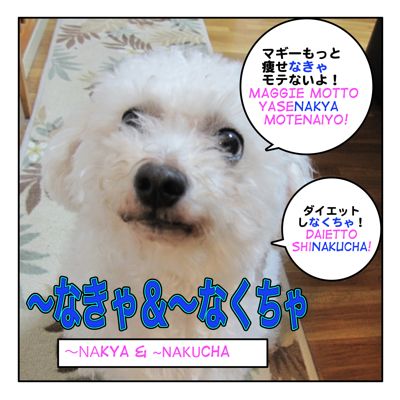
「マギーもっと痩せなきゃモテないよ!」
= Maggie motto yasenakya motenai yo!
= Maggie, you won’t attract anybody if you don’t lose weight.
「ダイエットしなくちゃ!」
= Daietto shinakucha!
= You have to go on a diet.
We have a guest teacher, Anzu-Sensei today.
My dear Twitter Follower pupulinoさん sent me this picture. Thank you!! !ochame!
I made a lesson on ~ちゃう =~chau + ~ちゃった = ~ chatta before.
Today’s lesson is on other casual suffixes.
(verb 未然形 = mizenkai) + なくちゃ = ~ (verb) + naku cha
and
(verb 未然形 = mizenkei ) + なきゃ = (verb) +nakya
:n: 未然形 = mizenkei = imperfective form
People who just learned formal Japanese from textbooks and/or strict teachers may find this difficult because they are not traditionally taught. Actually we use these suffixes very often in casual conversation.
They mean “to have to do something” or “must do something”
OK, let’s start!!
When you want to say,
“I have to go now”, many of you would translate that as,
A) もう(私は*)行かなくてはいけない or ならない。
= Mou (watashi wa* ) ikanakute wa ikenai or naranai
 (more polite) いけません。or なりません。
= ikemasen. or narimasen.
or
B) もう(私は*) 行かなければいけない or ならない。
= Mou (watashi wa*) ikanakereba ikenai or naranai
(more polite) いけません。or なりません。
=ikemasen or narimasen.
Note : * We often omit subjects.
* ならない ( = naranai) and なりません ( = narimasen) are more formal than いけない ( = ikenai) and いけません ( = ikemasen).
A lot of time we don’t finish the sentences.
↓
もう行かなくては… or 行かなければ
= Mou ikanakutewa…or ikanakereba
Now, let’s make them more casual. When we talk to our friends, family, or ourselves, we don’t say,
A) もう(私は*)行かなくてはいけません。or なりません。
= Mou (watashi wa* ) ikanakute wa ikemasen. or narimasen.
instead, we say,
↓
もう行かなくちゃ
= Mou ikanakucha
and
B) もう(私は*)行かなければいけません。or なりません。
= Mou (watashi wa*) ikanakereba ikemasen or narimasen.
will be
↓
もう行かなきゃ
= Mou ikanakya
🔸See the change of the suffix?
(verb nai-stem) + なくてはいけない or ならない
= (verb nai-stem) + nakutewa ikenai or naranai
(verb nai-stem)+なくちゃ
= (verb nai-stem)) + nakucha
(verb nai-stem)+ なければいけない or ならない
= (verb nai-stem )+ nakereba ikenai or naranai
(verb nai-stem ) +なきゃ
= (verb nai-stem ) + nakya
★ Telling yourself or other people what you have to do.
Ex. I have to eat.
• 食べなきゃ(いけない)
= tabenakya (ikenai)
• 食べなくちゃ(いけない)
= tabenakucha (ikenai)
Ex. I have to study.
• 勉強しなきゃ(いけない)
= benkyou shinakya (ikenai)
• 勉強しなくちゃ(いけない)
= benkyou shinakucha (ikenai)
Ex. I have to reply
• 返事を出さなきゃ(いけない)
= henji wo dasanakya (ikenai)
• 返事を出さなくちゃ(いけない)
= henji wo dasanakucha (ikenai)
🔸 When we use them.
★with possible consequences
Ex. If I don’t study, I will fail the exam.
勉強しなくちゃ or しなきゃ 試験に受からない。
= Benkyou shinakucha or shinakya shiken ni ukaranai.
★Showing your determination
Ex. I really have to win!
•絶対に勝たなくちゃ(いけない)or (だめだ)
= Zettai ni katanakucha (ikenai) or (dameda)
•絶対に勝たなきゃ(いけない)or (だめだ)
= Zettai ni katanakya (ikenai) or (dameda)
★When you tell other people what to do.
Ex. You have to study Japanese more!
•もっと日本語の勉強しなくちゃ(いけないよ)or (だめだよ)
= Motto nihongo no benkyou shinakucha (ikenaiyo) or (damedayo)
•もっと日本語の勉強しなきゃ(いけないよ)or (だめだよ)
= Motto nihongo no benkyou shinakya (ikenaiyo) or (damedayo)
Ex. You have to go to bed now.
• もう寝なくちゃ(いけませんよ)or (だめですよ)
= Mou nenakucha (ikemasen yo) or ( dame desu yo)
• もう寝なきゃ(いけませんよ)or (だめですよ)
= Mou nenakya (ikemasen yo) or ( dame desu yo)
★When you tell other people what to do and the possible consequences.
• もっと日本語の勉強しなくちゃ or しなきゃ、マギー先生に怒られるよ。
= Motto nihongo no benkyou shinakucha or shinakya Maggie sensei ni okorareru yo.
= If you don’t study Japanese, Maggie Sensei will chew you out.
 マギー先生より = Maggie Sensei yori = From Maggie Sensei
あんず先生が言う様に、もっと運動しなくちゃね。
= Anzu sensei ga iu you ni, motto undou shinakucha ikenai wane.
= I guess I should exercise more like Anzu sensei said.
Thank you, Anzu sensei!
***
Will you be my Patron?
I appreciate your support! サポートありがとう!
110 Comments
こんにちは、 Maggie 先生、
I just have one small question – I have seen a lot written about the difference between when to use いけない and ならない in terms of the various nuances of obligation. But so far, I cannot find any good explanation about the difference between when to use ~なければ and ~なくては. Is there a nuance I am missing, or are they interchangeable and equal formality level?
Thank you in advance for your help!
こんにちは JJ
OK, you know the nuance difference between いけない and ならない already.
なければ and なくては are basically the same.
Personally I use なければ for slightly stronger obligation and なくては to show one’s strong will.
先生、お返事どうもありがとうございました!
どういたしまして、JJ! :)
Hi Maggie sensei!
I noticed that in many of your examples, you used ~なきゃ/なくちゃ and then put いけない in parentheses afterwards. My Japanese friend always uses the いけない after she says なきゃ. Is the いけない optional? And if it is, does using it make the sentence more formal? Thank you for the great lesson as always!
Hi Emily
Yes, the original form is
Vなければいけない/いけません
Vなくてはいけない/ いけません
→(casual) Vなきゃ・なくちゃいけない・いけません
→(even more casual) you drop いけない and say Vなきゃ・なくちゃ
Thank you so much for the help!
You’re very welcome! ☺️
Hello maggie sensei!
I don’t know if this place for it, but I went accross this while reading “そんな指図されにゃいかんのだ”, and I can’t seem to understand this されにゃいかん part, can you help me ?
Hello,
にゃいかん is a very casual (or also a dialect in certain area) way to say 〜なければいけない
Why do I have to be told to do such a thing.
Thank you for the answer ! But in that case, what is there in the sentence that indicates it is a question, isn’t のだ affirmative ?
Not a question. Why do I have to do that? = I don’t have to do that.
のだ is for statement but when you express your strong feelings.
Thank you for the answer. However, I have but one last question. Isn’t なければいけない “have to do” rather than “don’t have to do” ? Isn’t the character saying he has to do it ? Sorry for bothering you so long 😅
なければいけない itself means “have to do something” but by adding のか you make a question but at the same time you can express your strong feelings of disagreement.
The same idea in English.
I don’t have to do ~: なくてもいい
Why do I have to do that? = (どうして/なぜ)〜なければいけないのですか? / 〜のか (more rough)
How would I say past tense of “I had to” with short forms such as なくちゃ & しなきゃ
HI Kikuchan
To make a past tense,
なくちゃ・なきゃ+いけなかった
I had to go by 6:00.
6時までに行かなくちゃいけなかった。
6時までに行かなきゃいけなかった。
Hey Maggie Sensei, I was reading One Piece and came across this sentence from Luffy. He says, 船から落ちなきゃいいじゃないか!In English it says, “I’ll be fine as long as I don’t fall off the boat”. My mind wants to make it “I have to fall off the boat” I guess I’m a little confused about when なきゃ becomes “As long I don’t x” I hope this makes sense!
Hi Desmon
The English translation is correct.
I’ll be fine as long as I don’t fall off the boat”
Vなければいけない (casual Vなきゃいけない) means “have to do ~ ” but
Vなければいい (casual Vなきゃいい) means “It’s OK as long as one doesn’t do ~ ”
OK, the basic structure of this sentence is
~なければいい
Oh, it’s short hand for the negative form! Thank you so much! That really helps!
You’re very welcome! :)
Howdy madam,
I hope you don’t mind question no.87on this page (you work too hard ^-^)
I’m kind of a bad student XD. But i was wondering if my way of breaking down the explanations is not a good way.
E.g:
~なければ+いけない/ならない
I explain it to myself as: [if the action is not ”able” to be done]+[“it” won’t proceed/become] .
Which when rephrased becomes “must do” etc.
I think “able”, because i think of the 得る sound. Lol I don’t exactly know why…
With today, i was kind of wondering if the same sort of thought process is possible with your lesson here on:
~ 無く+ちゃ
~ 無き+ゃ
Thank-you Maggie and staff XD
From Shaun,
Hi Shaun!
Oh is it the 87th question? I had no idea. 😁
~なければ+いけない/ならない
the first part なければ [if the action is not ”able” to be done] is actually [if the action is not done]
As for なくちゃ・なきゃ,
無く+ちゃ is kind of make sense but the second one ~ 無き+ゃ, I wonder how you interpret this little ゃ
Vなくてはならない →なくちゃ Vなければならない →なきゃ
It might be easier to think that this type of casual contraction is similar to “gotta” in English. It is easier to say that way in spoken Japanese.
>>き+ゃ, I wonder how you interpret this little ゃ<<
Well that makes both of us XD.
I think out of a habit i broke down 無きゃ to 無き as in 欠点無き… which was a wrong turn i guess.
いつもThank you very much.
Haha, OK.
Yes, since this is for casual speech, I think it will be better not to interpret this なき as 無き which is very literal.
またね〜♪ 😊
I came across a kya following a te form of verb. Is this even more of a contraction?
The sentence context is a shop keeper saying something like, “Just buy whatever you want,” I think…
てめえで気に入ったモン 持ってきゃいいだろうが。
I’m not sure about the “motte kya” part, though.
Thanks for your help! :bow:
Hello Ed
That’s a very brutal speech (Especially てめえ・だろうが)
持っていけばいいではないですか。
→持っていけばいいじゃない
→drop い from 持っていけば (This is another casual contraction) 持ってけばいいじゃないか。
→けば→きゃ
→持ってきゃいいじゃないか。
→more brutal 持ってきゃいいだろうが。
マギー先生
こんばんは。お久しぶりですね。
ちょっと質問が有るのですが、「〜なくちゃ」の過去形は何ですか。金沢大学に留学していた時に友達が教えてくれたんだけど、忘れてしまいました。
宜しくお願い致します
勇士
(追伸(P. S.):間違いが有れば、ちょっと直していただきませんか。おっ!そういえば、すみませんが、質問がもう一つ有ります。「〜(ら)れば」と「〜たら」の違いは何ですか。)
いつも有難うございます (as always, thank you very much.)
こんにちは、勇士!
The past tense of 「〜なくちゃ」 is
なくちゃいけなかった/ならなかった
行かなくちゃ I gotta go (now)
行かなくちゃいけなかった I had to go.
「〜(ら)れば」 You mean られれば?
Or you simply want to know the difference between たら and ば?
勇士の日本語の文章、直すところありませんでした。おめでとうございます!
マギー先生
こんばんは!分かりました。返信して下さって有難うございます。
そうですね。もっとこんな感じです:「Vタ形ら、___。」と「条件系、___。」
例えば:「日本語学校を卒業したら、専門学校に入りたいです。」と「大学を卒業すれば、国へ帰ろうと思っています」。
そうなのですか。ちょっとびっくりしました。(笑)
いつも有難うございます。
こんにちは!
そうですね、「〜たら」と「ば」 は同じように使えることもあるのですが、その二つの例文を比べると「ば」の方が仮定の気持ちが強いです。
「卒業したら〜たい」 When I graduate from the Japanese school, I would like to study ~
「卒業すれば」 If I graduate from the university, ~ (It sounds more hypothetical. The speaker is not 100% sure if he/she would graduate)
お待たせしまして申し訳在ありません。。
分かったと思います。「Vタ形ら」は絶対に起こるという事ですね。 「条件形」は起こるかどうか分かりませんが、起こる場合に「〇〇の条件」でしょうか。
英語で速く書いてしまいます。
The 「Vタ形ら」 pattern is used to express that a certain action will be done or that a certain situation will arise upon the completion or occurrence of a matter, action, or state that the speaker is certain will happen.百パーセントで起こるという事です。
The 「条件形, or conditional form, the 「〜ば」 part of the sentence describes the requirements needed for an event or occurrence to manifest itself.
(その説明は私が金沢に留学した時来ます。それでも、マギー先生のおかげで、今分かってしまうかも知れません。)
そうですね。一つだけ
Vたら
百パーセントで起こるという事です。
→私が「〜ば」の説明のところで卒業するのが100%確かではない時と書いたからだと思いますがたらを使うときは必ずしも100%起きるというわけではありません。
あの例文(卒業すれば)に関して言えば、卒業という行為が完了した時という意味で使われています。
Your interpretation is right except the part 百パーセントで起こるという事です。
I think you said 100% because I said “When the speaker is not 100 pct sure.” in the explanation of ~ば but you use たら when you are not 100% sure either.
For that particular example sentences たら in 卒業したら, is the completion of “finishing the school (graduation)”
マギー先生
もう少し考えたいですが、説明して下さって有難うございます。
勇士
はい、また考えて悩んでわからなくなったらいつでもきてください。
分かりました!
Always appreciate the lessons, so much more useful than standard textbooks.
I was just wondering if there was a casual way of saying don’t have to do.
For example if you’ve had a busy week but finally have the day off is しなくちゃ事がなくて嬉しい correct? I cant help but feel there must be a more natural way of saying it.
Thank you!
Hi jb01
しなくちゃ事がなくて嬉しい →Technically しなきゃいけないことがなくて嬉しい
But it is a direct translation and it doesn’t sound natural. I would say
(忙しかったけど)やっと休むことができてうれしい。
= (I have been busy but) I am happy that I can finally get some rest.
Hi, Maggi sensei!~
I really like all your lessons and the way you explain them~
Everytime I don’t know how to use something or I need to learn something new I always come to your site because your examples and explanations are really good and clear. Thank you so much and please keep it up!~ ♥
@Miroslava
Thank YOU for visiting this site! I’m VERY happy to hear you like my lessons!
I guess I have to work harder!! もっとがんばらなくちゃね。(^_−)−☆
Hi Maggie先生,
Your site is back up, よかった!
Never realised how many times I check your lessons until they were no longer there.
Anyway, my question:
Omitting and contracting things is quite common in casual speech, so just saying
-なきゃ without ならない makes sense.
But I think I also heard the polite -なければ, meaning to say “have to”, without any follow-up, which seems casual to me.
Is this natural, or did I perhaps simply misheard/misinterpret?
@Jay
Hi Jay
Yes, I am back!
OK, you mean like a finishing a sentence with なければ?
If so, I wouldn’t say “casual” but you leave the sentence without finishing on purpose.
So instead of saying なければいけない you just omit いけない. The listener can tell what the speaker means.
もういかなければ (I have to go now)
(casual もういかなくちゃ/もういかなきゃ)
もっとがんばらなければ…
(casual もっとがんばらなくちゃ/がんばらなきゃ)
Hi Maggie Sensei,
I found the following statement from instagram. With a dog picture and the dog looks not happy :)
外に でなきゃ いけなくて 邪魔されるのが いやなん でしょうね。
Does that mean,
If not permitted to go outside, he is feeling not happy ( or displeasure )
外に でなきゃ = 外に でない IF not outside ( or literally means “going outside”)
いけなくて = いけない Not allow / don’t do
Thanks for your advice.
Cheers
Kenz
@Kenz
Hi Kenz
外にでる = go outside
外にでなければいけない=(the dog) has to go outside
→(casual contraction)
外にでなきゃいけない
→て form
外にでなきゃいけなくて = has to go outside and…/ Because the dog has to go out
Hi Maggie Sensei
わかりました。
A million thanks for your advice. You’re the best. !happyface!
Regards
Kenz
@Kenz
どういたしまして、Kenz! :)
ああ、先生、早い返事をありがとうございます!もう分かっています *\(^o^)/*
@アレクサンドラ
どういたしまして!
(NOTE FOR YOU: もう分かっています→”これでもうわかりました。”の方が自然ですよ。)
Maggie先生こんにちは。質問がありますけど、〜なきゃ 〜なくちゃ の過去形はどうですか?
@アレクサンドラ
こんにちは、アレクサンドラ
なきゃ、なくちゃの過去は= had to do somethingの場合は
なきゃいけない→なきゃいけなかった。/なきゃならない
なくちゃいけない→なくちゃいけなかった/なくちゃならない
の形なら表すことができます。
Ex. I had to go shopping. 買い物に行かなきゃ/なくちゃいけなかった。
Ex. I had to work. 仕事しなくちゃならなかった/しきゃならなかった。
Hi Maggie!
I have a question. The next sentence:
寝なければいけないのに、テレビゲームで遊んでしまいました。
When changed into casual style, becomes:
寝なきゃなのに、テレビゲームで遊んじゃった。
or at least according to my grammar book… But my question is, why the な after なきゃ?
Thans a lot!
@Mariana
Hi Mariana,
寝なければいけないのに、テレビゲームで遊んでしまいました。
the casual form is
寝なきゃいけないのに、テレビゲームで遊んじゃった。
If your textbook says 寝なきゃなのに, it must be a mistake. Unless it covers a super colloquial Japanese.
In slang, you use 寝なきゃ as a noun. (It is from a quote「もう寝なきゃ(いけなない)」) Since it is considered as a noun, you use な
寝なきゃなのに…
もう寝なきゃだわ。(female speech)
But this is super colloquial I doubt the textbook has that expression…
マギー先生、実は日本語の教科書はもっと口語文になるんですよね。
十年ぐらい前、初めて日本語を勉強した時に、アメリカ人の大学生に「なきゃ」と「なくちゃ」を教えますが、今年の「元気2」という教科書には、「なくちゃ」と「なきゃ」を教えます。びっくりします!
(Trying to say: Actually, Maggie-sensei, textbooks have been getting more colloquial. I studied Japanese for the first time perhaps ten years ago, and then we were not taught なきゃ / なくちゃ, but in my Genki II textbook this year we were taught these forms! 不適切な言葉遣いがありましたら、申し訳ありません。)
oops, that should say 教えませんが、not 教えますが. In my defense, I usually use plain forms as conjunctions, but I was trying to be a bit more polite for Maggie-sensei.
@Eri
こんにちは、Eri!
そうですね、普通の会話で、「なきゃ」や「なくちゃ」はよく使うので教科書でも教えて方がいいと思います。
Note for Eri
Eriの日本語に、不適切な言葉はないですよ。少しお手伝いしますね。
10年ぐらい前に初めて日本語を勉強した時には、「なきゃ」「なくちゃ」は習いませんでしたが、
(If you want to use “were not taught” →教えられませんでした (Passive form) but 教えてもらえませんでした is more natural)
今年の「元気2」という教科書では、〜を教えてあります。
(If you want to use には
今年の「元気2」という教科書には〜〜があります。or 書いてあります)
びっくりします is fine. But you were surprised so びっくりしました/ 驚きました may be better.)
やらなきゃいけない <if someone said this, is it a positive terms or negative terms?
thank you :-D
@Miiko
Not negative or positive.
If someone is talking to oneself, it simply means “I have to do it / I gotta do it”
If that person is talking to someone else, やらなきゃいけないでしょ= You have to do it.
Thank you for helping Sensei!
Hope you’ll have a great day! \(^o^)/
@Miiko
You’re very welcome!
Hope you have a nice weekend,too!! :)
Sensei, Hello!
I have a question, I’ve heard recently while watching a dorama, a character (a very very informal one) saying the positive version of nakya all the time. When he used it, it was like giving advice or telling “you should…”, so I inferred from that:
ikya > ikereba > ikereba ii > you should go ¿? maybe ¿? Is this used to give advice as well?
Is it some dialect? The city was Tokyo but that character used like some kind of dialect, or he was really really informal, I think
arigatou!
@Sarah
Hello Sarah
Yes, see my examples
★When you tell other people what to do.
★When you tell other people what to do and the possible consequences.
They all mean “you should” or “I should” (If you are talking to yourself, “I should”/ “We should” and if you are talking to someone else what they should do “You should”)
Ex. もっとがんばらなきゃ!= You should try harder. or I should study harder.
Ex. 勉強しなきゃ! = You should study! or I should study!
マッギ先生よろしく! 最近キンドルの本を買った「ちょっと食べちゃったパイ君」と言う。たくさん長い句がいる。
「なくちゃいけないって」ってどういう意味? I assume the “nakucha” here is “無く”? and why does the phrase end with 「って」? Is it just a casual ending to make it more childish?
授業とどうもありがとう!
または, is there any specific reason to use ~かなくて versus ~かなければ or ~なきゃ vs ~なちゃ?
皆さんが、「どちらかでもいい。」と言う。
も、か書き直してくださいね!
@Emma
こんにちは、Emma!
I need the whole sentence to understand the context better but
”なくちゃいけない” is a casual contraction of なくてはいけない
It shouldn’t be the state of “ない” so it means “you have to have something/ you can’t omit (skip) it”
Ex.この文章で助詞はなくてはいけません。
= Kono bunshou de joshi wa nakute wa ikemasen.
= You have to have a particle in this sentence.(You can’t skip the particle in this sentence.)
→(casual contraction)
この文章で助詞はなくちゃいけない
= Kono bunshou de joshi wa nakucha ikenai.
If it combines with other verb
Ex. 食べなくちゃいけない= tabenakucha ikenai = have to eat something
Ex. 勉強しなくちゃいけない= benkyou shinakucha ikenai = have to study
And I need to know the previous sentence って is usually used to quote what someone has just said.
Someone said “~~~~~”
→Someoneが〜〜〜って(言っていました。)
Generally なきゃ、なくちゃ form is for casual speech.
Maggie-sensei, thank you for all the help you give!
Could you please explain this use of なきゃ?
It’s from Over the Distance by Hitomi Yaida. I’m trying to translate it, but there are some parts that confuse me.
空で唄えない小鳥の声みたい
こんなに苦しい だけどあなたじゃなきゃ
I get it up to だけど. But the use of なきゃ here is confusing me.
Also a nakya here:
上手く泳げないあの時の未来
どうしても遠い だけどあなたじゃなきゃ意味ない
(In fact, that entire verse confuses me, especially the first bit. Sorry to ask so much, but can you explain how these sentences work?)
どうもありがとう先生!
@Silver
Hello Silver,
あなたじゃなきゃ a casual contraction of あなたでなくては and it omitted いけない(の)
and it means “It has to be you”
So “(the person I love) has to be you even if it hurts me this much (the first line) / thought it is very far (the second line)
手伝い(?)ありがとう!
Thank you! I have been wondering about that line for a long time. Now it makes sense!
I am still confused about the second verse though
上手く泳げない = Cannot swim well
あの時の未来 = That time in the future (?)
どうしても遠い だけど = even though it is very far
あなたじゃなきゃ意味ない = without you it means nothing
Have I got that right? The reason it is confusing me is the use of 泳ぐ. Is this a metaphorical phrase here, because literally it doesn’t make sense. How would you put it all together?
[Sorry to ask so much. It is just that recently I’ve had a few hits from Japanese people looking up my English translation, and I don’t want them to be learning it wrong because my translation skills are so bad :'( I’ve put the link to it as my URL if anyone wants to check over it]
[マギー先生は、とてもカワイイので、『マギーちゃん』 と言いたいですね!]
@Silver
(→手伝ってくれてありがとう)
I think you are doing great.
It is very hard to translate lyrics.
First I will help you line by line
上手く泳げない = Cannot swim well → Right.
あの時の未来 = That time in the future (?) →Your translation means “未来のあの時 “That time in the future” means “the future at that time”
Now if you put these two lines together.
↓
上手く泳げない あの時の未来
You are right. It doesn’t make sense because it is a poetic expression but it means
I couldn’t swim well in “my future” then.
どうしても遠い だけど = even though it is very far →Fine. (It’s far but…)
あなたじゃなきゃ意味ない = without you it means nothing →Fine but that means “あなたがいないと(あなたがいなきゃ)意味がない” the literal meaning is “It has to be you.”
Again when you put these two lines together,
→You are too far from me but it has to be you.
How’s that?
手伝ってくれてありがとう!! 分かりました!
That’s a really big help, thank you so much! I never would have been able to understand it without your explanation. So I will copy this out and read over it a few more times so I properly understand it. Thank you, Maggie-sensei and Yukari-sama!! Finally I know what Hitomi-san is singing about :D
@Silver
どういたしまして!あとはSilverのセンスで訳してみてね。がんばって!:)
マギー先生, thank you for the wonderful breakdown of なければ・なくてはいけない to なきゃ・なくちゃ.
It makes a lot of sense, so in fact, I quite understand it now.
But, I do have a question about the なきゃ when it is なきゃいい. Is it なければいい? or なくていい?
I was reading this manga, and the narration was 変われなきゃいい. I’ve only seen なければ with the negative, so it confuses me with the positive.
Thank you!!
@Tilly
Hi Tilly,
OK, 変われなきゃいい is a casual contraction of 変わらなければいい
Other examples
*しなければいい→しなきゃいい
Ex. ~をしたくなければしなきゃいいのに。
If you don’t want to do 〜, you don’t have to do that.
*ならなければいい→ならなきゃいい
Ex. そんなことにならなきゃいいが…
= I hope it won’t happen.
Maggie-sensei,
Thank you so much for the explanation and clarification.
Your blog is super helpful, I wish I had found it sooner!
@Tilly
You’re very welcome, Tilly!
And I am very happy to hear my site is helpful.
Feel free to come visit me anytime!
Dear Maggie san:
Folks in Kyoto-shi say kakanaitokyaikemasen (I have to write it). My Genki 1 textbook says the modal is nakyaikemasen without “ito.” Why, and what is “ito,” please.
@Gordon Tippett
Hello, Gordon!
I think your host family in Kyoto said
書かないといけません。
= Kakanai to ikemasen.
Not
書かないときゃいけません。
= Kakanai to kya ikemasen.
(This doesn’t make any sense..)
There are a couple of ways to say “You have to do something.”
1) ~ないといけません。(=~ nai to ikemasen.)
→the casual contraction is 〜なくちゃいけません。(= ~ nakucha ikemasen.)
Ex. 書かないといけません。(=kakanai to ikemasen.)→書かなくちゃいけません。(=kakanakucha ikemasen.)
or
2) 〜なければいけません。(= ~ nakereba ikemasen.)
→the casual contraction is ~なきゃいけません。(= nakya ikemasen.)
Ex. 書かなければいけません。(= kakanakereba ikemasen) →書かなきゃいけません。
So both 書かないといけません(=kakanaito ikemasen) and 書かなきゃいけません。(‘=kakanakya ikemasen) works when you want to say “have to write”
こんにちは、先生!
一つの設問があります。 「~なくてはならない」と「~なければならない」は大体同じですか?
もう一度、有り難うございます!!
@Orti
はい、大体同じように使っています。
But if you want to know the slight difference,
While なければいけない can be used to tell people what to do, なければならない is used when you have to follow certain rules, laws, certain obligations and you can’t know decide whether you do it or not on your own will.
( A little correction : 設問→質問)
Thanks for your explanation and correction, sensei!
what’s the difference between 設問 and 質問? they both appear as ‘Question’ in the dictionary :S
えっと。。。 and is there any difference between “なければならない” and “なくてはならない”?
@Orti
質問&設問 They both mean question(s)
質問・・・question, inquiry , when you ask someone about the things you don’t understand
設問・・・posing a question : when you ask someone a question that you already know the answer. (to test/quiz someone)
So when you have a question for me, 質問があります is better.
“なければならない” and “なくてはならない”
About the same. なければならない is slightly more formal but not much difference.
分かりました^^
いつも質問を答えて有り難うございます、先生!!
@Orti
どういたしまして!
(もう一つ…..質問”に”答える…) !happyface!
アァァ。。ありがとう!
ウァ。。 アンズ先生もうまく教えられますね!(^_^)/ (笑)
このレッスンをまた楽しまれた。
@Phylisscyn
アンズ先生かわいいね! !heart!
(A little correction : このレッスンをまた楽しまれた。→このレッスンもまた楽しかったです。)
This is so useful (^^)
but I was wondering, how does the nakya/nakucha form conjugate? Are they like na-adjectives or nouns etc? For example, if you were to say “I have to make dinner and/then I have to walk my dog”, would you say:
ご飯を作らなきゃで、犬を散歩させなきゃ
Thank you ^^
@pudding
Hi, pudding!
OK since なきゃ and なくちゃ is a part of なきゃ/なくちゃいけない, you use いけない part to conjugate.
I have to make dinner and (on top of that) I also have to walk my dog.
You just connect two sentences using し
= ご飯を作らなきゃ(or 作らなくちゃ)いけないし犬も散歩させなきゃ(or 散歩させなくちゃ)いけない。
先生ー寝てないとダメよと寝なくちゃダメですよは同じ意味ですか?
@stenier
寝てないとダメ : 例(たと)えば病気(びょうき)とかで寝ている状態(じょうたい)・横たわっている状態でいないといけない人に言います。
(Keep lying down, Stay in bed)
寝なきゃダメ:ずっと寝ていなくて起(お)きている人に言(い)います。(You should sleep. Go to bed! )
先生説明有難う!!
@stenier
どういたしまして!
先生それらの2つの漢字の違いは何ですか?聞くや聴く
@steiner
「聞く」is more general. 聴く is mainly used when you listen to something more attentively or intentionally listen to something. Like music, lecture, etc.
音楽を聴く, 講義を聴く
なるほど、有難うございます
@steinier
どういたしまして!
domou arigatou sensei^_^..
its help me a lot..thank you!!!
@Faika
こちらこそ!サイトにきてくれてありがとう!またきてね! :)
Ahmm. これ云いサイトでしょう。先生、”こちらこそ”って言うのは教えてくれませんか?ありがとう!bookmarkするはすだ!。
@Ron
Hi Ron! 来てくれてありがとう!
「こちらこそ」の使い方ですか?
Ex. A : 「ありがとう!」 Thank you! B : 「こちらこそ!」Me,too.
Ex. A : 「よろしくお願いします。」Nice to meet you!B : 「こちらこそ!」 Nice to meet you,too!
Ex. A : 「会えてうれしいです。」It’s a pleasure to meet you. B : 「こちらこそ!」Likewise
Ex. A: 「御迷惑をおかけいたしました。」I am terribly. B : 「こちらこそ….」Me,too.
So こちら refers to you or your side. So instead of repeating the same thing, you say this to the person.
Is it clear?
あのえ、先生。時々、”そう思います”ってか”私も”ってかを返事できろうとおもうんだ。同じ使用だろう。
@Ron
ごめんなさい。質問(しつもん)の意味(いみ)がよくわからないのですが、
So you want to ask,
Q : 「そう思います」と「私も」の使い方が同じですか?
If so…they are different.
そう思います = I think so
私も = me,too
If you say 私もそう思います, it means ” I think so,too.”
ごめんなさい。”こちらこそ”の使い方が本当にまだはっきりわかります。質問は”そう思います”と”私も”っていうのを、時々、返事できる。ね?どうもありがとう先生。
@Ron
OK, first let me help your sentences. ”こちらこそ”の使い方が本当にまだはっきりわかります。→You know clearly how to use”こちらこそ”? Then say, こちらこその使い方はもうはっきりわかります。
もう = already まだ = not yet
“時々返事できる” means “You can answer once in a while.” I assume you sometimes get confused when to use “私も” and ”そう思います”
Then I hope I answered your questions in my last comment.
そう思います is used only when you agree with someone.
私も just means, “me,too”
Try these :
Ex. 私はカレーが好きです。 Which one do you use? ” “私も” or ”そう思います”
Ex. マギーはかわいいです。Which one do you use? ” “私も” or ”そう思います”
If you want, follow me on twitter. We can practice there.
Nice, never seen your lessons before, I like how they are all in Kanji, keep it up!
@Stevo
Hi Stevo! Thank you for visiting my site! また来(き)てね! :)
Can なくちゃ and なきゃ be used by both girls and boys? Is one more girly then the other one?
Thank you
@Van
Yes, men and women both can use these forms.
Great lesson マギー先生!面白かったですよ~
もうノートに書き終わりました。
本当にありがとうございます~
もう行かなきゃww
@Rafael
こちらこそありがとう!!
もう完璧(かんぺき)に使えるね!
So, ~なきゃ and ~なくちゃ can be used interchangeably? Or, is there some difference in usage?
@Danielle:Canada
Hi, Danielle! ~なきゃ and ~なくちゃ can be used interchangeably in most cases. Some says they have exactly the same meaning but to be precise, there is a slight difference.
~なきゃ is a bit stronger than ~なくちゃ. If we feel something has to be done urgently or we really feel obliged to do something we tend to use ~なきゃ.
ありがとうございます! That helps