
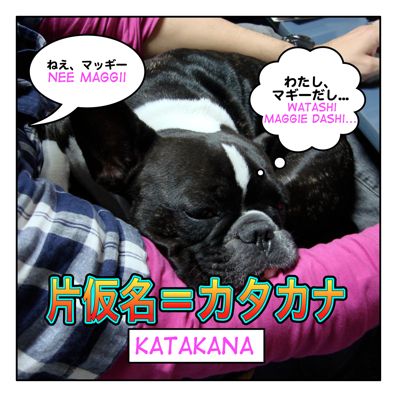
「ねえ、マッギー」
= Nee Maggii,
= Hey, Maggii,
「わたしマギーだし…」
= Watashi Maggie dashi….
= I am MAGGIE! (not Maggii)
Today I will post a katakana chart. We usually use katakana for foreign words and names.
As I explained in my previous katakana lesson , writing proper katakana words is not so easy because we changed the original
sound and convert the words into a Japanized version of the origianal.
From the picture above :
「ねえ、マッギー」
= Nee Maggii,
Many people have written my name, マギー as マッギー in the picture above.
「わたしマギーだし」
= Watashi Maggie dashi..
= I am Maggie.
〜し ending is very colloquial and it is grammatically wrong. (The correct way isわたしはマギーです。= Watashi wa Maggie desu.)
Even people who have lived in Japan for a long time have difficulties writing katakana words.
Especially tricky for most students are the stretch marker that looks like a dash: ー . And the small tsu: ツ.
We call the them 棒=bou (or describe it saying 伸ばす= nobasu= to stretch) and 小さいツ(=chisaii tsu), respectively.
!onpu! Katakana Chart!!
ア イ ウ エ オ
a i u e o
カ キ ク ケ コ
ka ki ku ke ko
サ シ ス セ ソ
sa shi su se so
タ チ ツ テ ト
ta chi tsu te to
Note : ツhas a small letter ッ
ナ ニ ヌ ネ ノ
na ni nu ne no
ハ ヒ フ ヘ ホ
ha hi fu he ho
マ ミ ム メ モ
ma mi mu me mo
ヤ ユ ヨ
ya yu yo
ラ リ ル レ ロ
ra ri ru re ro
ワ ヲ ン
wa wo n
Note : the pronunciation of ヲ =wo is the same as オ= o.
***************************
ガ ギ グ ゲ ゴ
ga gi gu ge go
ザ ジ ズ ゼ ゾ
za zi zu ze zo
ダ ヂ ヅ デ ド
da di du de do
バ ビ ブ ベ ボ
ba bi bu be bo
パ ピ プ ペ ポ
pa pi pu pe po
************************************
キャ キュ キョ
kya kyu kyo
シャ シュ ショ
sha shu sho
チャ チュ チョ
cha chu cho
ニャ ニュ ニョ
nya nyu nyo
ミャ ミュ ミョ
mya myu myo
ヒャ ヒュ ヒョ
hya hyu hyo
リャ リュ リョ
rya ryu ryo
拗音 (=youon) Digraphs with diacritics
ギャ ギュ ギョ
gya gyu gyo
ジャ ジュ ジョ
ja ju jo
ビャ ビュ ビョ
bya byu byo
ピャ ピュ ピョ
pya pyu pyo
*********************************************
Spelling tips :
1) How to write a word with V.
In the old days, we just used バビブベボ. So there was no difference between writing a word with V andB.
But a lot of people use ヴ now.
Ex. Victor →ヴィクター (Some still spell it ビクター)
Ex. Violin →ヴァイオリン (Some still spells バイオリン)
2) Modern Japanese uses small アイウエオ、ヤユヨ、ワand combine with other letters to express various foreign words (not just
English).
* Tea: ティー
* Tooth: トウース
* Fusion: フュージョン
* week = ウィーク (or ウイーク)
* wet = ウェット (or ウエット)
* wash = ウォッシュ (or ウオッシュ)
* quick = クィック (or クイック)
* shade = シェード
* jar = ジャー
* jet = ジェット
* Zermatt= ツェルマット (German : name of a place)
* canzone =カンツォーネ (Italian)
* fur = ファー
* fee = フィー
* face = フェイス (or フェース)
* fork = フォーク
* Disney = ディズニー
* Louis Vuitton = ルイ•ヴィトン (French)
* vocal = ヴォーカル (or ボーカル)
* Cirque de Soleil = シルク•ドゥ•ソレイユ (French)
etc.
3) There are a lot of Japanese words and abbreviations that look like English but exist only in Japan. Be careful because
they often mean something a little or even completely different from the original English.
You just have to remember these as new words.
★ウインカー(or ウィンカー)= winkaa = blinker, turning signal
★マクド = makudo = McDonald’s
★リモコン = rimokon = remote control
★パソコン = pasokon = personal computer
And some of the words are not originally from English.
★ホッチキス = hocchikisu = stapler
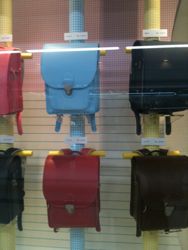
★ランドセル = randoseru = school bag for Japanese elementary school students
★パン = pan = bread
Also we have tons of 和製英語= wasei eigo = Japanese English = coined katakana words.
 Ex. チャック = chakku = zipper, トランプ = toranpu = cards, マンション = condominium,
ガッツポーズ = victory pose, ペアルック = When a couple wears the same matching outfits., etc.
We tend to assume katakana is easy compared to Kanji. That’s true. But writing katakana properly is not that easy, especially
knowing when to add ッ and ー and when not to!
Many people have written my name, マギー as マッギー as in the picture.
It’s a small difference but mistakes like these are sure giveaways that the writer is not a native.
We adapt foreign words and convert the pronunciation to make it easier for Japanese to pronounce them. We often alter them to
avoid consonant sounds that Japanese often difficulty pronouncing.
I suggest you think of these katakana words as new words and pay special attention to the spelling. But there are some tricks to
writing katakana. Here are a few of the most common patterns that I figured out.
ー= dash is used to stretch the sound
If the words has (or end with) ar, au, oa, er, ur, ir, or, ee, oo, ea, ey, ie, y , you add ー
* car → カー
* sauce →ソース
* speaker →スピーカー
* dresser→ドレッサー
*number →ナンバー
*shoot →シュート
*work →ワーク
*recorder→レコーダー
*moon →ムーン
*school →スクール
*fork →フォーク
*boat→ボート
*Maggie→マギー
*meat→ ミート
*heat →ヒート
*sheet→シート
*seat→シート
*feet → フィート
*noodle →ヌードル
*key → キー
*heart = ハート
(This is a general rule and there are exceptions so be careful!)
Ex. cook is not クーク it is クック
Coffee has only one “o” but we stretch the sound コーヒー
* Other than the above rules, if you think the word has a extended vowel sound, add an ー
Ex. coat =コート, note = ノート, computer = コンピューター
:l: When to use small ツ
Before ap, ip, up, op, ck, ot, it, ic,tt
(Note : There are exceptions.)
* skip = スキップ
* shop = ショップ
* shock= ショック
* cup = カップ
* map = マップ
* kick = キック
* mop = モップ
* tack = タック
*ship = シップ
* Be sure to convert the sound to Japanese pronunciation. Do not pronounce it in proper English. There’s a good bet no one will
understand you:
If a word finishes with the following letters, write,
☆ t , tt→ト ★ p→プ ☆k, ck →ク★ l, r , le→ル ☆ s→ス
★ f→フ ☆d,dd→ド ★x →ックス☆ g →グ ★ m →ム
*mitt → ミット
*spoon →スプーン
*set→セット
*pot →ポット
*map →マップ
*talk →トーク
*book →ブック
*hotel →ホテル
*mall →モール
*middle→ミドル
*meat →ミート
*foot→フット
*socks→ソックス
*leaf →リーフ
*card→カード
*maid→メイド
*fax → ファックス
*mix → ミックス
*egg →エッグ
*ham →ハム
:d: Now test yourself.
1) keyboard 2) book 3) cutter 4) hat 5) deliver 6) popular music 7) six 8) park 9) dog 10) custom
(Check the answers below)

マギーせんせいより = Maggie Sensei yori = From Maggie Sensei
カタカナのテストをよくツイッターでしています。れんしゅうしたかったらフォローしてね。
= Katakana no tesuto wo yoku tuittaa de shiteimasu. Renshuu shitakattara forou shitene.
= I often give katakana quizzes on Twitter so if you want to practice, follow me!
Answers :
1) キーボード 2) ブック 3) カッター 4) ハット 5) デリバー 6) ポピュラー ミュージック 7) シックス 8) パーク 9) ドッグ
10) カスタム
***
Will you be my Patron?
I appreciate your support! サポートありがとう!
18 Comments
Thank you so much!
Would you know how to pronounce katakana when there is a vowel used instead of the nobasu?
For example: ケアウホウ
It is a name of a town/beach in hawaii
In this case ホウ is used instead of ホー
In these cases, would one pronounce the vowel? Like ホ・ウ (ho-u)
Or still say it like ホー (hoo)
Hello Kelly
It depends on the word and it could be very different from the original sound.
As you said, the original “ho” could be closer to ホー but ケアウホウ (Bay = 湾(わん)) is commonly used for the bay.
The thing is you don’t always pronounce the Japanese vowels あいうえお/アイウエオ when they are combined with consonants
Ex. ほうりつ (法律) houritsu = law ➡️Actual pronunciation is hōritsu (ō = stretching “o” sounds)
I see! If I understand, even with ホウ the same rule applies and one would say this like hō (stretched)
So even in katakana, generally whether a nobasu or vowel is used (ホー/ホウ) this just means the consonants are both being stretched. And it would be read as (hō).
And whether it shows up with ー or ウ in the name is more just a written formality.
Thanks just surprised me when I saw the vowel instead of the nobasu.
As I usually see in katakana the nobasu used to imply stretching the vowel (ニューヨーク/フィジー)
Likewise in hiragana the vowel is used instead as you say. (ほうりつ/りょこう)
So when I saw ホウ instead of ホー I wasn’t sure if that had meant to pronounce the vowel! (笑)
Thank you very much for your explanation! If not mistaken I think I got it now and was just overthinking it.
So even in katakana, generally whether a nobasu or vowel is used (ホー/ホウ) this just means the consonants are both being stretched. And it would be read as (hō).
→That’s right.
So you know how to write katakana for the well-known things, places, countries, people’s names such as ニューヨーク、フィジー, ヨークシャ(ー), ドーナツ,etc. However if you hear uncommon names, it is very natural to get confused whether you stretch the vowel or use the vowels. :)
Maggie Sensei, how do you write Fernan and Donelle in katakana? Is it
Fernan – ペルナン or フェルナン
Donelle -ドネリ or ドネリー or ドネッレ
I’m really confused
@Maria
How about
Fernan フェルナン
Donelle ドネル
please show me how to write shihan in japaneese
thanks jay
@jay
Hi jay
Is it a person’s name?
Shihan = If you pronounce “h”, シハン. If “h” is silent, シアン
Hi. Rules are quite helpful. I was not quite sure how to translate Joaquin into Katakana though. Pronounced sort of like Wakkin It has oa in it so ー should fit in there somewhere
ツ
Before ap, ip, up, op, ck, ot, it, ic,tt
None of that isn’t there though. But it sounds like a ツ should be there. Help would be appreciated.
Seems hard to convert words that don’t sound as they are written.
@Danny
Hi Danny,
“Joaquin” (in Spanish pronunciation) is ホアキン in Japanese.
Thanks!
@Danny
You’re welcome!
Another great blog 「マッギー」先生 (LOL, you see what I did there:p). You didn’t give any examples on ヮ though:/
@ゾモチ
Ughhhh!! (`ε´) (Yes! You are learning!!)
ヮ :Not that common but you can use it when you write クヮ or グヮ to express some sound instead of クワ or グワ
Ex. シークヮーサー (=Shii kuwaa saa) : A citrus drink in Okinawa
Ex. グヮ〜!= Guaa! (instead of グアー or ガー) to express loud sound.
You can use them when you write some foreign word which has kwa or gwa sound.
Yay! You guys made it!! :) I only have one question as weird as that sounds. Which would you guys prefer to learn first hiragan or katakana? I feel like learning Kata first is better but i already know a lot of hiragana cause i see it so much. Should i just continue finishing hiragana first? Thanks so much for this lesson as always. -Itsu
@Itsumaru
Hi, Itsu! Yes! We made it!
I would definitely finish hiranaga and then go for katakana. Hope you get here soon!!
Thank you, Maggie Sensei! You’re too nice and generous! Will share this on Facebook. :)
@Andini
My pleasure! Hope it helps for many people.