
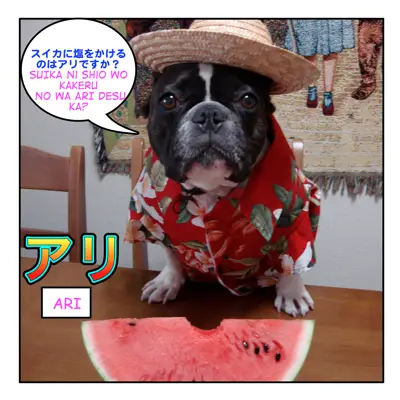
「スイカに塩をかけるのはアリですか?」
= Suika ni shio wo kakeru nowa ari desu ka?
= Do you put salt on your watermelon? / Is it acceptable to put salt on the watermelon?
Hi everyone! It has been really hot here in Japan. It is time to eat watermelon. Yum! :h:
By the way, do you sprinkle salt on the watermelon? Because all of my family has done that since I was a little girl.
We believe salt makes some food sweeter. (Do you know we add salt to sweet bean paste – 餡 = an?)
Anyway, some people around me use salt when they eat watermelon as well but some never use it.
I wonder if this is something regional and if they do that in other countries…
So I tweeted the question and asked my followers.
🐶 みんなはスイカに塩(しお)をかけて食(た)べる?それともそのまま食(た)べる?
= Minna wa suika ni shio wo kakete taberu? Soretomo sonomama taberu?
= Do you sprinkle salt on watermelon? Or do you eat it without salt?
None of them use salts including some Japanese followers.
*************
So today’s word is アリ ( = ari) We have stared to hear this word a lot these couple of years.
It’s a slangy word and it came from a word, 有る ( = aru) or 有り得る ( = ariuru), possible, likely to happen
Note : The opposite word of 有り得る ( = arieru) is あり得ない ( = arienai)
➡️ See my lesson : ありえない = arienai = impossible, it can’t be happened, Not a chance
Also the opposite word of あり/アリ ( = ari) is ない/ナイ ( = nai)
Let’s take a look a the picture above again.
Ex. すいかに塩をかけるのってアリ?
= Suika ni shio wo kakeru notte ari?
= Would you sprinkle salt on your watermelon?
⭐️ How to use アリ ( = ari)
🔸 Question forms :
★〜ってアリ?
= 〜 tte ari?
★〜(の)はアリ?
= ~ (no) wa ari?
★(statement) + コレってアリ(ですか)?
= (statement) + kore tte ari (desuka) ?
★(statement) +そんなのアリ(ですか)?
= (statement) +sonna no ari ( desuka)?
You say this when you want to ask,
*Would you do that?
*Do you like it?/ Would you like it?
*Is it acceptable?
*Do you think it’s OK?
*Would you care if you were in this situation?
!to right! Some questions are hypothetical and some simply ask if you like them or not.
⬇️
Ex. 「付き合っている人がいるのに元カレまたは 元カノとお茶を飲むのはアリ?」
= Tsukiatte iru hito ga iru noni moto kare mata wa moto kano to ocha wo nomu no wa ari?
= Even if you are dating someone, is it OK for you to go out with your ex-boyfriend or ex-girlfriend for a cup of tea?
Ex. 「マギー、出川君と付き合うのってアリ?」
= Maggie, Degawakun to tsukiau notte ari?
= Maggie, would you go on a date with Degawa-kun?
➡️ Maggie: 「ない!ない!それはない!」
= Nai! Nai!! Sore wa nai!
= No way!
Note: Sometimes you just keep saying ない ( = nai)
ない、ない、ない、ない!!
= Nai, nai, nai, nai!
🔹 Variation :
Ex. 「ムリ!ムリ!!」= Muri muri!!
➡️ ムリ = 無理= muri = impossible, No way!
➡️「ありえない!」= Arienai! = impossible, No way!
Ex. 「ご飯にマヨネーズをかけるのってアリ?」
= Gohan ni mayoneizu wo kakerunotte ari?
= Do you like to eat rice with mayo?
Ex. 「彼が君は僕にはもったいないから別れようって。そんなのアリ?」
= Kare ga kimi wa boku ni wa mottai nai kara wakareyoutte. Sonnano ari?
= My boyfriend said he wanted to break up with me because he doesn’t deserve me. It can’t be true, right?
Ex. (You point at your outfits) 「ねえ、この組み合わせってアリだと思う?」
= Nee kono kumiawasette ari dato omou?
=Hey, do you think this outfit looks good?
Ex. 全然アリ!
= Zenzen ari!
= It’s totally possible/ acceptable / It’s not bad at all.
(Note : 全然 ( = zenzen) is usually used in a negative sentence. But we use it in an affirmative sentence in casual Japanese.)
⭐️ Statement forms :
Ex.僕、年上の彼女でもアリです。
= Boku, toshiue no kanojo demo ari desu.
= I have no problem dating an older woman.
Ex. 私?20歳年上の人でも全然アリだよ。
= Watashi? Nijussai toshiue no hito demo zenzen ari dayo.
= Me? I have no problem dating a 20 years older guy.
Note : In this 全然 ( = zenzen) means “totally”
Usually 全然 ( = zenzen) is used in a negative phrase but in modern Japanese, it is used to stress the meaning.
 マギー先生より = Maggie Sensei yori = From Maggie Sensei
スイカに塩かけるの?アリ!アリ!!
= Suika ni shio kakeru no? Ari! Ari!!
= Sprinkle salt on the watermelon? Yes! I do that!
***
Will you be my Patron?
I appreciate your support! サポートありがとう!
16 Comments
Maggie-sensei, thank you so much for this explanation! I’ve been struggling with this word in a text I’m translating and thought I was completely lost. However, by some magic power I have found this post and I’m eternally grateful! !CHECKHEART! !CHECKHEART! !CHECKHEART!
@Simply Sally
Hi Sally
I am glad you found us with your magical power,too! :)
Hi, I am a native Japanese speaker and I think your lessons are very interesting and useful even for me.
But I don’t think the word アリ literally came form あり得る/有り得る. This is because in this case the opposite word of アリ is ナシ.
For example, you can say:
スイカに塩をかけるのは,アリですか,ナシですか。
or
スイカに塩をかけるのは,やっぱりナシですか。
If アリ is a short form of 有り得る, how do we explain ナシ? We have 有り得る but don’t have 無し得る.
So, I think it is natural to consider that these アリand ナシ are directly came from classical Japanese words あり and なし, whose modern forms are ある and ない, respectively.
As you know, あり and なし are still often used idiomatically in modern Japanese, and I think アリ (あり) itself can deliver the meaning of possibility just like ある in “そんなことあるかな?”.
Moreover, I think アリ (あり) is not a very rude slang. Indeed, it is not suitable for writing, but you can say “〜という対策もありだと思います” or “社長に直接相談してみることもありだと思います” in your business meeting.
We have to investigate when the expression was coined.
@脈あり脈なし様
はじめまして!日本人の方もこのサイトに来て下さるのですね。有り難うございます!!
まずアリの説明ですが、このレッスンでは元の言葉は「ある」か「あり得る」のどちらかということで説明しました。
実際、”アリ”は「ある」だけにすると”経験があるかどうか”という解釈にもつながるかもしれない(→すいかに塩をかけたことはありますか?)そして”~することがあるか”だけではなく”〜することが許容範囲か、出来うるか”と結構、気持的なものが加わることの多い言葉だと思い「あり得る」も表記してあります。その辺りがうまくこのサイトに来て下さっている皆さんに理解を頂けていればいいのですが…
例えば、
「〜君と付き合うのアリ?」
「なし!/ない!」
というシチュエーションの場合、「なし/ない」はもちろん「なし得る」ではなくレッスンで説明した様に「ありえない」かと思います。
Moreover, I think アリ (あり) is not a very rude slang.
→全く同感です。カジュアルだけれども失礼な表現ではないですよね。
俗語も毎回真剣勝負で毎日学ぶことばかりです。 :grin: これからも宜しくお願い致します!
It reminds me a bit of the use of “have something to do with…” (((o(*゚▽゚*)o))) or asking if an action can correctly fit a situation. Thank you, Maggie Sensei! You’re incredible good at teaching. ありがとうございます。
@Kharol
Thank you for checking the lesson,too!! ありがと〜!!
Thank you for the lesson! In Mexico we put salt and lime to pretty much any fruit.
@Pippa
Hola Pippa!
Thank you for the comment. How interesting. You put lime as well in Mexico?
I will try that!! (Except limes are kind of expensive in Japan….)
Congratulations on your second year! I have been using these lessons for a few months now as a supplement to my Japanese learning. Many are still over my head but I am learning a lot of wonderful thinks that you couldn’t get in a standard classroom. Thank you for all of your hard work!
~ R
@Rebecca
Thank you, Rebecca! Your words mean a lot to me!!
これからもがんばりま〜す!!
Congratiolation on your second anniversari, Yukari-sensei!
Keep up the good work, you’re awesome!~ :)
@Tass
Thank you, Tass!! ありがとう!
Thanks for the lesson, sensei! I learned something new today. :D
Oh, we put a dash of salt on watermelon, but only when it’s not that sweet. We also put salt on sour mangoes to intensify the sourness. A bit of salt work wonders! :D
@Amelie
Oh goodie! There is another one who puts salt on watermelon! Do you prefer sour mangoes??
スイカに塩かけてるね。。。やっぱり、試してみなくちゃね!
先生、レッスンありがとう!
@Aki
お塩はちょこっとだけかけてみて!そしてアリかどうか教えてね。