
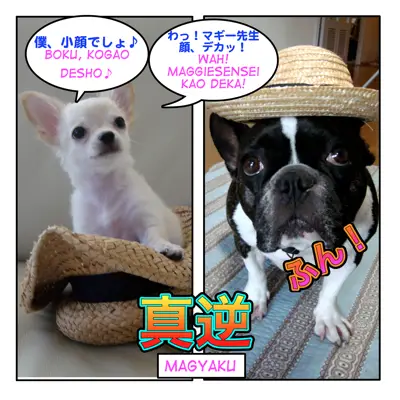
「僕、小顔でしょ♪」
= Boku kogao desho!
= I have a small face, don’t I?
「わっ!マギー先生の顔デカッ!」
= Wah! Maggie sensei no kao deká!
= Wow! Maggie Sensei’s face is huge!
ふん!
= Fun!
= Huh!
みなさん、今日は!
= Minasan Konnichiwa!
= Hi, everyone!
また、このサイトに来てくれてありがとう!
= Mata kono saito ni kite kurete arigatou!
= Thank you for visiting this site again.
Today’s guest teacher is マロン先生!( = Marron sensei) ! and today’s focus colloquial word is
 真逆 = まぎゃく = magyaku
It was one of the nominated trendy words of the year, 2004, but we still can’t find it in the dictionary. However, a lot of comedians have started to use this on TV, so it has become a pretty standard word. I found it very interesting because it’s originally a slangy expression but we have started to hear/see this word in relatively serious TV shows, interviews, and even written articles!
Note : 真逆 is originally read as まさか ( = masaka) but it has a different meaning. (It means No way! There is no way, etc. I will teach you some other time.)
真逆 ( = magyaku) means 正反対 ( = sei hantai ) exactly or just opposite of something or someone, contrary to something or someone
We often add 真 ( = ma) when we stress the meaning.
This kanji can be read ま ( = ma)、まん ( = man)、まっ ( = matt) depending on the compound word
•真後ろ = maushiro = right behind
•真上 = maue = right above
•真下= mashita= right below
•真夏 = manatsu = mid summer
•真冬 = mafuyu= mid winter
•真横 = mayoko = right next to
•真っ青 = massao = deep blue
•真っ白 = masshiro = stark white or pure white
•真っ黒 = makkuro = pitch black
•真っ新 = massara= brand new
•真四角 = mashikaku = perfectly square
•真っ直ぐ・真っすぐ = massugu = straight
•真っ暗 = makkura = pitch dark
•真っ裸 = mappadaka = stark naked, completely naked
•真っ最中 = massaichuu = right in the middle of ~
•真ん中 = mannaka = midst, right in the center
逆 ( = gyaku) means reverse, contrary, counter, opposite
Ex. 私達は逆の立場にいる。
= Watashitachi wa gyaku no tachiba ni iru.
= We are in opposite situations.
Ex. 逆の道を行く。
= Gyaku no michi wo iku
= to go the opposite route
so 真逆 ( = magyaku) = stresses the meaning of “opposite, contrary, reverse, different”
Let’s take a look at the picture above,
「僕、小顔でしょ♪」
= Boku kogao desho!
= I have a small face, don’t I?
「わっ!マギー先生の顔デカッ!」
= Wah! Maggie sensei no kao deká!
= Wow! Your face is huge, Miss Maggie!
📝 Notes :
I think I mentioned in a past lesson that having a “small face” is considered to be a good thing in Japan.
There are lots of fashion magazines showing makeup or hair styling techniques that will make your face look smaller.
So when people see your face and say
「わ〜、顔が小さい!!」
= Waa kao ga chiisai!!
= Wow! You have a small face!
It is a compliment.
デカッ!
= Deká!
is a colloquial way to say でかい = dekai = huge.
A fairly new way to finish a word is with the small っ/ ッ= small “つ”/”ツ” = tsu
Ex. 眠い = ねむい = nemui = sleepy →ねむっ! = nemuh!
Ex. 寒い = さむい = samui = cold →さむっ! = samuh!
When we compare two different things, ideas, concepts, or people, we say 真逆 (= magyaku)
Ex. 私達、真逆の性格だから…
= Watashitachi magyaku no seikaku dakara…
= We have completely different personalities so…
Ex. 真逆なタイプの二人の人を好きになってしまった。
= Magyaku na taipu no futari no hito wo suki ni natte shimatta.
= I fell in love with two completely different types of people.
Ex. 事実とは真逆
= Jijitsu to wa magyaku
= It is completely different from the truth, to be utterly false
Ex. 彼女は見た目と真逆なキャラだね。
= Kanojo wa mitame to magyaku na kyara dane.
= Her character is different from her appearance.
Ex. 最近、夜と昼、生活が真逆になっている。
= Saikin yoru to hiru seikatsu ga magyaku ni natteiru.
= My life has been reversed days and nights recently.
Note : In regular Japanese, we just say 逆 ( = gyaku) or 反対 ( =hantai), 違う ( = chigau), when we want to stress out the meaning, just say 正反対 ( = seihantai) or 全く違う ( = mattaku chigau)
OK, since it is a good opportunity, I will teach you related words!
🔸 逆さま = sakasama = upside down
we also say 上下逆さま = jouge sakasama = upside down
Ex. ずっと、知らずにこの絵を(上下)逆さまにかけていた。
= Zutto shirazu ni kono e wo (jouge) sakasama ni kakete ita.
= I’ve been hanging these pictures upside down all this time without knowing.
🔸裏返し = uragaeshi
Ex.マギー、Tシャツ、裏返しに着てるよ。
= Maggie, Tshatsu uragaeshi ni kiteruyo.
= Maggie, you are wearing your T-shirt inside out.
左右逆= left-right reversal
(We also say 左右反対 = sayuu hantai )
Ex. 靴を左右逆に履いてしまった。
= Kutsu wo sayuu gyaku ni haite shimatta.
= I wore my shoes on the wrong feet.
🔸 反対 = hantai = opposite, reverse,
Ex. 反対側= hantaigawa = the opposite side
Ex.愛と憎しみは反対だ。
= Ai to nikushimi wa hantai da.
= Love is the opposite of hatred.
🔸 あべこべ = abekobe = the other way around
あべこべにする = abekobe ni suru = to get ~ the wrong way round
Ex.ナイフとフォークの置き方があべこべだよ。
= Naifu to fooku no okikata ga abekobe dayo.
= You put the knife and a fork in backward.
Ex. あべこべの方向に進む
= abekobe no houkou ni susumu.
= to go in a different direction
 マギー先生より
= Maggie Sensei yori
= From Maggie Sensei
Marron is soo cute! If you want to see just how different we are, check out this video!
⬇️
***
Will you be my Patron?
I appreciate your support! サポートありがとう!

20 Comments
Hello, could you Dear Maggie Sensei perhaps please explain this one:
what is the origin of the “ん” in “真ん中”.
You say “真” has three different KUN readings, but if they were different readings, then the “ん” would be included in the “真” itself and not added after it.
I thought that the “ん” is a remaining part of “の”, as in “真の中”. But I am wrong.
What on earth is this “ん”. Could you perhaps look at it in 日本語源大辞典? I have no access to the book. I would be so grateful.
Thank you.
@Student
Hi Student,
I don’t have 日本語語源大辞典 but 真ん中 came from a word 真中 (manaka). For the pronunciation purpose, they added ん in the middle.
it’s great. i would like to see more from your lessons. your lesson helped me understand clearly. thank you so much sensei
@tham
ありがとう!うれしいです !JYANE!
Thank you so much for this lessons, and all others! I don’t comment much, but I am SERIOUSLY GRATEFUL for all of these!!!
@chibola
Thank YOU for your comment!! よかったらいつでもコメントしてね!!
LOL… these cute puppies make me laugh.
Maggie, don’t let marron sit on your hat! Because someday he maybe sits on your head too
MaggieとMarronの性格が真逆ですか。
@Adelheid
Thank you for your comment! Haha, OK, will be careful not to let him sit on my hat.
MaggieとMarronの見かけ(=appearance) が、真逆です!
your site is the best source to learn Japanese ^-^
btw, I came across these words “よちちは”&”よちの” I always thought it means something like “watashi”…????not really sure?
@manju
Hi Manju!
“よちちは”&”よちの” ? I have never heard of them. If I come across these words, I will let you know. Where did you see them? It would help if you give me the whole sentence.
maybe I’ve mistaken it with another word *-*
it could have been a name actually.
thanks for replying ^0^
@manju
OK, anytime! :h:
For me, Marron-sensei and Maggie-sensei are both cute! :D
Btw, I have a question. I’m confused with these two words: 点検 and 検問. The dictionary says both mean inspection. But is/are there any difference/s? Like, when it comes to how it’s used or something?
Thanks! ^^
@amelie
Oh there are very different.
点検 is to check something is functioning properly.
Ex. 車の点検、エンジンの点検
検問 is used when police stop passersby or cars to inspect.
Oh, I see. They are indeed different.
Thanks for enlightening me, sensei! ^^
@Amelie
どういたしまして!Amelie!
デカイってスラングでしょう?
ま、マギーの顔はユニークからマロンちゃん羨ましいよね~!^。~うふ
先生、An Anっていう雑誌を知ってるの?女の子のためにの雑誌からジャニーズはモデルしてるんだ!赤西仁も山Pも真っ裸で雑誌にいったの。。。なんか嫌だね・・・
けど、亀くんはそんな事したないから嬉しいね^O^
新しいレッスンありがとう!
今日から、学校を始まるの!あの、今学年も、日本から新しい生徒がないの。。。残念ねぇ~_~
@Aki
Hi Aki! ”でかい”は”大きい”のくだけた(casual)言い方だけれどもスラングではなく昔からある言葉ですよ。カタカナで書くから新しく見えるよね。
anan?もちろん知ってるよ。ハハ、そうね。亀君は大丈夫だよ!
Akiの大学では日本人の留学生(りゅうがくせい)今年はいないの?残念!!でもAkiの大学に行く日本人留学生はラッキーだよね。Akiがいるから! :)
Thank you for the lesson, Maggie sensei. Nice video at the end. :)
@Pippa
Thank YOU for checking the lesson!! また来てね!