
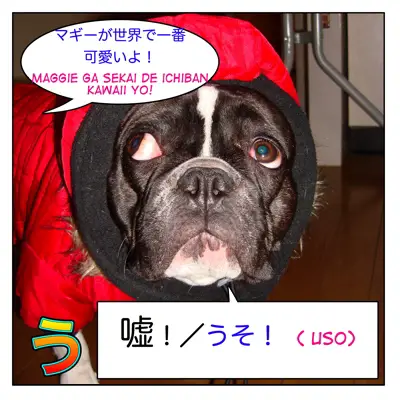
「マギーが世界で一番可愛いよ!」
= Maggie ga sekai de ichiban kawaiiyo!
= Maggie is the cutest in the world!
「嘘! 」
= Uso!
= Liar! / No way! / You must be kidding!
Today’s word is 嘘 = うそ = Uso.
It means “lie”.
:w: verb : 嘘をつく = uso wo tsuku. = to lie
Ex. 私に嘘をつかないで(+下さい。)
= Watashi ni uso wo tsukanai de ( + kudasai).
= Don’t lie to me!
* a liar = 嘘つき = うそつき= usotsuki
Ex. 彼は嘘つきだ。/です。
= Kare wa usotsuki da./ desu. (“です ( = desu) is more formal than だ ( = da )
=He is a liar!
Japanese often use “うそ ( = Uso ) when they are surprised, like ”Really?” “Are you sure?” “No kidding!” No way!” or when they hear something unbelievable or unexpected.
Ex. 「マギーがミスユニバースで優勝したよ!」
Maggie ga misu yunibaasu de yuushou shitayo.
=Maggie won the “Miss Universe” contest!
「うっそ〜!」
= ” Ussoo”
=“No way!”
(うっそ〜 ( = Ussoo) is more colloquial.)
 You also say 「ありえない!」( = arienai ) = it can’t be true!
They often combine うそ ( = uso) and 本当 = ほんとう ( = hontou ) / (more colloquial) ほんと/ ホント?= honto = really, the truth
Ex.
A : 「昨日、街でマギーの彼に会ったよ!」
= Kinou machi de Maggie no kare ni atta yo.
= I saw Your (Maggie’s) boyfriend on the street yesterday.
B : 「えっ?うそ!本当?」
= Eh? Uso? Hontou ?
= No way, really?
As you can see “うそ!” ( = uso) is used very casually in daily conversation and doesn’t always mean “lie”.
( Note : 本当? ( = hontou?) Really? could be replaced by “マジ(で)? ( = Maji(de)?) “Are you serious?” in colloquial Japanese.)
Ex. A : 「 明日雨だって!」
= “Ashita ame datte!”
= They said / I heard it would rain tomorrow.
B: 「うそ~! 」
= Usoo!”
= No, kidding! / I didn’t expect it would rain tomorrow.
🔸 Added Sound file for the above phrases. :)
 マギー先生より = Maggie Sensei yori = From Maggie Sensei
でも、本当は私は自分のことを世界で一番可愛いと信じています。 ;-)
= Demo hontou wa watashi wa jibun no koto wo sekai de ichiban kawaii to shinjite imasu.
= But the truth is that I do believe I’m the cutest girl in the world!
***
Will you be my Patron?
I appreciate your support! サポートありがとう!
21 Comments
Have just found this website.. and it is really helpful!
arigatou ne maggie-san.. anata ga kawaii… I suppose..
kyowa benkyo tanoshikatta.. :D
and please provide more listening also.. so that we can learn by hearing! :D
hontonni arigatou gozaimasuu..
Hi Dinul!
Welcome to my site!
There are many lessons here with audio files. Hope you find them useful.
Hi Maggie-sensei,
Thanks so much for your website, it’s been super helpful! I have a question regarding this sentence – 状況や場面を回想で語ると、どうしても説明的で嘘くさくなってしまう気がしたんです。May I know what does 嘘 in this context mean? Does the meaning lean towards more of “contrived”?
Thanks in advance :)
Hi Meredith
Yes, “contrived” is one way of translating the word 嘘くさい
So 嘘 in that context mean “fictional/unrealistic/false” (not real).
More conversational expression is 嘘っぽい
Maggie sensei….

watashi ni kono section wa muzukashi desu ga, tanoshikatta desu !JYANE! !JYANE!
@Fahmi san
Uso? Muzukashikatta? :)
Haip uso desu ga, muzukashikata
@Fahmi san
This is one of my old lessons. Just know you say “uso” in the situation like you can’t believe something. Ex. Really? No way!
Yeah i like to learn from the beginning of your lesson because i like it boucingheart! boucingheart! boucingheart!
Hi Maggie-sensei,
The last sentence is interesting.
でも、本当は私は自分のことを世界で一番可愛いと信じています。
I assume the particle を is used with 信じています and so is the particle と.
i.e. マギー先生を信じてる マギー先生が最高だと信じてる
So it seems special that two particles are tied to the same word cause normally I see each particle is attached to each word in a sentence.
What if the を is replaced with が?
でも、本当は私は自分のことが世界で一番可愛いと信じています。
@changkh
Hello changkh again,
でも、本当は私は自分のことを世界で一番可愛いと信じています。
What I, Maggie, believe is the fact that I am the cutest in the world.(世界で一番可愛いということ)
私は (自分のことを世界で一番可愛い) と信じています。
= 私は (自分のことを世界で一番可愛い)ということ)を信じています。
You use 信じる with both particles, を and と
1) Aを信じる to believe A (noun/nominalized verb) Ex. 噂を信じる=uwasa wo shinjiru= to believe in the rumor
2) Aと信じる to believe that ~~~~ Ex. 彼が日本に来るという噂を信じる= Kare ga nihon ni kuru toiu uwasa wo shinjiru = to believe the rumor that he is coming to Japan.
Hi Maggie-sensei,
I can understand the meaning of the sentence but what I am confused about is the use of を.
If I were to just extract the sub clause to a separate sentence by itself – 自分のことを世界で一番可愛い, is this grammatically correct since there is no verb in the sentence.
That is why in the original sentence, I cannot help but feel that both を and と are associated with 信じています, the only verb in the entire sentence.
@changkh
Hello changkh
Ahh I see. You can say
1) 自分が一番かわいいと信じる
2) 自分は一番かわいいと信じる
3) 自分を一番かわいいと信じる
The difference :
1) & 2) to believe “I am the cutest.”
3) to believe yourself as the cutest.
Can I ask you something even it didn’t fit the theme?
I’m getting a little confiused about 「」and 【】in which context are they used? I though it is like () if you say something and add in () extra information to that but I see 「」is used very often also by all your sentences in Japanese.. I’ll be really thankful if you could explain?
And I’m really thankful for your lessons I’m German and here it’s really hard to find good daily stuff the difference between male/female/neutral (have you a lesson to neutral too?) speech and
exspacially slang.. thank you very much!! By the way thank your stuff i learn both Japanese and
English ;)
@Cho
Hello Cho!
Welcome to our site!
「」are single quotation marks and they are used for dialogue or speech
Ex. Maggie said “blah blah blah”
→マギーは「blah blah blah」と言いました。
or highlight of the word.
Ex. I hate “exams”.
私は「試験」が嫌いだ。
【】are not as common as 「」We use them for math,chemistry code, phonetic symbols, explanations, rephrase some word, etc.
As for the neutral speech, though I am a woman, I try to teach you neutral Japanese. But once in a while I include male or female speech. And when I do, I add the remarks “female speech”-“male speech”
I hope I answered your questions.
Schönen Tag noch!
Huh, thank you really much for the fast answer!
That helped me!!
But how is ist for example when you uses in a twitter biography, when you write something about yourself or information?
I just picked the biography from a musician I like:
カノン(アンティック-珈琲店-/AN CAFEベース) 2013年11月6日full album『非可逆ZiprocK』発売。【アプリ】『Pinky☆Distortion』【音楽】『アンティック-珈琲店-』『kanon×kanon』【楽曲提供etc.】LiSA、ave;new、劇団V、KERAソン
How are they used in context like this?
Because it’s no speach, and what are the differences between 「」and 【】?
i know you said【】isn’t common but I saw it much lately.
sorry for annyoing but i do not know who else to ask.
@Cho
Actually these examples you found with【】are to highlight the genre, some classification.
【アプリ】【音楽】【楽曲提供etc.】
It is just their stile of writing the description. No specific rules.
「」are used for the titles.
We usually use 『』 for the quote in a quote.
(“I heard Maggie said “blahblah” said Yukari = ゆかりは「マギーが『blahblah』って言っているのを聞いたよ。」と言った。
but In your example, they are using them to show the title instead of regular single 「」
I know of 嘘つき + [something] like 嘘つきあなた but can 嘘つき be used alone? Say, like:
「マギーがミスユニバースで優勝したよ!」
「うそつき!」
Also, since for this situation I quite often heard うそつけ instead, I’d like to know if it is true that it’s a bit more colloquial than うそつき ? I heard it several times said by a MC in Harajuku, so I guess it may not be a form to avoid, but I’d prefer to be sure it’s not kind of vulgar. (some colloquial and slang terms can be used quite carelessly but there are words that should really be avoided, this is why I ask)
ありがとうございます!Maggie先生は劇可愛っ!
めっちゃマットさん
Yes! 嘘つき!can be used alone.
Your example sentences are perfect. (Except the fact I did win the contest, ehen!) But if you say 嘘つき!It means “You are a liar”.
嘘!(嘘っ!ウソッ!) is like a reaction word which is used when you are very surprised.
嘘つけ!means “You are lying!” but is sounds stronger like “No shit!”
嘘つけ!or 嘘だろ!are not that colloquial expressions but mainly used by men. As long as you know it is a bit rough but comfortable to use it with your close friends, it is OK to use.
Maggie先生は劇可愛っ!→ウソ!!
“Watashi ni uso wo tsukanai de kudasai” is a great sentense that I would like to learn… but do you pronounce it like: “Watashi ni uso o tsukanai de kudasai or Watashi ni usoo tsukanai de kudasai? love to see a audio file to the sentense!
and Maji is spelled with katakana is it imported from a other country or just a really fresh word?
MVHH
Harrihaffi-san
Konnichiwa! Upon your request, I have just added a new audio file so please check it. Although we write “uso wo tsukanai de” in romaji to distinguish “を” and “お”, the pronunciation is the same. So as you said “usoo tsukanaide” would be more natural Japanese sound.
マジ is not a word from other country. It is a slang.
It came from 真面目に?(=majime ni? seriously?) We tend to abbreviate the word.
Young people love to use it. I will introduce you some other expressions using MAJI
マジに〜する(majini ~ suru) to do something seriously
マジ本気(maji honki) Seriously
マジギレ(する)majigire suru. =To be snapped (seriously)
超マジ (chou maji) = Very seriously.
They are not bad words but please be careful not to use these term in business situation!