
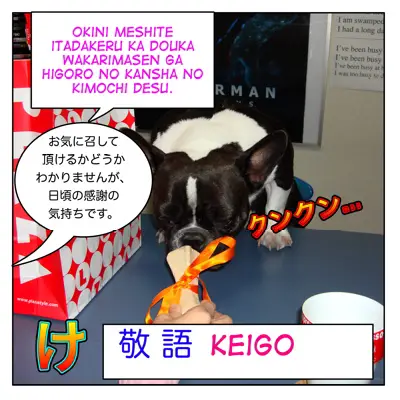
お気に召して頂けるかどうかわかりませんが、日頃の感謝の気持ちです。」
Oki ni meshite itadakeru ka dou ka wakarimasen ga higoro no kansha no kimochi desu.
I am not sure if you would like this or not but this is just a token of my appreciation.
Today we will learn 「敬語」( = keigo).
Uh-oh….tough one! Yep! It is difficult and many Japanese people get confused as well.
敬語 ( = keigo) or 尊敬語 ( = sonkeigo) is an “honorific expression/language“.
In order to speak Japanese properly, we have to learn this 「敬語」( = keigo) and 「 謙譲語 」( = kenjyougo) , humble or modest version of Japanese.
The Kanji of 「 敬」( = kei/ uyamau ) means “to respect” or “to admire”. (尊敬 ( = sonkei) means the same.)
You use 敬語 ( = keigo) towards people who are socially higher, customers, or people you are not familiar with.
You, students have to use 敬語 ( = keigo) towards 先生 ( = sensei), teachers as myself!
You hear 敬語 ( = keigo) in daily conversation all the time in the stores, the restaurants, on the street, on the phone, etc.
Let’s take a look at the phrase in the picture first.
My student says : 「お気に召すかどうかわかりませんが、」
oki ni mesuka douka wakariamsen ga..
(I am not sure if you would like it or not but..)
(Basic form) → 敬語 ( = keigo)
* 気に入る ( = ki ni iru) to like something/s.o. → お気に召す ( = oki ni mesu)
日頃の感謝の気持ちです。 ( = hirogo no kansha no kimochi desu.)
* 日頃:( = higoro ) usually , continuous
* 感謝:( =kansha) gratitude, appreciation
* 気持ち:( = kimochi) feelings, a token of ~
This is a token of my (continuous) appreciation.
*クンクン ( = kunkun) : sniffing sound
Now, before going to 敬語 ( = keigo)、let’s see the patterns of making 丁寧語 ( = teineigo) polite form.
The simplest way to make some Japanese words more polite is to add 御 ( お ( = o) or “ ご( = go) ) to the beginning of a word.
*お口 ( = okuchi ) → (o + kuchi) mouth
Ex. 「お口に合うかどうか..」
= Okuchi ni au ka douka..
= (I wonder if this tastes good enough for your mouth..)→“I am not sure if you like this food but (I do hope you like it) .”
*お元気ですか? ( = ogenki desuka) ? → (o+genki desuka?) How are you?
*お時間 ( = ojikan) →(o+jikan) time
Ex. 「ちょっとお時間ありますか?」
= Chotto ojikan arimasuka?=
= “Do you have time?”
*お忙しい ( = oisogashii ) →(o+isogashii) in hurry
Ex. 「お忙しいですか?」
= oisogashii desuka?
= Are you busy?
The Kanji for “o ” is 御 and its’ other way of reading is “ご ( = go ) “. So some words take “o “ and some take “ go “. (And some can’t take either one.) It depends on the word.
*御主人(様) ( = goshujin(sama) ) When you refer to someone’s husband or an owner of the stores, restaurants, etc. The original meaning of shujin is a master. (Note: The polite word for “wife” is 奥様 ( = okusama))
* 御機嫌 ( = gokigen) mood
* 御住所 ( = gojyuusho) address
* 御相談 ( = gosoudan) to consult
* 御名前 is read “おなまえ ( = onamae) not “ごなまえ ( = gonamae)”.
So if you see the kanji, 御、you have to figure out whether it is ご ( = go) or お ( = o ) (or おん( = on ) →御社 = おんしゃ(= onsha) your company )
But don’t overuse this. It would sound funny if you use it too much and sometimes it sounds strange if men use it.
* お野菜 ( = oyasai) vegetable:Fine and acceptable!
* おジュース ( = ojyuusu) : juice This is possible but sounds a bit overdone.
* おバナナ ( = obanana) : banana Too much. This sounds really strange
* お骨 ( = okotsu) : bone ⚠️ Never use it for the fish or meat bone!! Only for funerals…
<How to address other people’s family >
When you refer to someone’s family, you have to keep it in mind to use the polite form.
For example, 母 ( = haha) usually refers to your own mother. お母さん ( = okaasan) could be your mother or another person’s mother. お母様 ( = okaasama) or お母様方 ( = okaasama gata) ( plural mothers) are very polite form to address other people’s mothers.
(check my family related lesson for more details.)
Ex. 私の母は60歳 です。
= Watashi no haha wa 60 sai desu.
= My mom is 60 years old.
Ex. お母様はお元気でいらっしゃいますか?
= okaasama wa ogenki de irasshaimasuka?
= How is your mother? (very polite)
★父 ( = chichi) father (one’s own)
 お父さん ( = otousan) (polite/friendly)
お父様 ( = otousama ) (formal)
★ 兄 ( = ani) brother (one’s own)
お兄さん ( = oniisan) (polite/friendly)
お兄様 ( = oniisama) (formal)
★姉 ( = ane) older sister (one’s own)
お姉さん ( = oneesan) (polite/friendly)
お姉様 ( = oneesama) (formal)
敬語の動詞 ( = keigo no doushi ) honorific verbs
How to change regular verbs into 「丁寧語」( = teineigo / polite form)
(ex. 〜です、ます desu, masu form. Usually you can use it both when you refer to your actions and other people’s actions.) and「 敬語」 ( = keigo)
(Ex. 〜になる ( = ni naru)、〜になられる ( = ninarareru) and etc.
You only use them when you refer to other people’s actions.)
(Basic form)
丁寧語 ( = teineigo) polite
敬語 ( = keigo) formal/very polite
:u:
★飲む ( = nomu) = to drink
飲みます ( = nomimasu)
お飲みになる ( = onomininaru)
★ 急ぐ ( = isogu) = to be in hurry
急ぎます ( = isogimasu)
お急ぎになる ( = oisogini naru)
★ 試す ( = tamesu ) to try
試します ( = tameshimasu)
お試しになる ( = oameshini naru )
★買う ( = kau ) to buy
買います ( = kaimasu)
買われる kawareru
★書く ( = kaku ) to write
書きます ( = kakimasu)
書かれる ( = kakareru) to write
★ 来る ( = kuru) = to come
来ます ( = kimasu)
来られる ( = korareru)
* Also
いらっしゃる ( = irassharu )
or
お超しになる ( = okoshi ni naru) can be keigo for this.
★試す ( = tamesu ) to try
試します ( = tameshimasu)
:rrrr: お試しになる ( = otameshini naru)
★食べる ( = taberu) to eat
食べます ( = tabemasu)
召し上がる ( = meshiagaru)
★いる ( = iru ) to be somewhere, to stay
います ( = imasu)
いらっしゃる ( = irassharu)
★言う ( = iu) to say
言います ( = iimasu)
おっしゃる ( = ossharu)
Note : The first three verbs are ( ~になる =~(ni)naru ) form. The next three verbs are 〜られる ( = ~(ra) reru) form. The last three verbs are the one which take special forms.
 Test yourself!
Now your turn! Read the following casual sentences and make them in 丁寧 ( = teinei) , polite form, and then try to make them intake their form! Good luck!
1)明日、会社に来る
= Ashita kaisha ni kuru?
= Are you coming to the office tomorrow?
2)今週の会議はどうする?
= Konshuu no kaigi wa dousuru?
= What are you going to do about the meeting this week?
3)この映画観たことある?
= Kono eiga mita koto aru?
= Have you seen this movie?
4)今、鈴木さんは出かけているの?
= Ima, Suzuki san wa dekakete iru no?
= Is Suzuki-san out now?
5)料理、冷めるから早く食べたら?
= Ryouri, sameru kara hayaku tabetara?
= Help yourself before the food gets colder.
6)これ誰が描いた絵?
= Kore dare ga kaita e?
= Who drew this picture?
7)田中さんって知ってる?
= Tanaka sanntte shitteru?
= Do you know Mr.Tanaka?
🔹 (答え) ( = kotae) Answers
(1) 明日会社 に来ますか?
= Ashita kaisha ni kimasuka?
明日は、会社にい らっしゃいますか?
= Ashita wa kaisha ni irasshaimasu ka?
(2) 今週の会議はどうしますか?
= Konshuu no kaigi wa doushimasu ka?
今週の会議はどうされますか?
= Konshuu no kaigi wa dou saremasu ka?
(3) この 映画を観たことはありますか?
= Kono eiga wo mita koto wa arimasu ka?
この映画をご覧になったことはありますか?
= Kono eiga wo goran ni natta koto wa airmasu ka?
(4) 今、鈴木さんは出かけていますか?
= Ima, suzuki san wa dekakete imasu ka?
只今、鈴木様はお出かけでしょうか?
Tadaima, Suzuki-sama wa odekakete de shouka?
(5) 料理が冷めてしま うので早く食べたら如何ですか?
= Ryouri ga samete shimau node hayaku tabetara ikaga desuka?
どう ぞ、お料理が冷めてしまいますのでお早くお召し上がり下さい。
= Douzo, oryouri ga samete shimaimasu node ohayaku omesiagari kudasai .
(6) これは 誰が描いた絵ですか?
= Kore wa dare ga kaita e desu ka?
こちらの絵はどなたがお描きになったのでしょうか?
= Kochirano e wa donata ga okaki ni natta node shouka?
(7) 田中さんを知っていますか?
= Tanaka san wo shitte imasu ka?
田中さんをご存知ですか?
Tanaka-san wo gozonji desu ka?
Note :
コンビニ敬語 ( = conbini keigo) 、ファミレス敬語 ( = famiresu keigo) or バイト敬語 ( = baito keigo) part-time.
Recently the peculiar form of 敬語 ( = keigo) among young people who work for family restaurants or convenience stores is getting controversial.
The examples of those “konbini”or “famiresu” keigo are…
* こちらメニューになります。
= Kochira menyuu ni narimasu.
→こちらがメニューでございます。
→ Kochira ga menyuu nde gozaimasu.
* お会計、2000円になります。
= Okaikei, nisen en ni narimasu.
→お会計は、2000円でございます。
= Okaikei wa, nisen en de gozaimasu.
*こちら、Aランチのほうになります。
= Kochira, A ranchi no hou ni narimasu.
→こちらがAランチでございます。
= Kochiraga A ranchi de gozaimasu.
* 1万円からお預かりします。
= Ichiman en kara oazukari shimasu.
→1万円をお預かりします。
= Ichiman en oazukari shimasu.
* 温めますか?
= Atatame masu ka?
→温めましょうか?
= Atatamemashou ka?
They even have manuals using these 敬語( = keigo)
So like all languages, the Japanese language has been changing, too.
 マギー先生より = Maggie sensei yori = From Maggie-sensei
本日、御多忙中、こちらのブログにいらっしゃって下さった皆様、誠に有難うございました。
またのお越しを心からお待ち申し上げております。
= Honjitu gotabouchuu kochirano burogu ni irasshatte kudasatta minasama , makoto ni arigatou gozaimashita.
mata no okoshi wo kokoro kara omaci moushiagete orimasu.
= Thank you for taking time out of your busy schedule to visit this blog. I really hope you come to visit us again.
❤️ Check my other 敬語 form lesson.
Click here. →敬語(Keigo)Honorific Form
***
Will you be my Patron?
I appreciate your support! サポートありがとう!
56 Comments
hello, i want to ask something
what is the difference of
どこへ行かれますか。
and
どこへいらしゃいますか。
ありがとうございます。
Hi Theo
The mean the same, “Where are you going?” but いらっしゃる is more polite than 行かれる
(Also when you use 行かれる・いらっしゃる, you might want to use どちらへ instead of どこへ. It sounds more polite.)
Thanks, im currently finishing minna no nihongo 2 which should cover until n4 right? my kanji game is weakk thoughh, can you recommend any book that is good for foreigners? im still 16 and i want to speak and read japanese i think its really interesting. Thank you very much!
There are many kanji books or apps out there. I would work on vocabulary and kanji at the same time.
How about getting a book on JLPTN4 Vocabulary book? (For example, JLPT N4語彙マスター, etc. )
Also if you use Twitter, follow me. I am tweeting kanji4Day often.
Dear Maggie Sensei,
Can you please tell me if the Te kudasai form of “goran ni narimasu” is “goran ni natte kudasai?
If it’s correct, why do I also hear people use goran kudasai?
Yoroshiku onegaishimasu
Hi Tata
Yes てください ( = te kudasai) form of ご覧になる ( = goran ni naru) is
ご覧になってください。= Goran ni natte kudasai.
But the shorten version ご覧ください ( = goran kudasai) is more common because it sounds “simpler”. :)
Arigatou gozaimasu :)
どういたしまして💕
I’m not sure if this is correct, but I learnt that there is a slight difference
ご覧ください is from the お/ご +verb stem + ください pattern, which suggests that the action will benefit the person doing it
E.g. メニューをご覧ください – please take a look at the menu (so that you can choose your food etc)
And ご覧になってください is an honorific verb inside the てください pattern, which does not have the connotation of “doing something for your benefit”
E.g. 私たちをおまちになってください – please wait for us (I couldn’t think of a good example using ご覧)
Hi Elenor
You may also want to check my Honorific Form lesson. Click here.
When you describe a customer is looking at the menu you say
お客様は/がメニューをご覧になっている
And if the customer is waiting
お客様がお待ちになっている
They both describe the state of doing something.
And the plain form is ご覧になる/お待ちになる
Now when you ask someone to do something
ご/お〜なってください
But you sometimes drop なって
ご覧になってください。
ご覧ください。
お待ちになってください。
お待ちください。
So they are all correct.
As for the “benefit”, ~なってください/ください is used when the speaker asks the listener to do something in a polite way.
For example if you say, ご覧いただけます/お待ちいただけます then the action will benefit the person doing it.
Hello!
I am studying Japanese Honorific forms right now.
Whenever I get stuck, I also refer to your website.
Thank you for sharing such great content.
Something that has been tripping me is “ご覧になってください。” versus “ご覧ください”. I am glad to read in this comment that saying “ご覧になってください。” is OK and correct.
There is so much to learn!
Hello Jen,
Let me add more information.
ご覧ください is more common than ご覧になってください。
This is an old post so please check the new keigo lesson,too!
Hello Maggie Sensei.
I just had a brief read of the new Keigo lesson. So my understanding is that ご覧になってください is using a double honorific. I am coming to realise that “ご覧ください” is definitely more common. But for service people, using double honorific is sometimes ok. I have heard both used so all and all, it is good to know both are correct statements. Thank you!
That’s right. ご覧になってください is commonly used among service people. However, ご覧ください is much more common.
In my personal opinion, though you describe someone who is superior is looking at something, you say ご覧になっている but I would use ご覧ください.
I’ve been looking for jobs located in Japan online and the requirement is knowing how to speak business Japanese. I’m wondering if 丁寧語 is sufficient as many young Japanese people don’t know how to speak 尊敬語 or 謙譲語 as well. Is business Japanese really required? Do young Japanese people use 敬語 during working hours? I really want to work for a Japanese company someday. Hope you can answer my question.
Hi Lea,
It depends on what kind of workplace you apply for.
I’d say, if you speak 丁寧語, you would be fine in a general work place.
Using the right 敬語 is difficult for even native speakers. So as I mentioned in my shopping lesson, young people tend to use the wrong keigo.
However, f your job requires talking to or dealing with the customers/clients/other company, some basic 尊敬語・謙譲語 will be necessary.
If you have to write emails/letters, you will need another level of 敬語 and formal business terms.
Dear Maggie Sensei,
Could you help me with my question, please? I was wondering if Japanese children use “teneigo” when they address their parents?
I’ll be thankful if you find time to answer it.
Sincerely,
Elena
Hi Yolochka
Generally speaking, they use “casual” speech when they talk to their parents. :)
いつもお世話利なります。
i have a question regarding business keigo. may i seek the answer from you? Thank you in advance.
When do you use ~いただきます?
another one would when is a good time is use 申し上げる?
@choon han
こんにちは、choon han.
いただきます
nounをいただきます。
= I will receive/eat something
When you eat something/when you receive something from someone.
Ex. いただきます。
Ex. 遠慮なくいただきます。
= Enryo naku itadakimasu.
Ex. お電話をいただけますか?
= Odenwa wo itadakemasuka?
= Could I have a phone call from you?
〜させていただきます
= to do something for you (Allow me to do something for you.)
Ex.明日、お電話をさせていただきます。
= I will give you a call tomorrow.
***
申し上げる is a modest way to say 言う
お願い申し上げます。
= Onegai moushiagemasu.
= I’d like to ask / Please ~
You often see it in formal letter.
心よりお喜び申し上げます。= Kokoro yoro oyorokobi moushiagemasu. = I am very delighted to hear the news.
御礼申し上げます。= Orei moushiagemasu = I’d love to express my gratitude.
when you have several verbs in a sentence, do I conjugate all of them to the honorific expression?
ex: I : 先生、今お宿題を終わりしたら、今何をいたしますか?
@kahn moza
You can focus on the last verb.
先生、宿題が終わったら、何をしたらよろしいでしょうか?
Hi Maggie,
When do I use お〜になる and when do I use ukemi(受身) as keigo?
Also, does it not confuse the listener since passive form is also keigo?
Thank you!
@Man Hua
O-V ni naru is more polite than reru/rareru form
And you don’t get keigo reru-rareru and passive reru-rareru if you pay attention to the context and particles.
この本はAによって書かれた。
= Kono hon wa A ni yotte kakareta.
= This book was written by A.
Aさんがこの本を書かれた。
= A san ga kono hon wo kakareta.
= A -san wrote this book.
Maggie先生 心の底からありがとうございます。 !new!
I am shocked how accurate you are and how easy it is to learn from you !! I am french and not native english but it comes so naturally さすがに先生は先生だけあって教育的な考えの所有でございますね。今度の木曜日口頭試験がございます。とくに敬語について実行いたすべきでございますので、すごく緊張いたします。それこそ、こちらのレッスンは最も適切な素材と存じます。。
幸あれと祈ってください !! !heart3!
@Zack
うれしいコメントありがとうございます!
木曜日に口頭試験があるのですね。がんばってください。うまくいきます様に!!
Sensei, I came across the suffix naku from the work wasurenaku and goshinpainaku. Is it a honorific form? I read that wasurenaku is a negative form of the honorific 忘れる but I cant seem to find any sites that support this. Please help.
@Anne
Hello Anne!
~なく form is a shorter way to say ならないように so it is not a honorific form but just a polite way to say not to forget something.
お忘れにならないようにお願いいたします。(Please do not forget)
→お忘れにならないように
→お忘れなく
Other example
お間違いのないようにお願い致します。(=Please do not make a mistake/mistake something)
→お間違いのないように
→お間違いなく
お間違いのないようお願いいたします。(Please do not make a mistake)
Maggie sensei!~~IN 「お気に召すかどうかわかりませんが、」
oki ni mesuka douka wakariamsen ga..do you pronounce 召す as me-su or mesu?(same as desu pronunciation?)~~
Ariagtou in advance~~~thank you
@Kasandra
We pronounce 召す “mesu” (not me-su) as you said like “desu”.
Hi, Maggie! Congrats on your awesome blog. :) I was reading this entry and I wanted to ask if there is a reason why in Japanese certain words, like certain foods take the prefix o- in polite speech. You mention お野菜 and I’ve also heard お魚 and お肉. But as you say it’s not extensive to other food words, like “banana”, etc. So why do you need the o- prefix for meat, fish, vegetables and some other foods? I read in a grammar book that the o- prefix is used for taboo words with dirty/unhealthy connotations, like お手洗い, which I can understand. Also, to some extent, with food , it could be for aesthetic reasons (i.e. to show refinement), like in English you say “pork stew” (pork being a word of French origin) and not “pig stew” but I’ve also heard お花, as in お花綺麗~!, which I don’t understand, because flowers are something beautiful and have a lovely smell.
@Irea
Hello Irea1
Thank you for visiting this site!
We don’t put お by its value or aesthetic reasons. It is a technique to make you sound polite when you talk to others.
For example when you refer to the phone call you made you say 電話 but when you refer to the call someone else made it is considered to be polite to say お電話
Women tend to use お more than men. A lot of women say お花 but if a man says “お花がきれい” it sounds a big feminine.
There are no specific rules which word takes お. But usually we don’t put お in front of katakana words.
X おバナナ X おコンピューター x おオレンジ
Nice expanation, I hope i could learn keigo
@Annie
You can! I know it seems to be tough but learn sukoshi zutsu!
Great Blog,- thanx!
Is there a honorific expression for 興味 が ある ?
Thank you in advance for your help!
Asta-K.
@Asta-karolina
Hi, Asta-K!
The honorific expression for 興味がある is 興味がおありになる/お持ちになる
ども ありがとう
@Asta-Karolina
どういたしまして !happyface!
wow, thank you sensei, you try to answer my question so fast,i think it may take a few day for you to reply me. yes,it’s my typo. i read it again and again ,but still have alot of typos,and english is not my native language, so some sentence may look so strange. anyway.thank you so much now i know about (お)~ 下さい。is used for asking for a favor.and the last question i ask my teacher he said some verbs they rearly use with られる like いいえ、課長はまだ帰られません。
@tyty
Yes, (ら)れる is used for polite expressions. (The form is the same as 受身=ukemi= passive form.)
書(か)く→ 書かれる
言(い)う→ 言われる
聞(き)く→ 聞かれる
日本語これからもがんばって下さいね!
hello,maggie sensei, i’m new comer here, and i don’t know wether u answer in old leasson or not ,but i have some confuse about 謙譲語 られるand お~に なる。 my textbook said お~に なる have imply the meaning “依頼” ,like “そこに名前をお書きになってください。this sentence i understand, but i read a grammar book it write like this
先生はアメリカの大学で日本語をお教えになります。
先生はアメリカの大学で日本語を教えられます。
both are right ,but it dosen’t imply any meaning of 依頼. so i don’t know when we use られる and お~に なる.
one more 課長はもう帰られましたか。 いいえ、まだお帰りになりません。 can we write いいえ、まだ帰られましせん。or not ?
hope sensei can help me, thanks you. sorry for post alot ,because i see some words i write wrong so i post again.
@tyty
Hi tyty! You are always welcome to leave a comment or question in my old lessons.
お〜なる is just a polite form and it doesn’t have 依頼 meaning. However if you say
(お)〜下さい。is used for asking for a favor.
Ex. おかけ下さい。= Please sit down.
Ex. お召し上がり下さい。= Please eat.
Ex. お電話下さい。= Please give me a call
The next question :
いいえ、まだ帰られま
しせんNo. It is not correct. You don’t need “し”. Or is it typo and you wanted to say 帰られません? Then, it is correct.
マギー先生、こんにちは。
そのレッソンは難しかったです。T_T
敬語は難しいですが、大事ですね。
明日は、総領事が私の職場にいらっしゃいますから、頑張ります!(^-^)
レッソンありがとうございました!★
@Luna
このレッスンは随分前(ずいぶんまえ)に作りました。また機会(きかい)があればもっとベーシクなレッスンを作りますね。
お仕事がんばって下さいね!Good luck!
I recommend the manga 日本人の知らない日本語 to read something funny about this バイト敬語. 例えば、ウエートレスが「こちらはパスタになりま~す」と言って、日本語を勉強している外国人が「じゃ、今は何?」と応答するとか。
@Cygnus
I have read the book. It is hilarious! :h: でも映画は観ていません。
映画化まだされていないですけれども、ドラマがあるなんですよ!だが、漫画の方が面白いと思います。
Maybe it’d be useful for the readers to know what お is normally attached to genuinely Japanese words, whereas 御 precedes words of Chinese origin: 漢語. だから「お名前」と読まれるんだ(訓読みだから)。 I believe it’s not correct to add it to katakana. おビル(笑)。
超可愛い葉書を送ってくれてありがとう!びっくりした。このページが大好きなので、貢献したかった。
@Cygnus
Oh you are the one!! :)
Thank you sooooo much again for your contribution! We really appreciate it!!!
As for the reading of 御, I also explained in my 御の字 mini lesson!
I will visit your blog,too!!
Oh, sorry. I was so surprised to receive such a cute postcard and, to top it all, with perfect Spanish :-).
@Cygnus
ああ、そうでした。映画化されたのは「ダーリンは外国人」の方でした。「日本人の知らない日本語 」のドラマのエピソードはいくつかみましたが……原作の方が絶対面白いですね。
Jaja! Bueno, a veces hablaremos en español!
マギー先生どうもありがとうございました。ものすごく助かりました。
@カイル
うれしいコメント有り難うございました!また来て下さいね。
本当に ありがとうございます。お疲れさま マッギイー先生。
yammy様
こちらこそ、有り難うございます。どうか、またいらして下さいね。(しっかり敬語でした〜!)