
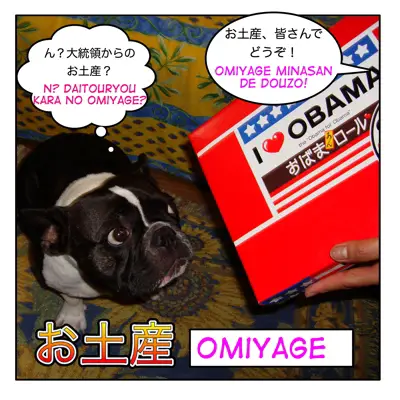
「お土産,皆さんでどうぞ!」
= おみやげ、みなさんでどうぞ!
= Omiyage、 minasan de douzo!
=Here’s a souvenir (gift) for everyone!
ん?大統領からのお土産?
= ん?だいとうりょうからのおみやげ?
=Nn? Daitouryou kara no omiyage?
=“What? Is it a gift from the President?”
皆さん、今日は! ( = みなさん、こんにちは! = Minasan konnichiwa!) Hello, everyone!
Today we will focus on 「お土産」 ( = おみやげ = Omiyage)!!!
「土産」( = みやげ = miyage) ( more polite 「お土産」= おみやげ = omiyage)
 Adding お ( = o) to the beginning of certain words makes them more polite)
Let’ see the 漢字( = かんじ = kanji) first!
土 ど/つち = do/tsuchi : dirt, earth, local
産 (さん/うまれる) san/umareru to bear, produce, production, things that come from a certain land.
→産物 ( = さんぶつ = sanbutsu) production, 産業 ( = さんぎょう = sangyou) industry, 生産 ( =せいさん= seisan) production, お産 ( = おさん = osan) delivery, to bear (a baby)
土産:This could be read as “どさん= do san” but we usually read it as “みやげ= miyage” for a gift . It is 当て字 ( = あてじ ~ateji), a substitute character.
An “omiyage” is a gift or a souvenir for your friends, family, or co-workers that you get when you travel somewhere.
Every tourist spot has its typical local souvenirs. Japan is full of souvenir shops. They’re even places that you might not even consider “tourist spots.” And it is customary to get a little something to bring back home to friends and family when you travel anywhere — be it for business or pleasure.
⭐️<Related words>
• 観光地 ( = かんこうち = kankouchi) a tourist site
•土産物屋(店)( = みやげものや(てん) = miyage mono ya (or ten)) souvenir shops, gift shops
• 観光地には多くの土産物屋があります。
= かんこうちにはおおくのみやげものやがあります。
= Kankouchi niwa ooku no miyagemonoya ga arimasu.
=There are a lot of souvenir (gift) shops in tourist sites.
• 名物 ( = めいぶつ = meibutsu) or 名産物 ( = めいさんぶつ = meisanbutsu) a (local) specialty, something typical or well-known or popular in a particular place.
Ex. 名物料理
= めいぶつりょうり
= meibutsu ryouri
= local dishes
Ex. その土地の名産物
= そのとちのめいさんぶつ
= Sono tochi no meisanbutsu
= the specialty of the place, the local specialty
Ex. 大阪の名物はたこ焼きです。
= おおさかのめいぶつはたこやきです。
= Oosaka no meibutsu wa takoyaki desu.
= “Takoyaki” (octopus dumplings) is a famous Osaka specialty.
Note : Sometimes 名物 ( = meibutsu) can be used for a person.
マギーはドギーアカデミーの名物先生だ。
= マギーはドギーアカデミーのめいぶつせんせいだ。
=Maggie wa Doggie Academy no meibutsu sensei da.
=Maggie is a very popular(or well-known) teacher at Doggie Academy.
• 記念 ( = きねん = kinen) a souvenir, memory
Ex. 旅の記念に〜を買う。
= たびのきねんに〜をかう
= tabi no kinen ni ~ wo kau.
= to buy something as a souvenir to remember a trip.
= 旅の思い出に〜を買う
= たびのおもいでに〜をかう
= tabi no omoide ni ~ wo kau.
= To buy something to remember one’s trip by.
Also 土産 ( = みやげ = miyage) could be simply a gift you take when you visit someone’s house or even for your family.
• 手土産にケーキを持って行く。
= Temiyage ni keiki wo motte iku.
= to take cakes as a present.
手土産 ( = てみやげ = temiyage)a gift which you carry yourself with your hands=手 (=te).
• お土産(手土産)を買って家に帰る。
= おみやげ(てみやげ)をかっていえにかえる。
= Omiyage (temiyage) wo katte ie ni kaeru.
= to get some presents (←usually food) for one’s family and go home.
•土産話 ( = みやげばなし = miyage banashi) stories about one’s travels, report of your trip
「京都に旅行に行くんだけどお土産何がいい?」
= きょうとにりょこうにいくんだけどおみやげなにがいい?
= Kyouto ni ryokou ni ikun da keredo, omiyage nani ga ii?
= I am going to Kyoto. What kind of souvenir would you like from there?
「お土産は何もいらないから、土産話を聞かせて!」
= おみやげはなにもいらないから、みやげばなしをきかせて。
= Omiyage wa nani mo iranai kara miyage banashi wo kikasete.
= Don’t bother buying anything for me but just let me hear your travel stories.
In the picture above, a person is handing Maggie a gift and saying,
「皆さんでどうぞ!」
= みなさんでどうぞ!
= minasan de douzo
means “This is for everyone!”←(Please share these with everybody!)
or 皆さんで召し上がって下さい。
= みなさんでめしあがってください。
= Minasan de meshiagatte kudasai.
= Please eat this/these with everyone.
Sometimes you just say
「これ皆さんで!」
= これみなさんで!
= Kore minasan de!
= This is for everyone!
It is a common phrase when you hand over sweets or food.
If we invite someone to our house or party, we often say to the guests in advance,
• 「手ぶらでどうぞ!」
= てぶらでどうぞ!
= Tebura de douzo!
= “Please don’t bring any gifts.”
手ぶら ( = てぶら = tebura) means literally not to have anything in your hands, empty-handed.
• 「どうぞ、手ぶらでいらして下さい。」more polite
= どうぞ、てぶらでいらしてください。
= Douzo tebura de irashite kudasai.
= “Please do not worry about coming empty-handed. (Just come!)”
• 「手ぶらでは、いけないよねえ。」
= てぶらでは、いけないよねえ。
=Tebura de wa ikenai yonee.)
= We should take something.
←(“We can’t visit empty-handed.”)
Note: There is an advertisement for 宅急便 ( = takkyuubin) delivery service
「手ぶらでスキーへお出かけ下さい!」
= Tebura de sukii e odekake kudasai!
=Please go skiing empty-handed (without taking all the ski gears!)“ or
「手ぶらで空港へ!」
= てぶらでくうこうへ!
= tebura de kuukou e!
= ”Go to the airport empty-handed (We will deliver your suitcase to the airport!)
How to thank people when you receive a present:
I assume you already know,
有り難う ( = ありがとう = arigatou) “Thank you!” or 有り難うございます。 ( = ありがとうございます= Arigatou gozaimasu.) “Thank you so much” (more polite than arigatou).
• 「お気遣い頂いて すみません。(有り難うございます。)」
= おきづかいいただいてすみません。(ありがとうございます。)
= Okizukai itadaite sumimasen (or arigatou gozaimasu.)
=Thank you so much for your consideration! ”
• 「どうぞお気遣いなく。」
= どうぞおきづかいなく。
= Douzo okizukai naku.
= “Please don’t worry about me.”
• 「御馳走様です。」
= ごちそうさまです。
= Gochisou sama desu.
= ”Thank you! (for this food or these sweets — said before actually eating) ” (When you receive something to eat.)
• 「それでは遠慮なく頂きます。(頂戴します。)」
= それではえんりょなくいただきます。(ちょうだいします。)
= Soredewa enryo naku itadakimasu. (or choudai shimasu.)
= ”I will take your gift without hesitation”
→” I will take it with appreciation.”
• 「これは*珍しいものを有り難うございます。」
= これはめずらしいものをありがとうございます。
= Kore wa mezurashii mono wo arigatou gozaimasu.)
= Thank you so much for this rare thing. ←(implies the gift is something hard to get.)
*高価なもの ( = こうかなもの = Kouka na mono) pricey (expensive) things
If you have received something from the person before (or repeatedly) you say,
• 「いつもすみません。(有り難うございます。)」
= いつもすみません。(ありがとうございます。)
= Itsumo sumimasen. (Arigatou gozaimasu.)
• 「いつも頂いてばかりですみません。」
= いつもいただいてばかりですみません。
=Itsumo itadaite iru bakari de sumimasen.
= I feel bad because I keep receiving gifts from you.
Casual
• 「これ、大好物です。有り難う!」more casual
= これ、だいこうぶつです。ありがとう!
=Kore daikoubutsu desu. Arigatou!
= “This is my favorite. Thank you!”
Also if someone gives you something in return for your gift or something you did for that person, you say,
• 「何か却って申し訳ありません。」
= なにかかえってもうしわけありません。
= Nanka kaette moushiwake arimasen.
= “Sorry that I (we) ended up making you worry about causing more trouble (bringing us something) by inviting you.”
Note: The gift or some action in return of your previous gift is called お返し( = okaeshi)
Ex.「これは先日頂いたお土産のちょっとしたお返しです。」
= これはせんじついただいたおみやげのちょっとしたおかえしです。
= Kore wa senjitu itadaita omiyage no chotto shita okaeshi desu.
= This is a little reciprocal gift for the gift you gave me the other day.
Ex.(Receiving a gift) 「ありがとう。今度何かお返し買ってくるね。」(casual)
= ありがとう。こんどなにかおかえしかってくるね。
= Arigatou. Kondo nanika okaeshi katte kurune.
= “Thank you. I will buy something in return.”
Cultural Note: Are we supposed to open a gift right away in front of a person who gave it to you or not?
I wrote about Japanese formal gift wrapping for special occasions in my shopping lesson.
There are certain types of gifts that are formal and seasonal.
*お中元 ( = おちゅうげん = ochuugen) summer gift
*お歳暮 ( = おせいぼ = oseibo) end of year gift
*新築祝い ( = しんちくいわい = shinchiku iwai ) house-warming, etc.
Besides casual birthday presents or personal presents between friends, it is considered to be rude to open some formal gifts in front of the person who just gave them to you.
Take special care not to open specially wrapped money such as お祝い ( = おいわい = oiwai) best wish for happy occasions、お見舞い ( = おみまい = omimai) get-well、ご仏前 ( = ごぶつぜん = gobutsuzen) for Buddhism funeral etc. Japanese are often astonished whenever they see a Christmas scene in western movies, when kids or adults rip the paper and open nicely wrapped presents. We usually open the paper very carefully and fold it nicely. (I think it is not just for courtesy but also we can keep the nice wrapping paper for the next gift!?)
It could be fun to buy omiyage because there are a variety of things everywhere in Japan and in the world but sometimes we feel obliged to buy omiyage for our friends or co-workers.
We say to friends or family before your trip,
「お土産何か買ってくるね。」
= おみやげなにかかってくるね。
= Omiyage nanka katte kuru ne.
= ”I will buy something for you there!”
We jokingly say to our friends or family who are going to travel somewhere,
「お土産楽しみにしてるよ。」
= おみやげたのしみにしているよ。
= Omiyage tanoshimi ni shite iruyo.
= “I am (We are) looking forward to your present/souvenir .”
「お土産買って来てね。」
= おみやげかってきてね。
= Omiyage katte kite ne.
= “Please buy me/us something (from where you are going.)”
Whenever we travel, we feel pressured and some always think “What to get, how many should I get for the whole trip and it is a nightmare…..
To help those who suffer from finding “omiyage”, there is a service called 「海外お土産サービス」( = かいがいおみやげサービス = kaigai omiyage saabisu.)
You can order your gifts before you go abroad and have the souvenirs delivered directly to your house. Japanese tourist places are very commercialized. They are always good at finding some original gift of the place.
Maggie sensei has just got a box of Japanese sweets but please take a good look at the box.
It says 「おばまロール」” Obama roll”. There is a little town called 小浜 =おばま = Obama in Fukui.
Coincidentally it has the same name as President Obama. Since the Presidential election, this town has been rooting for Mr.Obama to be President. They even organized 「オバマを勝手に応援する会」( = オバマをかってにおうえんするかい = Obama wo katte ni ouen suru kai.) a non-official organization to support Obama.
*勝手に( = かってに = Katteni): without asking, without permission, on its own
*応援する ( = おうえんする = ouen suru): to root, to back-up, to support
*会( = かい = kai): association, organization, society
They sell lots of gifts, sweets, T-shirts, and many other kinds of merchandise, all of them using Obama’s name and his comic figure.
Everywhere you go there are ご当地もの( = ごとうちもの = gotouchi mono) typical local things that you can get only in that area.
 マギー先生より ( = Maggie-sensei yori) From Maggie-sensei
みんなは日本に来た時に何かお土産を買いますか? ( = Minna wa nihon ni kita toki ni nanika omiyage wo kaimasu ka?)
What are you going to get as a gift when you come to Japan?
もう日本に来たことがある人は何を買いましたか? ( = Mou nihon ni kita koto ga aru hito wa nani wo kaimashitaka?)
For one who has been to Japan, what did you buy
誰か、ご当地マギーのお土産作ってくれないかなあ.. ( = Dare ka gotuchi Maggie no omiyage tsukutte kurenai kanaa..)
I wonder if anybody would make a local-Maggie gift..)
***
Will you be my Patron?
I appreciate your support! サポートありがとう!
16 Comments
I think お土産 is not considered as Ateji. It is Jukujikun I think. “Jukujikun are when the standard kanji for a word are related to the meaning, but not the sound”. But Ateji “principally refer to kanji used phonetically to represent native or borrowed words without regard to the underlying meaning of the characters”.
@Aidin
Wow! You are very good! I checked it and there seems to have two theories. (土産 could be 当て字 or 熟字訓)
Also there a fine line between 当て字 and 熟字訓. We mix them up sometime or some consider 熟字訓 a part of 当て字.
According to the etymology dictionary, 土産 was originally from all different words. I can’t copy and paste here so please go check the site.
Anyway thank you for your comment.
I am sorry but I can’t go too deep in this lesson. :)
ありがと五歳マスタ!!!!! これ大好物!!!!!茂市と ありがと誤差います!!!!!!!
@errolronal
五歳マスタ??? Ah you are writing that way on purpose? Then I won’t correct you. :)
どういたしまして!
Maggiesensei, I have doubts with these sentences:
1) みんなは日本に来た時に何かお土産を買いますか?
“What are you going to get as a gift when you come to Japan?”
The “kita toki ni” seems to be in the past, but then I know that in Japanese the “a” form of verbs is used at times without the “past” connotation like for example: “yameta hou ga ii”. Is it a rule to use the “a” form of the verb when talking about something that will be done in the future?
What about when people use the dictionary form with “toki”? I recall that pattern being used, like “kuru toki ni”.
2) 何か却って申し訳ありません。
“Sorry that I (we) ended up making you worry about causing more trouble (bringing us something) by inviting you.”
In this lesson Maggiesensei you provided a lot of examples of how to answer to favors or some situations. :) I wanted to know if it is ok for men to use this expressions. I bet men use them for people they don’t have much confidence with and with superiors but what about people of lower age and friends? Is it ok to use it for all situations?
「どうぞ、手ぶらでいらして下さい。」
“Please do not worry about coming empty-handed. (Just come!)”
I can’t find the definition of the word “irashite”. :/
Sorry for the lengthy post. :/ Thank you Maggiesensei as always. :)
@NecroMadMat
こんにちは!
なるほど!!I am always impressed with your questions.
1) You are right. The past tense of 来る is 来た, so it looks strange, huh?
When you are simply talking about the future, you can use 来る
Ex1) 日本に来る時は言ってね。
= Let me know when you come to Japan.
As you said we can use 来た時 for the real past action.
Ex. 2) 去年、日本に来た時はとても寒かった。
= It was really cold when I visited (came to )Japan last year.
We also use 来た時 for future when you assume some action is completed = will have come
So the translation of
Ex.3) 日本に来たら言ってね。
could be the same as E1) but actually it means “Let me know when you will have arrived in Japan./will have come to Japan.”
And Ex.3 has slightly more possibility of coming to Japan.
So you can use ~た時 when you did something or when will have done something.
2) 却って申し訳ありません。
Is totally OK for men to use.
If you are talking to your friends, you can say
却って気を遣わせちゃって….
却ってごめん。
却って悪かったね/な。
(な suffix is for men.)
3) いらしてください is a contraction form of いらっしゃってください
an honorific form of 来てください
Hope I answered all your questions. !happyface!
Thank you Maggiesensei. XD It is all clearer now. It is just a matter of practice, practice, practice, to get it down. :) Thank you Maggiesensei for your precious time, as always. ;)
@NecroMadMat
You’re welcome! That’s right! Practice! Practice!! And you can always practice making sentences with me here or on Twitter. !happyface!
相変わらず、素晴らしいレッソンです。
聞きたいことがあるんですが、大好物というものは食べ物だけでしょうか。たとえば、お土産はシーディーなら、「これは大好き/とても気に入る」とかと応答しますか。
ちなみに、「一番」じゃなくて「one of my favourite…」は何といいますか。
例:
This is one of my favourite presents
This is one of my favourite journeys of the last 20 years.
根掘り葉掘り訪ねて申し訳ありません (当然辞書で調べた表現。おかしかもしれません。)
追伸:私も包装紙を大切にします(笑)。
追伸2:ご当地キットカットもありますよね。東北で枝豆キットカットを買いました。
@Cygnus
大好物は普通は食べ物や飲み物だけです。そうですね、もしCDだったら「(歌手の名前)大好き!/この曲大好き!」って言いますね。
one of my favorite はお気に入りの一つ、(とても)気に入ったものの一つ、大好きなものの一つ、気に入ったものの一つ, etc.
This is one of my favorite presents :これは私がとても気に入ったプレゼントの一つです。
This is one of my favorite journeys of the last 20 years = in this case it will be a bit odd to translate “favorite” for the trip. We would say 楽しい or よかった, 心に残った = memorable, etc.
ここ20年でとても楽しかった旅の一つです。etc.
★根掘り葉掘り is usually negative and it is used when you pry into the affairs of others. Just say いろいろ
★ご当地キットカットいろいろありますよ!!
★Cyguns : Are you following me on Twitter? If so, you can ask me question on Twitter anytime.
I check Twitter more often.
I don’t use Twitter, I spend too much time already with my blog and Facebook. Plus, by asking questions related to a lesson, they remain in that particular entry. Is it okay for you to answer questions here? You can take your time :-).
@Cygnus
OK, no problem.
For the same reason, I don’t do Facebook at the moment.
You can keep asking me questions here.
大坂の名物はたこ焼きで、去年の夏休みに大坂で沢山たこ焼きを食べました。
初めてたこ焼きを食べて美味しすぎて、食べて終わったらもう8個を買いました!!
大坂で毎日たこ焼きを食べました!!☆*:.。. o(≧▽≦)o .。.:*☆
There might be some mistakes here and there. ごめんなさい。でも分かりますか。
How to say 1 box in japanese? 日本語で「1box」は何ですか。
@アリナ
もちろん、上手な日本語だから全部わかりましたよ。大阪のタコ焼きは特に美味しいですよね。
1 box = 一箱 = hitoohako
Maggie sensei ^__^ Hello ! Thank you for this lesson. I’ve always found interesting the omiyage system. I remember a comic where someone offers a bottle of wine to a co-worker as an omiyage, then the man forget the bottle in the subway, someone find it and offer it to another person as an omiyage, this person offers it to another person, etc… And at the end the bottle of wine is offered to a last person, who is the man that originally forgot it in the subway XD
I don’t remember exactly but isn’t there a way to say “this is a just a little thing, please accept it” or something like that ?
The story about the Obama city is funny ^^ Were the Obama rolls good ?
Have a nice day, mata ne !
Salut! Latitia-san!
The comic story is funny! It was a story of “re-gifters”, huh?
That’ right. When we give a gift, we have to give it in a humble way like
これはつまらないものですが、どうぞ!(=Kore wa tsumaranai mono desuga, douzo!) This is a boring stuff but please take it.
大したものではありませんが、どうぞ!(=Taishita mono dewa arimasen ga douzo!) It’s not anything fancy but…
ちょっとしたものですが、どうぞ!(=Chotto shita mono desuga, douzo!) This is a little something but..
ささやかですが、どうぞ!(=Sasayaka desu ga douzo!) This is a small something but..
Even between friends we say,
つまらないものだけど、大したものじゃないけど、ちょっとしたものだけど、ささやかだけど、〜
おばまロールはとっても 美味しかったです!Yum!!
また来てね!