
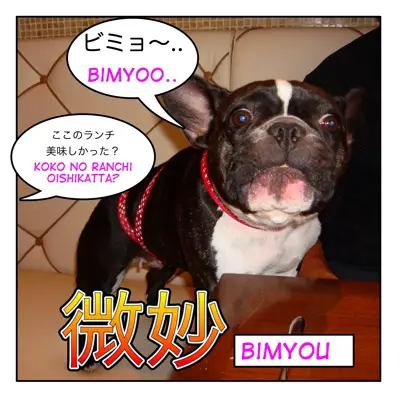
「ここのランチ美味しかった?」
=Koko no ranchi oishikatta?
= “How was the lunch at this place?”
「ビミョ〜..」
=Bimyoo..
= “Not really…”
Today’s word is 微妙 ( = bimyou)
Let’s see the 漢字 ( = Kanji) first.
微 :bi, mi/kasuka, wazuka = a bit, slightly,
妙 : myou/tae = strange
If you look it up in a dictionary, it means subtle, fine, sensitive, delicate, complicated or tender
Here are some examples:
* 両国の間の微妙な問題
= Ryoukoku no aida no bimyou na mondai
= a matter of great delicacy between two countries
* 微妙な違い
= bimyou na chigai
= subtle difference
* 彼らは微妙な関係だ。
= Karera wa bimyou na kankei da.
= They have a delicate relationship.
So these are some standard uses of the word.
But younger people have started to use it when they want to make their statements less offensive or direct.
「〜についてどう思う?」( =~ ni tsuite dou omou?)
「微妙」( = Bimyou) Sometimes we write in Katakana. ビミョー!( = Bimyou) for a slang.
Meaning, “Not so good”, “Not really”, “It is hard to say but negative.”
It is a very fuzzy way to say “No!”
Look at the picture above. Maggie doesn’t like the lunch. (You can tell by her expression!)
So when someone asks her if she liked the lunch, she says 「ビミョ〜(or 微妙)…」( = bimyou).
She didn’t like the lunch. It could be really bad or somewhere between 「まずい」( = mazui) “bad taste” and 「普通」( = futsuu) “normal”.
You can also describe the taste as 微妙な味 ( = Bimyou na aji), indescribable taste
Let’s look at some more examples,
Your girlfriend asks you how you like her new dress and it looks awful! You don’t want to offend her so instead of telling her the truth you can say,
「これ、新しい服なんだけど、どう思う?」
= Kore, atarashii fuku nanda kedo dou omou?
= “How do you like my new dress?”
「微妙…」
= bimyou
= “It’s OK but…(there is something wrong…)”
It implies you don’t like it so much — but you never actually say anything negative.
Of course, she won’t be happy with your answer, but it’s better than having said it clearly. Remember this next time your girlfriend asks you if she looks fat in something.
When someone asks you if you are free tomorrow and you don’t want to go or you may be busy,
「明日、空いてる?」
= Ashita aiteru?
= “Are you free tomorrow?”
you can say:
「ちょっと微妙です。」
= Chotto bimyou desu.
= “Not sure..(Yes and No.) “
It is a very convenient word when you don’t want to give them a direct answer.
If you say:
「行けません。」
= Ikemasen.
= “I can’t go!”
or
「行きたくありません。」
= Ikitaku arimasen.
= ”I don’t want to go!”
You might hurt your friend’s feeling or cause some problems.
But if you say, 「微妙…」( = bimyou) , you can avoid the awkwardness.
Also, when you are not sure of certain thing you can use 微妙 ( = bimyou)
For example, a customer asks you:
「明日までにその仕事出来上がりますか?」
= Ashita made ni sono shigoto dekiagari masu ka?
= “Can you finish the work by tomorrow?”
「う〜ん、ちょっと微妙ですねえ。」
= Uun, chotto bimyou desu nee.
= “Well, it is hard to say…”
It implies it is difficult to finish it by tomorrow, but you don’t want to tell your customer you can’t make it or it is difficult to do so.
 マギー先生より =Maggie sensei yori From Maggie-sensei
このレッスン、役に立った? = Kono ressun yaku ni tatta? “Was this lesson useful?”
誰?「ビミョ〜!」って言ったのは!!
=Dare? “Bimyo~”tte itta nowa!!
= “Who dares say “Bimyooo!”!!!”
***
Will you be my Patron?
I appreciate your support! サポートありがとう!
16 Comments
My email address was wrong in that one. Sorry!
Hello! I’m living in Japan and seeing someone. When I asked about our relationship status they said 微妙な関係だ. In English they said “it’s a gray relationship.” I’m not sure how I feel about the translation or meaning of this phrase. The Japanese person holds my hand and kisses me in public. They tell me all the time “好き、めっちゃ好き、大好き”. I don’t what the feeling behind 微妙 is. Is it bad in this situation? Could I look at this as just dating? Not ready for a relationship? Is this like セフレ? I just don’t fully understand and we have a bit of a language barrier.
@Amanda
Hi Amanda,
Who said 微妙な関係だ? The guys you have been dating?
If you ask them “私達の関係ってどんな関係?” = What is our relationship? and they answer that, they don’t want to make any commitments so your relationship doesn’t sound exclusive.
I am sure they do have feelings for you. But a man who says 好き、めっちゃ好き、大好き and describes the relationship, 微妙…It is dubious.
If you are looking for the real relationship, you should tell them. 真剣なお付き合いがしたい。
Oh okay that’s really interesting. Arigatou Sensei! ^_~
@Reibun (Raven)
Douitashimashite! !happyface! !CHECKHEART!
So basically, bimyou means “meh”? :)
@Dina
Haha, yes. But it’s a little more subtle. :)
そうっすね!Great lesson! I was familiar with 微妙 but this made it clearer for me! Thank you very much 先生!
めっちゃマット♪
Happy to hear that!!
Salut!
Thank you for the answer, it’s very clear ! :)
Oh this was interesting :o
Is it the same to answer “chotto…” or to answer “bimyou….” ? Like, for exemple :
– Ashita aiteru ?
– Anoo… ashita ha chotto… / – Anoo… bimyou desu…
Is it the same ?
Thank you, Maggie sensei !
Mata ne :D
Laetitia-san,
Hello! It is always nice to hear from you!
– Ashita aiteru ?
– 1) Anoo… ashita ha chotto…
– 2) Anoo… bimyou desu…
They are both very similar and subtle ways to decline but there is a slight difference.
If I ask you out and you say
1) -> I think you have declined for sure. And I wouldn’t ask you why because obviously you don’t want to give me a specific reason.
2) -> I would also take it as “No!” but it gives me an impression that you might be able make it and you are not sure about that yet.
But you are right. If I ask my friends out and they say 1) or 2) , I wouldn’t push you anymore.
You can also use “chotto” and “bimyou” together.
– Ashita aiteru ?
– Chotto bimyou (desu.)
Hope my answer is not so bimyou….
ゆかりさんは偉い先生ですねぇ。
loafyi-san
いえいえ…マギー先生にこき使われていますから…(=Maggie-sensei ni koki tsukawarete imasukara… ) =”It’s just because Maggie-sensei makes me work hard..”
また遊びに来て下さいね。
Great lesson!
I saw this on Gimmeaflakeman and followed the link here.
Thank you for your hard work.
markshmily-san,
Thank you for your comment! Arigatou!!