
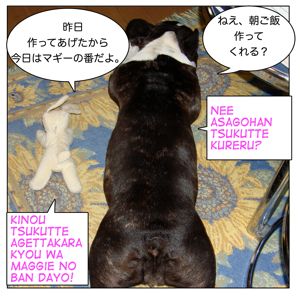
🐶「ねえ、朝ご飯作ってくれる?」
= Nee asagohan tsukutte kureru?
= “Hey, can you make me breakfast?”
「昨日作ってあげたから今日はマギーの番だよ!」
= Kinou tsukutte ageta kara kyou wa Maggie no ban dayo!)
=“I made it for you yesterday, so it’s your turn today!”
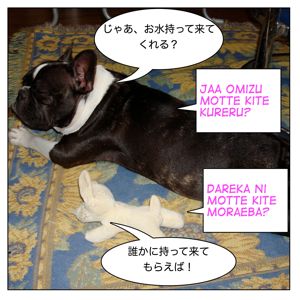
🐶「じゃあお水持って来てくれる?」
= Jaa omizu motte kite kureru?
= “Then can you bring me water?”
「誰かに持ってきてもらえば!」
= Dare ka ni motte kite moraeba!
= “Have someone bring it to you!”
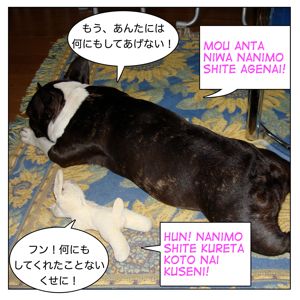
🐶 「もうあんたには何もしてあげない!」
= Mou anta niwa nanimo (or nannimo) shite agenai!
= “I won’t do anything for you anymore!”
「フン!何もしてくれたことないくせに!」
= Hun! Nanimo (or Nannimo) shite kureta koto nai kuse ni!
=“Ha! You have never done anything for me anyway!”
Today we will learn :
1) ~(し)てくれる ( = ~(shi)te kureru)
2) ~(し)てあげる ( = ~(shi)te ageru)
3) ~(し)てもらう ( = ~(shi)te morau)
We use them when someone does a favor for us or when you do something for someone.
First, let’s check the basic patterns :
•くれる(=kureru)
 negative form くれない ( = kurenai)
past tense くれた ( = kureta)
past negative くれなかった ( = kurenakatta)
*formal form 下さる ( = kudasaru)
•あげる(=ageru)
negative form あげない ( = agenai)
past tense あげた ( = ageta)
past negative あげなかった ( = agenakatta)
*formal form 差し上げる ( = sashiageru)
•もらう( = morau)
negative form もらわない ( = morawanai)
past tense もらった ( = moratta)
past negative もらわなかった ( = morawanakatta)
*formal form 頂く ( = itadaku)
*Remarks:
1) We won’t focus on the formal forms in this lesson.
2) くれる ( = kureru), あげる ( = ageru), もらう ( = morau) are used between friends and family. So be careful who you use them with.
1) When you give or receive some objects :
• (〜を)くれる
= (objects~wo) kureru
= Someone gives you something (from the receiver’s point of view)
• (〜を)あげる
= (objects~wo) ageru
= to give someone something (from the speaker’s point of view)
• ( 〜を) もらう
= (objects~wo) morau
= to receive something from someone (from the receiver’s point of view)
⭐️Basic sentence structures :
• A (subject) が ( = ga)/は ( = wa) + B に ( = ni) + (objects) を ( = wo) +くれる ( = kureru) give
• A (subject) が ( = ga) /は ( = wa)+ B に ( = ni) + (objects) を ( = wo) + あげる ( = ageru) give
• A (subject) が ( = ga) /は ( = wa) + B から ( = kara) + (objects) を ( = wo) + もらう ( = morau) receive
→ The order can be switched
A が ( = ga)/は ( = wa) + objects を+ B に ( = ni) +くれる ( = kureru)、あげる ( = ageru) 、もらう ( = morau)/ B から ( = kara) +もらう ( = morau))
•くれる ( = kureru)
Ex. 1) マギーが(私に)お菓子をくれた。
= Maggie ga (watashini) okashi wo kureta.
= Maggie gave me sweets.
*Note: Usually the receiver should be “私 ( = watashi), me“, not the third person.
X 山田さんが加藤さんにお菓子をくれた。→wrong!
= Yamada san ga katou san ni okashi wo kureta.
but if the receiver is close to you such as your family, sweethearts or pets, you can say :
山田さんが息子にお菓子をくれた。
= Yamada san ga musuko ni okashi wo kureta.
= Yamada-san gave my son sweets.
•そのお菓子を息子にくれますか?
= Sono okashi wo musuko ni kuremasu ka?
= Can you give the sweets to my son?
You can also say
そのお菓子を息子にもらえますか?
= Sono okashi (wo)musuko ni moraemasu ka?
** We usually say 頂けますか ( = itadakemasuka) polite form
•マギー、そのお菓子(は)、誰がくれたの?
= Maggie, sono okashi (wa) dare gakureta no?
= Maggie, who gave you the sweets?
You can also say
誰からそのお菓子(を)もらったの?
= Darekara sono okashi (wo)morattano?
= Who did you get that from?
Also 私 ( = watashi), “I”, can’t be a subject.
X 私がマギーにお菓子をくれた。
= Watashi ga maggie ni okashi wo kureta.
wrong!
You should use あげた ( = ageta) instead of くれた ( = kureta)
•あげる ( = ageru)
Ex. 2) 私は、マギーにお菓子をあげた。
= Watashi wa Maggie ni okashi wo ageta.
= I gave Maggie sweets.
*Note : The receiver can’t be “私 ( = watashi), me“
↓
X あなたが私にお菓子をあげた。→wrong
= Anata ga watashi ni okashi wo ageta.
You should use くれた ( = kureta) instead of あげた ( = ageta)
X マギー、私にお菓子をあげますか?→wrong
= Maggie, watasni ni okashi wo agemasu ka?
You should use くれますか ( = kuremasu ka) instead of あげますか ( = agemasuka)
The third person can be the subject and object.
山田さんが加藤さんにお菓子をあげた。
= Yamada san ga katou san ni okashi wo ageta.
= Yamada-san gave Kato-san sweets.
•もらう ( = morau)
Ex. 3) 私はマギーにお菓子をもらった。
= Watashi wa Maggie ni okashi wo moratta.
= I received sweets from Maggie.
Ex. 4)「この花は誰からもらったの?」
= Kono hana wa dare kara moratta no?
= “Who did you receive these flowers from?”
( = “Who gave you these flowers?” )
「彼からもらいました。」
= Kare kara moraimashita.
=” I got (received) them from my boyfriend.”
Ex. 5)「申し込み用紙が欲しい人は事務所でもらって下さい。」
= Moushikomi youshi ga hoshii hito wa jimusho de moratte kudasai.?
= A person who wants the application form, please receive it at the office.
→”If you want the application form, please get it at the office.”
2) Now let’s learn the statements involving receiving or giving actions.
•~ (し)てくれる ( = ~(shi)te kureru)
someone does a favor for you (the receiver’s point of view)
• ~(し)てあげる ( = ~(shi)te ageru)
to do something (nice) for someone else, to do someone a favor (the speaker’s point of view)
• ~(し)てもらう ( = ~(shi)te morau)
to have someone to do a favor for you.
For example, if Mr.Suzuki treated you to dinner or something you may just want to say :
• 鈴木さんが私をおごった。(not natural)
= Suzuki san ga watashi wo ogotta.
Mr. Suzuki treated me.
• 私は鈴木さんにおごられた。(not natural)
= Watashi wa Suzuki san ni ogorareta.
= I was treated by Mr.Suzuki
But these phrases are very “flat” and not natural. We don’t use or hear these in daily life.
Instead, we say :
鈴木さんがおごってくれた。
= Suzuki san ga ogotte kureta.
= Mr.Suzuki treated me.
(or 御馳走してくれた。
= gochisou shite kureta.
Note : 御馳走する ( = gochisou suru) is more polite than おごる ( = ogoru)
(私は)鈴木さんにおごってもらった。
= ( Watashi wa) Suzuki san ni ogotte moratta.) (from my, the receiver’s, point of view)
= I was treated by Mr.Suzuki ( = Mr.Suzuki treated me.)
(Or 御馳走してもらった。
= gochisou shite moratta.
It adds certain feelings to the statement such as “I am very fortunate” “Mr.Suzuki is nice and generous.”
Also Mr.Suzuki will say
マギーにおごってあげた。
= Maggie ni ogotte ageta.
= I treated Maggie!
(from Suzuki-san’s point of view. He thinks he did something nice for Maggie.)
⭐️ ~ (し)てくれる
= ~ (shi)te kureru
= someone does a favor for you,
You can use it when you ask someone a favor.
• ここに名前を書いてくれる?
= Koko ni namae wo kaite kureru?
= “Can you write your name here?”
• 料理(を)つくってくれる?
= Ryouri (o) tsukutte kureru?
= Can you cook (for me)?
• 明日来てくれますか?
= Ashita(or asu) kite kuremasu ka?
→adding ます ( = masu) makes it more polite.
“Can you come tomorrow (for me)?”
• 朝6時に起こしてくれる?
= Asa rokuji ni okoshite kureru?
= Can you wake me up tomorrow morning?
• 母がお弁当を作ってくれた。
= Haha ga obentou wo tsukutte kureta.
= “My mother made lunch for me.”
•マギー先生が日本語を教えてくれました。
= Maggie sensei ga nihongo wo oshiete kuremashita.
= “Miss Maggie taught me Japanese.”
→adding まし( = mashi)makes it more polite.
🔸 ~(し) てあげる ( = ~(shi) teageru) to do something for someone, to do someone a favor
• ここに名前を書いてあげる
= Koko ni namae wo kaite ageru.
= “I will write my name here (for you)!”
• 料理を作ってあげます
= Ryouri wo tsukutte age masu
→ adding ます( = masu) makes it more polite.
“I will cook for you!”
•明日、来てあげる
= Ashita kite ageru
= “I will come here tomorrow.” (for you!)
•朝6時に起こしてあげる
= Asa rokuji ni okoshite ageru.
= “I will (do you a favor and) wake you up tomorrow.
•息子にお弁当を作ってあげる
= Musuko ni obentou wo tsukutte ageru.
= I will (do him a favor and) make lunch for my son. (for his favor)
• 日本語を教えてあげる
= Nihongo wo oshiete ageru.
= I will (do you a favor) and teach you Japanese.
Note: Again we use あげる ( = ageru) and してあげる( = (shi)te ageru)often between friends but avoid using them towards higher-ranking people or superiors.
We use it with equal-level or lower-ranking people. So if you misuse it with superiors, they might think you are looking down on them.
🔸 ~ (し )て) もらう( = 〜(shi)te morau) to have someone to do a favor for you.
• ここに名前を書いてもらう
= Koko ni namae wo kaite morau.
= to have someone write their name (for me).
• 料理を作ってもらう
= Ryouri wo tsukutte morau.
= to have someone cook for me
• 明日、来てもらう
= Ashita (asu) kite morau.
= to have someone come here tomorrow
• 朝6時に起こしてもらう
= Asa rokuji ni okoshite morau.
= to have someone to wake me up at 6:00 in the morning
• 母にお弁当を作ってもらう
= Haha ni obentou wo tsukutte morau.
= to have one’s mother make lunch for me.
• マギー先生に日本語を教えてもらう
= Maggie sensei ni nihongo wo oshiete morau.
= to have Miss Maggie to teach Japanese for me
🔸Now it is time to practice!!
Try to make sentences using the following verbs and make あげる ( = ageru), くれる ( = kureru),もらう ( = morau) sentences.
1) 洗濯 ( = sentaku) to do laundry
2)買い物に行く ( = kaimono ni iku) to go shopping
3)もらう ( = morau) to receive ** might be confusing but please try!
4) 掃除をする ( = souji wo suru.) to clean
⬇️
Answer examples :
1) 洗濯をしてあげる。( = sentaku wo shite ageru) to do the laundry for you
Ex. 明日、洗濯をしてあげようか?
= Ashita sentaku wo shite ageyou ka?
= Do you want me to do the laundry for you tomorrow?
*洗濯をしてくれる。( = sentaku wo shite kureru?) Someone does the laundry for me
Ex. 洗濯をしてくれるの?
= Sentaku wo shite kureru no?
= Will you do the laundry for me?
* 洗濯をしてもらう。( = Sentaku wo shite morau) to have someone do the laundry for me
Ex.いつも母に洗濯をしてもらっている。
= Itsumo haha ni sentaku wo shite moratte iru.
= I always have my mom do the laundry.
2) * 買い物に行ってあげる。
= kaimono ni itte ageru
= to go shopping for you
Ex. 街に行くから買い物に行ってあげるよ。
= Machi ni iku kara kaimono ni itte ageruyo
= I will go to town so I will do the shopping for you.
* 買い物に行ってくれる。
= Kaimono ni itte kureru
= Someone goes shopping for me
Ex. ついでに買い物に行ってくれる?
= Tsuide ni kaimono ni itte kureru?
= “Can you go shopping while you are out?”
* 買い物に行ってもらう。
= kaimono ni itte morau
= to have someone go shopping for me
Ex. 田中さんにお中元の買い物をしてもらう。
= Tanaka san ni ochuugen no kaimono wo shite morau.
= I have Tanaka-san go shopping for me. (Tanaka san goes shopping for me.)
3)*もらってあげる
= moratte ageru
Ex. これ、誰もいらないの?ならもらってあげるよ。
= Kore are mo iranaino? Nara moratte ageruyo.
= “Nobody wants this? Then I will take it (for you)!”
*もらってくれる
= moratte kureru
Ex. この服、大きいから誰かもらってくれる?
= Kono fuku ookii kara dare ka moratte kureru?
= “These clothes are too big for me. (So) Does anybody want to do me a favor and take this (for me)?”
It may sound redundant but you can say
→*もらってもらう
= moratte morau
Ex. 誰もいらないのなら彼にもらってもらいます。
= Dare mo iranai no nara kare ni moratte moraimasu.
= If nobody wants this, I will have him take it.
4)*掃除をしてあげる ( = souji wo shite ageru) to clean up for you
Ex. あなた(→person’s name) の部屋、汚いから掃除をしてあげようか?
= Anata no heya kitanai kara souji wo shite ageyou ka?
= “Your room is getting messier. Do you want me to clean it up for you?
* 掃除をしてくれる
= souji wo shite kureru
= Someone cleans up for me
Ex. 掃除をしてくれる人がいていいね。
= Souji wo shite kureru hito ga ite iine.
= “You are lucky to have someone who cleans up for you.”
*掃除をしてもらう ( = souji wo shite morau) to have someone clean up
Ex. 部屋が汚くなってきたから彼に掃除をしてもらおう。
= Hewa ga kitanaku natte kitakara kare ni souji wo shite moraou.
= Since the room is getting, let’s get him to clean it up.
From the pictures above :
「昨日作ってあげたから今日はマギーの番だよ!」
= Kinou tsukutte ageta kara kyou wa Maggie no ban dayo!
= “I made it for you yesterday, so it’s your turn today!”
•番 ( = ban) turn
Ex.今度、私の番?
= Kondo watashi no ban?
= Is this my turn?
「フン!何もしてくれたことないくせに!」
= Hun! Nan nimo (or Nanimo) shite kureta koto nai kuse ni!
= “Ha! You have never done anything for me anyway!”
•~くせに ( = kuseni) even if, but, when you emphasize or accuse someone’s fault
Ex. 彼は何もできないくせに文句ばかり言う。
= Kare wa nani mo deikinai kuse ni monku bakari iu
= He can’t do anything, but he always complains.
If you want to learn more about くせに ( = kuseni) go check this lesson.
 マギー先生より ( = Maggie sensei yori)
ホワイトデーに何かくれた人にはいい成績をあげます。
= Howaito dei ni nanika kureta hito niwa ii seiseki wo agemasu.)
えっ?バレンタインに何ももらっていないって?
= Eh? Barentain ni nani mo moratte inai tte?
= I will give you a good score if you give me something for “White Day”!
What? You didn’t get anything from me for Valentine’s Day?
!to right! Esta leccion está traducida en español.
Our friend, Orti, volunteered to translate this lesson in Spanish. Go check the translation. Click here.
Muchas gracias, Orti! ❤️
***
My Patreon ありがとうx10 supporters
Audio File for this lesson
Link: Click here
I appreciate your support! サポートありがとう!
239 Comments
Hi Maggie sensei,
I have 2 question about this lesson
in this lesson, sensei wrote that
X 山田さんが加藤さんにお菓子をくれた。→wrong!
we are all agree that くれる is use for “family group or very close friends”
but today, my Japanese co-worker asked me that
このかばん、誰が買ってくれた?
I just don’t understand that why he used “くれた” instead of “あげた”、he’s not in my “family group”, and he also don’t really know that the one bought me a bag is one of my family or not?
I got confused about this example too:
“= Can you give the sweets to my son?
You can also say
そのお菓子を息子にもらえますか?”
isn’t it should be translate to “can I received the sweets from my son”?
because in ~もらう grammar, the one go with に・から is the one we received things from?
Hello ルアン
山田さんが加藤さんにお菓子をくれた
In this case, if the two parties, 山田さん and 加藤さん are not related to the speaker, it sounds unnatural.
You say 誰が買ってくれた? (Who bought the bag for you?) or 誰に買ってもらったの? (Who did you get the bag from?) to someone who is close to you based on the idea or assumption that someone else bought the bag for you. (In this case, the giver could be your family , customers, friends, etc.)
This phrase only works with someone close to you, equal to you or superior (who has been working more than you have or for the same period of time.)
Thank you so much maggie sensei
Can you explain this for me too?
“= Can you give the sweets to my son?
You can also say
そのお菓子を息子にもらえますか?”
isn’t it should be translate to “can I received the sweets from my son”?
because in ~もらう grammar, the one go with に・から is the one we received things from?
It’s written in this lesson too
If the sentence is
そのお菓子は (or を) 息子にもらった
Then, it could be I received this snack for my son (from someone) or I received the snack from my son.
However, そのお菓子を息子にもらえますか? is a request.
If you are asking your son to give you the snack, you wouldn’t say 息子に
You are obviously asking the listener so it won’t be translated can I received the sweets from my son”?
thank you so much Maggie sensei
Anytime, ルアン :)
Hello Maggie. i don’t understand the meaning of 相手してあげません in the following sentence: 認めないと今後も相手してあげませんよぉ‼. Can you explain to me?
Hello again Mutuio3
相手をする means “to associate with someone/ to deal with someone/ to keep someone’s company/to play with someone”
So it depends on the context but it means
If you don’t accept it, I won’t hang out with you anymore, OK?
so the general meaning of 相手をする would be hang out and depending on the context you use the words you put as a translation, right?
the context of the phrase would be a boy challenges a girl to a competition, she accepted and arrogantly said that she would easily defeat him. after losing to him, he asks her to admit defeat and apologizes and if she doesn’t, he won’t partner up with her anymore.
That’s right.
And in that context you gave me, your translation is right.
先生、こんにちは。
問題があります。先生が教えていただけませんか。
~にもらう・~からもらう
私の例文です。
①私は田中さんに本をもらいました。
②私は田中さんから本をもらいました。
③私は会社の人にかばんをもらいました。
④私は会社に人からかばんをもらいました。
もし”に”を”から”に換えたら、例文の意味が変わりますか。
場合によって、”~にもらう”と”~からもらう”の使い方が違いますか。
先生 お願いいたします。どうもありがとうございます。
先生、すみません。
インターネットで調べてみましたが。
このように説明します。
個人(Aさんなど)「に」「から」もらいます。借ります。
組織(公的機関、学校、銀行など)「から」もらいます。借ります。
調べたことは正しいですか。先生が教えていただけませんか。
個人同士なら「に」でも「から」でも両方使います。
Aさんから本をもらいました。
Aさんに本をもらいました。
組織からもらったり借りた場合は「から」を使います。
図書館に借りた x 不自然
図書館から借りた
「から」を使うときは「に」よりも出所(origin) を強調します。
こんにちは、Ha Thao
① = ②
③ = ④
意味は同じになります。
先生 こんにちは。
はい、わかりました。
返事してくれて、どうもありがとうございました。
どういたしまして❤️
Hi Maggie,
How are you? Everything going well for you I hope!
I came across a phrase today that I’d never seen involving もらう:
この幸せなもらわれっ子のお犬様め。
It’s being said by a cat who is having a fight with a dog.
I get the feeling he’s being rude (because he’s quite a rude cat and he’s talking about a dog).
The もらわれっ子 bit – is this a derogatory phrase? Kind of like an unwanted adopted child?
Thanks for your help as always!
Peter.
Hi Peter,
Haha I thought you are talking about me. U^ェ^U
Right もらわれっ子 means a adopted kid (the formal word is 養子(ようし) an adopted child/person)
And you are right. Though it sounds a little cute, it could be used as a derogatory term.
Hi Maggie-sensei🌻
I have a weird question and it’s a bit off-topic. I hope you don’t mind!
Let’s say that we’re close friends. We were having a talk but you were a bit too fast for me to catch what you were saying. I would want to say something like 「ごめん、聞こえなかったよ。もう一度言ってくれる?」, right?
But if I had only said 「ごめん、聞こえなかったよ」 would you still understand what I mean?😅
Hi Vivi,
Yes!
You can just say ごめん、聞こえなかった。/ごめん、今、何て言った? / えっ? 何?
Hi Maggie-sensei!
I have an example that actually confuses me.
‘Even if you look at me like that, I won’t give you anything’
Sonna me de mitemo, nani mo kurete yaranai no yo
Shouldn’t it be ‘ageru’ instead of kureru in this case? Since it’s someone saying ‘I’ won’t give you anything?
Hello Wendy
kureteyaru is a very rough way to say “to give” (= ageru). You use that when you are looking down on someone.
It means the same as “Sonna me de mitemo nani mo agenai yo.”
So it’s just a condescending/rude way of saying ‘agenai yo’? And it’s not about a perspective change?
So it’s just a condescending/rude way of saying ‘agenai yo’?→Right. I am not going to give you ~
こんばんは先生!!先生、「~てほし」と「~てもらいたい」と「~ていただきたい」、の違うを教えていただけませんか
〜てほしい You simply express your desire for someone to do something
〜てもらいたい It involves stronger feelings of desire for someone to do something for you.
〜ていただきたい The idea is the same as もらいたい but it sounds more polite.
がんばってほしい I want them (you) to try harder.
がんばってもらいたい = I want them (you) to try harder for me.
(more polite) がんばっていただきたい= I would like them (you) to try harder for me.
はい先生わかりました。教えてくださってありがとうございます先生
どういたしまして💕
Hello Maggie Sensei!
I have a question regarding てくださる and ていただく. If I want to thank my teacher for telling me about a book, which would be the correct way of saying it-
この本について教えてくださってありがとうございました。Or
この本について教えていただいてありがとうございました。
Since the teacher’s action is the focus here, I thought てくださって would be correct. But I am not sure.
Can you please help me?
Thanks!
Hello Ruchika
Yes, you are right.
It should be この本について教えてくださってありがとうございました。
いただく focuses on you who receive someone’s favor.
くださる focuses on someone who does/did something for you.
(You may also want to check my How to ask for a favor lesson.)
Thankyou! I will go through the section you mentioned.
You’re welcome! :)
Hi Maggie-sensei!
I’ve been a bit puzzled about the different uses of ‘morau’. I understand the one you explained in this lesson but I’ve heard it being used in other ways.
For example in this sentence what is the actual purpose or meaning?
今週限りで会社を辞めてもらいたい。
konshuu kagiri de kaisha o yamete moraitai.
In this case it doesn’t really mean receiving something from someone. And how do I know if ‘kureru’ is not a better use for this example instead of moraitai?
Hi Wendy
Ah OK.
As you said, もらう・もらった is used when you receive something or someone does/did something for you or when you ask for a favor.
I covered the second usage in my “How to make a request” lesson. Click this link
If you still have a doubt after the lesson, let me know.
Hello Maggie-sensei,
I’ve read the page on the ‘How to make a request’ lesson and I think I’m understanding it better now.
I was watching anime and I came across an example which I was wondering about?
It went like this:
S: ‘Mom why did you give me so many green peas?’
M: ‘It’s not good to be picky about your food’
Suki kirai te youku nai to omotte
M: ‘I thought this might be a good chance to get you over that’
Kono kikai ni kokufuku shite moraitaina~tte
In this case, is it because the mother is requesting her son to not be picky about food? Or wishes he would not be picky about food? Because technically the translation ‘might be a good chance to help you get over that’ isn’t really a reques/wish to my understanding?
Hi Wendy
First the mother’s quote is unfinished. You sometimes leave the sentence unfinished on purpose to make it sound vague or soft to avoid confrontation
この機会に克服してもらいたいなって(思ったからグリーンピースをいれたの (=omotta kara guriin piisu wo ireta no))
So in this case, is it not a direct request but expressing her “wish” that she wanted her son to like green pees.
I still don’t understand 100% but I think I’m getting the general idea of it!
Also I didn’t know that was an indicator of an unfinished sentence, I learned something again. Thank you Maggie-sensei!
Hi Maggie,
Hope you are well :)
I’m looking into giving and receiving today, and I just want to check I’ve got this sentence correct:
A:「あの、そのチュニック…」
B:「これかい?トレガーの旦那から買ったのさ。
身幅が足りなかったんで、裾を切って胸のとこを幅出しさせて貰ったよ」
A: Erm, that tunic…
B: This? I bought it from Treger’s master. The body width wasn’t sufficient, so he cut the hem and widened the chest area for me.
I still get a bit stuck sometimes on who does what, but the て貰った says to me that the action of widening the chest was done for B (not by B), presumably by the person she bought it from (so, トレガーの旦那).
Is that about right…?
Many Thanks,
Peter.
HI, Peter,
元気?
This させてもらった doesn’t specify who fixed the tunic but B took the liberty of doing or having someone do so.
“I took the liberty of cutting (or having someone cutting the hem) and widening the chest area (after B bought it from トレガー”
Hi Maggie,
I’m well thanks :)
Right, so might the following translation be more accurate?
“The body width wasn’t sufficient, so I had the hem cut and the chest area widened.” (by some unspecified individual, which may even have been herself)
Many thanks again!
Peter.
Yes, your translation is right. 😊
Maggie sensei,
マギー先生が日本語を教えてくれました。
For this sentence, if I want to use keigo for showing my respect to Maggie sensei, how do I say?
and for
マギー先生が外国の学生に日本語を教えてあげました。
If i want to use keigo also, how do I say?
マギー先生が日本語を教えてくれました。
The honorific form is
マギー先生が日本語を教えてくださった。
Maggie Sensei taught me Japanese.
(From your point of view.)
マギー先生が外国の学生に日本語を教えてあげました。
あげました can be used for the third person but the you can’t use keigo there.
If the speaker/writer teaches someone superior something, you can use kenjougo, さしあげる
Thanks Maggie sensei.
Now I know that the honorific expression of tekureru is tekudasaru.
The humble form of teageru is sashiageru.
How about temorau sensei?
For ex:
私はマギー先生に日本語を教えてもらう。
How to use the humble here ?
マギー先生が日本語を教えてくださって、言葉にできないほど感謝いたします!
(What my heart wants to say but …is there something wrong in the sentence ….)
I just posted 謙譲語/敬語 lessons so hopefully you can learn something from those lessons as well.
教えてもらう。→honorific form 教えていただく
If you are talking to a teacher directly,
〜先生、日本語を教えてくださり言葉にできないほど感謝しております。
(connecting masu-stem looks more formal than connecting with te-form.)
Or when you express your gratitude,
〜先生に日本語を教えていただき、言葉にできないほど感謝しております。
Thank you for the nice example sentence. I feel flattered.
Thank you Maggie sensei !!!!
I will read your 謙譲語/敬語 lessons :)
どういたしまして! U^ェ^U
Dear Maggie 先生 ❤
Please help me for my below question
Regarding how to say to give / receive objects “を + あげる / くれる / もらう”、FOR THIRD PARTY: A (giver) and B (receiver)
1, あげる
as in your note : ok to say A gives B sth
2, くれる
as in your note : ok to say A gives B sth (B must be my family, sweethearts or pets)
3, もらう
You don’t make note but through ex5, I understand that it’s ok to say B receives sth from A, regardless B has close relation with me or not, for example : Suzuki san receives a lot of flowers from Ken san
Do I understand it right? 😊
(Here is your ex5
「申し込み用紙が欲しい人は事務所でもらって下さい。」)
どうもありがとうございます 🌷🌷🌷
Hi Sarang,
Yes, you got them right. :)
Maggie sensei,
Thanks for making this lesson. It’s so great.
This is the topic which is not easily to digest ….
I have a question.
After reading and think, my understanding is
Vてあげる、Vてくれる、Vてもらう are giving and receiving centering on “私”.
Those grammar can be giving, can be receiving but they are centering on “watashi” like” do favor to “watashi”, “watashi” have SO do some favor, “watashi” received favor someone did.
If I want to say
(1) Mr A did some favor to Ms . B, can I use てあげる。
Mr A はMrBに掃除してあげる
(2) Mr B received a favor (掃除) from Mr B. can I use てもらう
Mr B は MrAに掃除してもらった。
(3) Mr B have Mr A do favor (掃除) for him
Mr B は MrA に掃除してもらう。
Thank you Maggie sensei
All your example sentences (1) ~ (3) are possible
くれる/あげる/もらう is based on the speaker’s point of view.
You can also describe the third person does something for the other third person from their point of view.
Maggie sensei,
I have a question. Could you please help me?
(1)コラを頼めば
Is that mean ” Why don’t we order coca cola”?
(2) 好きなものを飲んでもらえば
My infer is
飲んでもらう=have (them) drink what they like
好きなものを飲んでもらえば=why don’t we have them drink what they like
First, my question is “is my understanding of the above correct?”
(3) But this sentence I don”t know the meaning, could you help me?
明日店に来てもらえるんだよね!『店長が店員に話しています)
(1) コーラを頼めば?
Why don’t you (or we) order Coke?
(2) Your interpretation is right.
(3) You are coming to the store (restaurant, coffee shop) (to work for me), right?
It implies “I can count on you tomorrow, right?”
Maggie sensei,
Thank you so much much much!
Love you 心
You are very very welcome!
Love you,too!
こんいちは Maggie 先生😀
I have 3 questions for below situation:
Last week my friend went to Japan for business.
He knows that I like Japanese lipstick so he bought a lipstick for me (I didn’t ask him to buy, he vouluntarily bought it for me)
1, I want to tell my mom that :
I was bought a Japanese lipstick by my friend
—–> Can I say this?
(1) 私は友達に日本のリップスティック”が”買われてもらいました
*😜 I want to stress on “I was bought” to imply that something like I am a special friend with him so he is interested in me then bought it for me 😊 rather than saying
(2) 友達が私に日本のリップスティックを買えってくれました ーーー> I feel (2) stresses on “my friend did” rather than “I am a special friend with him”
If my 日本語の sentence is wrong, please kindly teach me how to say it correctly
2, This sentence makes me confused that how can listener know well that
I asked him to buy
or he vouluntarily bought it for me?
(3) 私は友達に日本のリップスティックを買えってもらいました
3, In all (1)(2)(3), I finish by ました to show my respect attitude to my mom, not to my friend. Did I do it correctly?
♥️♥️♥️🌷🌷🌷 どうもありがとうございます
こんにちは、 Sarang
1.
(1) 私は友達に日本のリップスティック”が”買われてもらいました
→私は友達に日本のリップスティック”を”買ってもらいました。
(2) 友達が私に日本のリップスティックを買えってくれました
→友達が私に日本のリップスティックを買ってくれました
But to be more precise, he bought a lipstick in Japan and brought it back so you can also say
友達が日本で口紅を買って来てくれました。
(3) 私は友達に日本のリップスティックを買えってもらいました
→私は友達に日本のリップスティックを買ってもらいました
Again, if you say 日本のリップスティック, it could be just a lipstick which is made in Japan. You can buy them anywhere in the world.
But if you say 私は友達に日本でリップスティックを買ってきてもらいました。, it implies he bought a lipstick in Japan and brought it back to you.
Dear Maggie 先生
THANK YOU SO MUCH FOR YOUR HELP!!
(🤤Please help me delete my comment under your reply on Aug 29, 2018 at 12:55AM. I was mis-press reply button)
I just want to confirm to be sure that I could understand your meant correctly
1, I should say that
友達が日本で口紅を買って来てくれました。
To stress that I don’t ask him but because I’m a special friend with him, he voluntarily bought then brought lipstick from Japan for me.
Besides that, I still wait for your help for question 2&3 😁
🔴Q2, If I say this sentence with another friend (A san) who doesn’t know him:
私は友達に日本でリップスティックを買ってきてもらいました。
—>
how can A san differentiate 2 below cases
(A) ➡️I knew he would go to Japan in advance so I asked him to help me buy a lipstick in Japan first, ▶️ he agreed then ▶️ I sent money to him ▶️ he helped me bought it
In this case, I wasn’t presented a gift
(B) ➡️ I hadn’t known that he went to Japan until he gave me a lipstick and told me about buying it in Japan
In this case, I was presented a gift
🔴Q3, In all sentence, I finish by ました to show my respect attitude to my mom, not to my friend. Did I do it correctly?
*私は友達に日本でリップスティックを買ってきてもらいました。
*友達が日本で口紅を買って来てくれました。
⭕But if the person who bought lipstick for me is my boss 🤣 and I told it to my younger brother, can I say
私は課長に日本でリップスティックを買ってきていただいたよ。
(I use いただくto show my respect to my boss and
Use short form in past tense of いただく+ よ ➡️ to show that I don’t need to use 敬語 / 尊敬語 with my younger brother)
Is that OK? 😀
I’m sorry for my long questions👧
1. Yes, your interpretation is correct.
Q2.私は友達に日本でリップスティックを買ってきてもらいました。
This sentence sounds like you asked him to buy a lipstick from Japan for you.
In case of (B) You can say 友達が日本からリップスティックを買ってきてくれました。
But this could be either you asked him to buy you a lipstick beforehand and he bought it for you
or he bought you a lipstick voluntarily
You can also say 友達が日本で買ったリップスティックをくれました。He gave me a lipstick which he bought in Japan. (This won’t imply that you asked him.)
Q3: You usually use casual form when you talk to your own mother but it is possible to use ました form.
私は課長に日本でリップスティックを買ってきていただいたよ。
That’s fine. But again, when you are talking to your younger brother, you can stick to the casual form, too.
課長に日本で口紅を買ってもらっちゃった。
Dear Maggie 先生、
I can completely understand your explanation now 😀
Thank you so much for your help!!
I wish you good health and happy time
Thanks to my younger brother, I have been known your website
I always feel your great enthusiasm and your kind heart in each lesson
頑張り続けてください💪💪
We love you always 💖❤🌷🌹🌸
Hi Sarang
I’m happy to hear you understood. Please say hello to your younger brother!
Big hug for both of you💕
こにちは、マギー先生!
I hope you can help me with this one, I read a sentence a fellow student made and wondered if I could phrase it better. Her sentence went like this:
友達のためにケーキを作っています。明日会います。(a picture of a cake baking in the oven was included)
My attempt was this:
明日友達に会うので、ケーキを作ってあげています。
Now here’s where I’m uncertain, is it even possible to use あげて+います like that? Should it have been 作っていてあげます instead? Or are they both wrong and the あげて does not belong there at all?
教えてください。m(__)m
こんにちは、Altuser! 元気でしたか?
Great! Your sentence is much more natural.
明日友達に会うので、ケーキを作ってあげています。
作ってあげています is OK.
作っていてあげます X wrong
You can also say 作ってあげているところです (Check my ところ lesson.)
You can omit あげて part. You are going to see the friend so that is why you are making a cake.
明日、友達に会うので今、ケーキを作って(焼いて)います・ ケーキを作って(焼いて)いるところです。
ええ、元気です!
教えてありがとうございます。
The ところ lesson was very useful too. 勉強になりました!
よかった〜♪
Hi Maggie, I’m confused on how to make a sentence using ageru. The sentence is something like, “Thank you for everyone’s help in giving Tom a birthday poster.” Or “Thank you to everyone who helped to give Tom a birthday poster.”
Even though I (the speaker) am not close with “everyone” or “Tom” since it’s more as a charitable group effort, so I am really confused on how to word such a long sentence too. I tried using your sentences as reference and I tried to make my own:
“皆さんが、トムにお誕生日ポスターを手伝ってあげたの、本当にありがとう!”
Was this a correct way to do it? Thank you for your help! Your website has helped me so much!
Hi Rachel
Good question.
The basic pattern of あげる・くれる・もらう are as follows.
* Aさん+から/に +(〜を)+ ( Vて ) +もらう (polite いただく)You or your close family receives something from A-san.
* Aさん+に+(〜を)+ ( Vて ) +あげる (polite さしあげる)You do/give something for A-san.
* Aさんが+(〜を)+ ( Vて ) +くれる (polite くださる)A-san does something for you./A-san gives something to you (your familly)
All of these form have to have “you / the writer / the speaker ” as a receiver or giver
(When you use ていた, etc to describer the situaion. you can talk about other people.
Ex. BさんはAさんからVてもらっていた。)
So you can not use the pattern with “everyone” and “Tom” unless Tom is your family or someone really close to you.
I would say
みなさま、Aさんにポスターを贈(おく)るのにご協力(きょうりょく)いただき*ありがとうございます。(formal)
協力する = きょうりょくする= cooperate / help
Thank you so much for your help and your fast reply!!! I understand the context better but i’m still a little confused on why there is an * next to いただき*
Also if I wanted to make the sentence you provided into a more friendly way (since we’re all around the same age), could I say (?):
みなさん、Aさんにポスターを贈るのに協力もらう、ありがとう!
Sorry for so many questions. I want to make sure I fully understand 😊
Actually, I just realized that since I’m not familiar with Tom, would it be incorrect/wrong to make the sentence more informal?
OK, if you want to use “casual” form then you can say
みなさん(or even more casual みんな) Aさんにポスターを贈るのに協力してくれてありがとう!
Hello Maggie Sensei. i want to ask something.
when i attend some of short course, the man who explain everthing said this.
~説明していただきます
i don’t really understand, does that sentence mean he explain things to himself ?
Thank you.
OK, when did he say that?
You say
説明させていただきます。
before you explain something or give a speech.
When you ask someone to explain,
説明していただきます。
Thankyou for the answer maggie sensei.
Maybe i was wrong when hearing things. those two sentence above is very similar and maybe the speaker is too fast so i hear different things.
so, 説明していただきます literally can be translated to i receive that you let me explain things ? is it correct ?
Thank you.
OK
説明していただきます is a polite way to say 説明してください。
The literal meaning is “I will have you explain to me.”
And 説明させていただきます means “allow me to explain it” just like 一言言わせていただきます = allow me to say one thing / let me say one thing.
ヨロシク
Thank you for helping, 天人! ☺️
Thankyou very much for the explanation maggie sensei and 天人!
😊💕
Maggie sensei ga nihongo o oshiete kuremashita.
Maggie sensei ni nihongo o oshiete morau.
Why is one marked ga and ni can you explain?
Maggie sensei ga nihongo o oshiete kuremashita.
Maggie is the subject so you need a subject marker, “ga”
Maggie sensei ni nihongo o oshiete morau.
The subject is a speaker not Maggie.
the particle “ni” has many meanings. One of them is “to” and it also means “from”
this “ni” means “from”.
Tasukete kurete arigatou gozaimasu!”ga”to “wa* no tsukai kata wa yoku wakarimasen.subject an topic seem the same to me lol in this case there is a difference though.
The difference between “ga” and “wa” is very complicated but if you are just talking about what Maggie does
Maggie sensei wa nihongo wo oshiete imasu. = Maggie teaches Japanese.
If you emphasizes who teaches Japanese, use “ga”
Maggie sensei ga nihongo wo oshiete kuremashita.
So basically “ga” stress what comes before.
I see thanks!
You’re welcome! :)
I would like to know if there is any difference in nunace between てくれる and てもらうsince most answers about it are ambiguous and contradict each other or some don’t mantion any difference between them so it would be importat to clarify any difference that may exist between the two.
Some say てもらう implies you asked a person to do something for you. How true is that? Could you explain, please?
Thanks.
OK, let’s compare the following two sentences.
1) 友達が教科書を貸してくれた。
2) 友達に教科書を貸してもらった。
The nuance difference.
1) implies “My friend is so nice and she lent me her textbook for me.” / My friend lent me a book and helped me. (She is really nice/I appreciate it.)
Focusing on “my friend” who lent me a book.
2) implies “I was so lucky. I got my friend lend me her textbook.”
Focusing on “I (myself)”
Q: てもらう implies you asked a person to do something for you. How true is that?
It will be easier to understand with more context.
教科書を忘れたが、友達が貸してくれた。
I forgot my textbook but my friend lent me hers.
教科書を忘れたので、友達に貸してもらった。
Since I forgot my textbook, I had my friend lend me hers ( = I asked my friend to lend me hers.)
Hi Maggie,
You write as an example above:
この花は誰からもらったの?」
= Kono hana wa dare kara moratta no?
However, as hana is the object of the give/take transacion, shouldn’t I say
” Kono hana wo dare kara moratta no?
Thanks!
Hi Karl
Good question.
You can also say,
誰からこの花をもらったの?
You use は when you talk about something and は has a function as a topic indicator.
You bring up a topic with は to show “I am talking about these flowers.”
So it won’t sound natural in English but it means
→ As for these flowers, who did you receive (them) from?”
The answers can be either
Karlからこの花をもらいました。
I got these flowers from Karl.
or
この花は、Karlからもらいました。
As for these flowers, I got (them) from Karl.
So you make it clear what you are talking about by using は in Japanese.
There’s a question like this:
「マイクさんはアミさんにチョコレートを………..」
Amongst the options, あげました and いただきました confused me. Because i think both can be the answers.
マイクさんはアミさんにチョコレートをあげました
Mike san GAVE chocolate to ami san
マイクさんはアミさんにチョコレートをいただきました
Mike san RECEIVED chocolate from ami san
But i was wrong, the answer was あげました only.
How come?
Can’t “もらう / いただく” be used for ‘third person’ from ‘third person?
I thought “もらう / いただく”is a neutral one, any subjects can use it
Thank you in advance 🙏
The key is マイクさん.
If the subject is 私 (or someone close to you like your family)
私/私の息子は、アミさんにチョコレートをいただきました。works.
If so, how to say “receive” for third person to third person that’s not close to me?
You can say
AはBに〜をもらう
AはBに〜をあげる
but it will be unnatural to use honorific/humble expression for the third person unless they are your family or someone you emphasize with.
So i don’t have to use honorific expression to someone older than me yet not personally close?
For example, let’s say i have a neighbor, named A, who is 50 years older than me. I’m not personally close to A yet i know A and respect A.
One day i saw A gave chocolate to B. (Let’s sayB is also my neighbor, 40 years older than me, not personally close as well yet i respect)
If i want to say B received chocolate from A, i don’t have to use honorific expression (itadaita)?
Just say moratta / moraimashita is enough?
Because i thought honorifics is used for someone older or someone you respect for… No matter how close or not you are to that person….
Sorry for asking always 😁
Thank you thank you in advance…..🙏
If you respect A and B and want to express that feeling, you can say for example,
AさんはBさんにチョコレートを渡されていた。
BさんはAさんからチョコレートを受け取られていた。
Maggie sensei, please HELP ME!
I have some questions about てもらう and てくれる.
例えば。
お姉さんに駅まで送ってくれる. This means “My syster will take me at station ?
お姉さんにプールに行くように誘ってくれる. This means “I was invited by my sister to go to the pool?
This pharses below means the same ? Please help me understand this form !!!
お姉さんに駅まで送ってもらう
お姉さんにプールに行くように誘ってもらう
@Caio
Your sentence: お姉さんに駅まで送ってくれる.・お姉さんにプールに行くように誘ってくれる.
You don’t use someone+に+Vくれる
You have to use (The subject は) + someone+に + Vてもらう or Soomeoneが+Vてくれる
→(私は)お姉さんに駅まで送ってもらう I got my sister take me to the station.
You can also say お姉さんが(私を)駅まで送ってくれる。 My sister will take me to the station for me.
I was invited / asked by my sister to go to the swimming pool?
(私は)お姉さんにプールに誘ってもらった。
お姉さんが(私を)プールに誘ってくれた。
My sister invited/asked me to go to the swimming pool.(And I am happy about that.)
Hello Maggie sensei!!
I tried finding out what this means without success —>友達は見える人いるから
I was wondering if it means “Because I have a friend who can see it” ?
but if that were the case, it should have been ” 見える人友達がいるから”
so thats why Its a pretty confussing sentence for me .Can you help me out?
Thank you in advance !!
@MAK
Hi, MAK
It must be a part of some casual conversation.
Since I don’t know the context, I can’t tell what the friend can see but, translation-wise, yes, your are right and
you can rephrase 見える友達がいるから or 友達に、見える人いるから。
i think that understood, so in this case: maggie先生が(は)私を日本語教えてくれた
is it right? Means Maggie sensei taught me japanese ?
いつもありがとうございます!
@Caio
→Maggie先生が(は)私に日本語を教えてくれた
or Maggie先生に日本語を教えてもらった。
Hello Maggie!
久しぶりでんな!元気だったかのう?
I’m playing the Japanese version of Final Fantasy III on my PSP.
In the early part of the game (right now I’m before the final boss fight) the 光の戦士たち were captured by the bahamur dragon at Dragon’s Peak and sent back into his nest. They found there a guy called デッシュ, which apparently was the one who they were searching for.
Now it comes my 気になる part. The moment デッシュ saw them, he started the conversation with: 「ハハハ!すべて見物させてもらったよ。おまえたちもドジだねえ~!ドラゴンにさらわれてザマないな!」.
I want just to make sure that I understand 「見物させてもらったよ」 correctly. Two translation-possibilities, where only one is correct.
1. Ironically speaking, the party received a favour from the Dragon of sightseeing his nest; デッシュ describes the situation from the party’s perspective, that’s why he uses ~てもらう.
– However this point does not explain, why !~させて!もらう was used here…
2. デッシュ allowed himself to watch (to observe) the whole spectacle, where the dragon captured the party, etc.
– This explains, why ~させてもらう was used.
In your opinion, Maggie, which point is correct, No. 1 or No. 2?
My bonus question is regarding ドラゴンにさらわれてザマないな!
I’d translated it as: What a pity you let yourself get caught by that dragon!” or “You let yourself get caught by that dragon! Shame on you!” or “Ow boy, that’s really bad, you let yourself get caught by that dragon!”
Which translation of ザマないな would fit here the most?
よろしくお願いします!
PS Now I found out the best way to learn Japanese; since I noticed I understand over 90% from the dialogues, I became suddenly able to play J-RPG games. 素晴らしいことじゃないか!さあ、次はファイナルファンタジー IXだわい!よーし!
@天人
ほんまやな〜久しぶりやなあ。(笑)
全て見物させてもらったよ
I saw everything.
As you said 1) 見物 in that sentence doesn’t mean “sightseeing” . When you witness or see/watch the fight and as “an entertainment” , you also use 見物
You can not exactly translate the nuance in English but 見物させてもらったよ just means “I saw / I have seen”. You use passive causative form when you look down on someone to show you are superior to others.
Ex. 全部聞かせてもらったよ。
= I have heard everything. / I heard everything.
If you need to translate “させてもらう” part in English somehow, it could be
I took the liberty of watching the whole thing.
but he uses his politeness as sarcasm.
bonus question:
I would say the first one
You can also translate “How pathetic” instead of “pity”
楽しそうね、ファイナルファンタジー!やってみようかな。
Thank you very much Maggie for your help!
Thanks to you, I learned something new today.
Yesterday I completed FF III! But I’m gonna spend a few days to make my save file a perfect one.
FF IX is awaiting…!*ワクワク*
Take care and see you soon!
@天人
Haha, you’re very welcome! Enjoy FF IX!!! (^_-)
Maggie sensei, I have a question about a sentence from your answer.
The sentence
全部聞かせてもらったよ. ( I have heard everything/ I heard everything)
Does it literally mean “ (Someone lets me heard everything) because it is a causative verb?
Hi Khan
聞かせる A lets B hear everything.
聞かせてもらう B got hear everything thanks to A.
But this is an expression you use when B heard something without A’s intention.
B takes liberty of hearing the story from A.
I see.
So does the sentence in this situation have the same usage, Maggie sensei.
A crimnial kidnaps a friend of a police that he hates. Then he tortures him. Before the police friend have any serious injuries. The police arrives. It was very lucky for him to be able to find the criminal hideout. He then handcuff the crimmial easily without using too much streghth. The crimminal surrenders and tell him to throw him back in jail. The police then stare at the criminal and say
” I was thinking about it, but before that…”
“君が言ってたことをそのまま俺もやらせてもらうよ”
After he says this sentence, he starts to punch the criminal face over and over.
Does this sentence means “I will do what you have said, too”?
The police takes the liberty of doing what the criminal have said.
Yes. I will take the liberty of doing what you have said, too.
When we talk about whether the listner`s urge to do a verb towards us (speakers),shall we use ってあげる?
お前は「他人を手伝ってあげるのは無意味で無駄ぞ」を考えるらしいのさ。
You likely think its useless and pointless to help others.
あ、そう。手伝ってあげたいと言う気持ちは全く無いよね。
分かった。好きにしなさい。
I got it. You’ve got no urge to help me at all. Fine, do as you want.
http://www.guidetojapanese.org/learn/book/export/html/239
I’d like to know when to use this “verb+teagetai” to indicate the listner’s urges toward us.
Does it need to have a “toiukimochi\toiukanji” after “verb+teagetai”?
@david
Hello david,
First do you know how/when to use たい? (If not check this lesson. たい&がる )
Vたい= would like to V
It expresses one’s desire.
Now Someoneに ( somethingを) Vて+あげ+ たい
expresses one’s desires (urge) to do something for someone.
手伝いたい = I want to help someone
手伝ってあげたい= I want to help someone for that person. (for that person sake)
The difference is while 手伝いたい is just expressing one’s desire, 手伝ってあげたい is used when you believe your action will help someone.
“verb+teagetai” to indicate the listener’s urges toward us.
In the second example sentence, the speaker is talking to someone else. So, the speaker thinks, the listener has no urge/desire to help the speaker.
Hi there!
Regarding the question: “Does it need to have a “toiukimochi\toiukanji” after “verb+teagetai”?” The answer is yes. In this case the という part has the function of describing what (kind of) feeling does the speaker mean, namely the feeling (or desire) to help someone (手伝ってあげたい).
The pattern ~てあげたい (like Maggie mentioned) is used here because the person, who the speaker is talking to, is:
1) the source of the action
2) the action is toward others (me or other people are the receivers of that action).
Just think like I’d talking to you and come to the conclusion, that you have got no urge to help other people (or particularly me) at all. You are the source of the action, and the action is toward others, therefore you have to use ~てあげたい and because I’m describing, what kind of action I mean, I use という気持ち.
Hope this helps a little.
ヨロシク
To be absolutely clear ” therefore you have to use ” => “therefore I have to use”. I, because I am sending the communicate (my opinion) to you.
It’s a bit confusing, but no panic. After 5 years of regular contact with 日本語you gonna get used to it!
@天人
Thank you for helping David!
@David
Sorry. I forgot to answer your question but 天人 helped you. That’s very nice of him!
Let me add one thing:
If you don’t use 気持ち in that sentence, you could also say
手伝ってあげたいとは全く思わないんだね。
御馳走してしてもらったと書いてました。
(してして)が書き間違えでしょう。
@アンディー
ありがとう! 直しました。 :)
By the way,you said that usingにもらう|にくれる on queries sound like the speaker is asking the listener to give something to the person on the setence.
金もらう|くれる? Will you give me money?
So,if I say 彼に金もらう|くれる?Can you give him money? (instead of
彼に金あげる?)
will it mean “can you give him money” as a favor to the speaker or to the one who’ll get the money?
Just a doubt on もらってもらう:
誰もいらないのなら彼にもらってもらいます。
If no one else wants this,I’ll have him take it.
Is that guy supposed to take it for him or for the speaker? Seems like it means “I’ll ask him to take it for himself as a favor to me”.
About the もらってもらう、your “そのお菓子をあなたの息子さんからもらってもらえますか?” example shows it as a もらってさせる (don’t know if this exist,though).
俺にお菓子を|お菓子を俺にもらうの?=俺にくれる?
彼らのお菓子を俺にもらってもらう?=彼らのお菓子を俺にもらってさせる?
Wonder whether I’m right or not. Some help would be good. Thanks!
@Vinicius
Someoneにsomethingをやってもらう
1) to have someone do something
A boss is talking to his subordinate.
この仕事は君にやってもらうよ。
= I will have you do this work.
彼らはなにもやってくれなかったから、これからはもっと(彼らに)手伝ってもらいます。
= They haven’t done anything so I will have them help us more.
2) to let someone do
彼女が来たら好きなものを食べてもらってください。
= When she comes, please let her eat anything she likes.
***
* もらってさせる doesn’t exist
***
OK, let me fix your sentences
* 俺にお菓子を|お菓子を俺にもらうの?=俺にくれる?
more natural →そのお菓子、俺にお菓子をくれるの?/ そのお菓子もらえるの?
* 彼らのお菓子を俺にもらってもらう?=彼らのお菓子を俺にもらってさせる?
→???You are asking someone to give you some snack?
* 金もらう|くれる? Will you give me money?
金もらえる?・金くれる?
(FYI “金” sounds very rough. お金 sounds better)
* So,if I say 彼に金もらう|くれる?Can you give him money? (instead of
彼に金あげる?)
→彼に金をもらう means you receive a money from him. “Can you give him money” is
彼にお金をあげてくれる?
Thank you very much.
* 彼らのお菓子を俺にもらってもらう?=彼らのお菓子を俺にもらってさせる?
→???You are asking someone to give you some snack?
Yes,it was supposed to mean “can you make them give me their snacks?”
I got anything you on your previous message,yet I’m still trying to figure out how to use もらってもらう propely. Its the kind of thing I’ve never heard nor read before.
Whereas
俺に本をもらえる? is Will you give me a book (as a favor to me)
Seems like 俺に\から本をもらってもらう?
means”will you take this book from me as a favor”?
誰もいらないのなら彼にもらってもらいます
->ね、これもらってもらう?うん、もらってあげるよ。
I wonder if that’s the right way of using もらってもらう?
鈴木は宿題を木村にもらった
鈴木は木村から宿題をもらった
Do both of these lines mean “Suzuki got the homework through Kimura?”
@vinicius
Yes!!
I meant “I got ,understood everying” from your last reply,not I got “anything”. Sorry.
@vincius
Oh good. I thought you said you didn’t get anything from my reply. Whew… 😀
1) “can you make them give me their snacks?”
If you want to use もらう, then
彼らから(私に)おやつをもらってもらえる?
(You can say 彼らに but we tend to avoid the same particle, in this case に)
You can also avoid two もらう and say
彼らに私におやつをくれないか頼(たの)んでくれない?
2) 俺に本をもらえる? is Will you give me a book (as a favor to me)
Seems like 俺に\から本をもらってもらう?
means”will you take this book from me as a favor”?
↓
If a speaker asks someone to give him the book, then
(俺に)その本もらえる?is possible. (You tend to drop 俺に)
But again, 俺にその本、くれない? is more natural.
BTW, you know 俺 is a male speech and it sounds a bit rough, right?
3) 誰もいらないのなら彼にもらってもらいます
->ね、これもらってもらう?うん、もらってあげるよ。
I wonder if that’s the right way of using もらってもらう?
↓
Do you want to say “Let’s do that. Let’s have him receive the book.” then
I would say, そうしよう。もらってもらおう。(Let’s do that. Let’s have him receive the book.)
I made this lesson long time ago. Now I think of it, I shouldn’t have included もらってもらう here. It depends on your level but it may have just confused you. Sorry.
I meant
ね、 この本もらってもらう?
“can you take this book from me as a favor for myself?”
うん、もらってあげる
“yes,I’ll take it as a favor”
If the lines above are wrong (they likely are) then should I think of morattemorau as a “make someone else take a thing that belongs to the speaker or listener”? Like as 取ってさせる?
この本は誰も要らないなら彼にもらってもらう|取ってさせる
if no one wants this book then I’ll make him\ allow him to own it (as a favor for me).
@vinicius
ね、 この本もらってもらう? →もらってくれる? is more natural.
(If you stick to もらう, この本もらってもらえる?)
彼にもらってもらう OK
取ってさせる→ You don’t say that.
Dear Maggie Sensei,
Now I understand the difference between あげます and くれます, I only have one question regarding もらいます.
(I’m sorry if someone has already asked that, there are so many comments that I couldn’t read all of them.)
I know where the position of わたし should be in senteces using あげます and くれます.
I’m just not sure where わたし can be if I say もらいます.
I know it can be in the beginning, eg. I received money from my mother: 私は母からお金をもらいました。
But if I want to say: “My mother received flowers from me”, can is say: 母は私に花をもらいました。?
Thank you very much in advance!
Berry
@Berry
Hi Berry. Sorry. I found your four messages. They went to SPAM folder for some reason. I erased the other three messages.
Q: I know it can be in the beginning, eg. I received money from my mother: 私は母からお金をもらいました。
But if I want to say: “My mother received flowers from me”, can is say: 母は私に花をもらいました。?
Yes, technically you can say 母は私に(or から)花をもらいました。
Since the speaker is a giver, it will be more natural to say 私は母に花をあげました。
But if the third person gave flowers to the speaker’s mother, you can say
母は、〜に花をもらいました。
(I will post the same Q&A in Maggie’s room in case you check there.)
Sorry for yet another post (I can’t modify my posted message! Do delete my previous posts if it is taking up space!)
I think I somewhat understand it after looking at the posts a couple of times.
The gist of it isn’t really about the particle に or the change in verb form. It is about the speaker/listeners’ perspective. Do correct me if i am wrong on this.
For example, it would be odd just to say “そのお菓子を息子にもらえますか” (can you receive that sweet from my son) since it would be rude to reject a gift when someone offers it to you in Japanese culture, let alone of a children. (It is okay to reject once or twice, however, to initiate this kind of question would probably means that “my son” has been rejected at least dozen times).
Because of this, whenever this question is initiated, it can only be perceived as “can i receive that sweet from my son” since the other option, “can you receive that sweet from my son” is literally not possible due to the norms Japanese shares.
Good question.
Someone else was asking me the same question in past.
You learned the following pattern with a particle に and もらう , right?
* マギーに本をもらう。
= I received a book from Maggie.
もらう= receive
に= from (a person who you get something from)
* マギーに本を貸してもらう
= I have Maggie lend me a book (for me)
= Maggie lends me a book.
V+てもらう = to have someone to do a favor for you.
に = object marker (a person who you get a favor from)
Now, how would you say when you want a book from me?
guessing from your question, you may answer,
マギーに本をもらえませんか?
If you say that, the listener would think
Can you give a book for Maggie?
The receiver of the book is Maggie.
You should say
私に本をもらえませんか?
= Can I have a book (from you)?
And if you want me to lend you a book, you say
私に本を貸してもらえませんか?
= Can you lend me a book?
***
You can use the same idea for this sentence.
そのお菓子を私の息子にもらえませんか?
私の息子 (my son) is a receiver
お菓子 is an object
もらえませんか? Can I have = Can you give ?
Can you give that sweet to my son?
If you meant to say I got that sweet from my son, you say
そのお菓子は私の息子からもらいました。
Sorry for the additional post as I just stumbled across a similar question.
I still can’t understand why it would differ so much just because the form of the verb changes. I am betting that the gist of it lies within the particle “に”. But even if the “に” here is “のために”, under what circumstances should we see the “に” here as “のために”?
One question.
Why is “Can you give the sweets to my son?” = そのお菓子を息子にもらえますか
Because of the particle “ni” and the receiving verb, shouldn’t it be (can you) received sweets from my son?
Hello Maggie Sensei!!
I have a bit of trouble with morau
I know that the meaning is “having someone doing something for me”
But somehow i cannot understans this prase : a bad guy asks to his victim to tell him what he knows : “Kikasetemorauka?”
it ithis verb , kiku that amkes everything bad :((((
i assume it is used in the “to hear” meaning right?
I cannot figure things out :cryingboy: with kureru and ageru it is easier but with morau i get confused^^
In this it would mean : “i would like to receive the favor from you that you let me hear you????” Basivally i don’t know who would let the other hear him…The locutor, the interlocutor?
Sorry for the confuse answer and i would like to says that your site is the best i have found to learn very usefull things in japanese!!
Thank you again for all your hard work on it!!! :-D
Sorry for the double message but here is another example : “言わせてもらうけど。 申し訳ありません !
Apparently it would mean “let me tell you something” but i just cannot comprhend it
Hello rysper!
Regarding your first question, I think it should be 「聞かせてもらおうか」 instead of 「聞かせてもらうか」. In this case it means “Let me hear it!” The sentence should be understood as follows: The bad guy receives a favour from his victim of letting him hear about something.
The same scenario goes to: 「見せてもらおうか!」 which means “Show me!”, as in 「キサマの本当の力、見せてもらおうか!」.
Regarding your second question, 言わせてもらうけど means “Let me tell you something…”. So basically you receive the permission from your 相手 that allows you to say something to her/him.
The same scenario goes to: 「私の立場から言わせてもらえば…」 which means “if you allow me to show you my point of view”.
ご参考になれば。
@天人
Thank you for helping rysper.
Thank you :-D
I can see what you mean but even with that it is a bit hard for me to “understand ” it
I think it is because with morau, the point of you is on me or someone close to me and feels a bit bizarre, whereas with kureru it is on the interlocutor and feels more “natural”.. so if i write “misetekureru(ka)” i can understand it a bit better than with “misetemorau(ka)” beacause with saying “show me”, the point on view is on the interlocutor and feels right..the translation “i would like you to show me” (the point of you is on me) doesn’t appear in my head naturally^^
So when the verb is more complicated like kikasete (in this case”to have the permission to hear”) i completely lose it^^
Just a little thing : why did you use the o form in this : 「聞かせてもらおうか」
ご教示ありがとうございま ! :-D i need to practice more :)
Generally してもらう means have someone do something.
And させてもらう means let someone do something (in the context of receiving a permission to do something).
From the context you will learn who receives the favour.
友達に空港へ連れてってもらいました。 => The Speaker received the favour of taking him to the airport from his friend.
マギー先生にrysperのエッセーを訂正してもらいます。=> You will receive from Maggie the favour of revising your essay.
聞かせてもらおうか sounds to me more natural in this case / context (=> a bad guy asks to his victim to tell him what he know).
Well, to be honest, these constructions are relatively easy. But I found on the Internet a nice pattern-combo, look:
ありがたく使わせてもらわせてもらうことにしました。 *mind blowing*
マギー、以上の文書の日本語が違うかどうか分からないけど、とにかく、英語にしてもらってみようか?^^
この「もらわせてもらう」・・・・。 orz
@天人
Thank you again for helping rysper
@rysper
Hi rysper, 天人さん is already helping you but just let me add something that I didn’t mention in my lesson.
You use あげる(→やる)・くれる・もらう for something favorable in general.
But you sometimes you them negatively.
*あげる(→usually with a casual form やる)
Ex. ぼこぼこにしてやる (threat)
= I will beat you up.
*くれる
Ex. よくもこんなことをしてくれたね。(くれたな)(sarcasm)
= How could you do that to me.
*もらう
Ex. 借りは返してもらう。(challenge/ command)
= I will have you pay me back what you owe me.
Now your question, you usually use
Someoneに〜をVてもらう = to have someone do something favorable for the speaker
Ex. マギーにこの文を訳してもらう。 I will have Maggie translate this sentence.
Ex. マギーにこの文を訳してもらおうか。Should we ask Maggie to translate this sentence? /Let’s ask Maggie to translate this sentence, shall we?
However, you sometimes use Vてもらう/ Vて+ もらおうか/(politer) Vて+ もらいましょうか when you challenge someone to do something.→It may sound polite but actually a speaker is telling a listener to do something.
聞かせてもらおうか (Talking to a listener directly)
= Let me hear your story / Let me hear you
= I will have you tell me something.
This could also mean
= Tell me / Explain ( ~ ) to me. (command)
やってもらおうか (Talking to a listener directly)
= I will challenge you to do ~ .
→Do ~ (command)
***
Vてもらう・もらいます means “to have someone do something favorable for you”
or to ask someone a permission to do something
→ Allow me to do something/ Let me do ~
But you also use Vてもらう・もらいます when you express your strong will regardless what one’s listener think.
→I’ll take the liberty to do something
言わせてもらうけど= Let me tell you something (and tell the listener your point)
You use this phrase when you make your point or talk back to someone.
Hope this helps…
ご苦労さまでした、マギーさん。詳しく教えてくれてありがとうございました。しかし、残りは私の質問のようです。この件に関しても少し手を貸してくれれば大変ありがたく存じます。
よろしくおねがいします。
@天人
Sorry! You mean this sentence?
ありがたく使わせてもらわせてもらうことにしました。
I would say this sentence is redundant.
ありがたく使わせてもらうことにしました。is more natural.
この見事な説明Hyakkaiありがとうご!!! !happyface!
If i try to put in application all (but i still have a lot of work to do), 英語にしてもらってみようか means : “can you try to translate (this) in english for me?” And if the meaning is to be “offensive, negative” it becomes : “i will have you try to translate (this) in english for me”. (the 2nd example could apply to the first but i chosed it here because it sounded more “rude”^^).
Thank you for the precision Maggie sensei!, i had noticed that in animes people often say “bad” things to others using kureru/ageru/moreru and i felt it was to be even more “rude” since usually you use them to add a “thankfull” nuance to your phrase.
Unfortunately i couldn’t translate ありがたく使わせてもらうことにしました :cryingboy: the とにしました preturbed me i know that it means “to choose to do something” but here it is bizarre^^
I won’t take anymore place in this page and i’m sorry to have taken that lot so far!!
again, ありがとうございました!!
@rysper
Hi rysper,
I am getting confused which question is to whom so I will just answer your second question.
使わせてもらうことにしました。
使わせてもらう = The literal meaning is “to allow myself to use ~ ” but it is a humble way to say 使う
〜ことにしました means “to decided to do something”
So 使わせてもらうことにしました。means
I decided to use it with appreciation.
Hi Maggie sensei
I am wondering if the following are the same.
I go to a shop and I would like to take a look at a toy
(placed inside a glass cabinet).
I point to the toy and ask the shop keeper.
これ、見せて もらえませんか? potential
これ、見せて もらえますか?
これ、見せて もらいますか?
これ、見せて くれられませんか? potential
これ、見せて くれられますか?
これ、見せて くれますか?
これ、見せて いただけないでしょうか?
これ、見せて ください。
Note: Assuming I want to take a look, and so, I used “見せて”
instead of “見て”. i.e. allow me to see.
Thank you very much.
Regards
Kenz
@Kenz
これ、見せて くれられませんか? should be 見せてくれませんか?
これ、見せて くれられますか? should be 見せてくれますか?
Please go check my latest lesson. I explained the difference of all the forms.
Hi maggie sensei,
Thank you so much.
Cheers,
Kenz
Can you tell me the difference between ageru:Increase in price
Noboru:to advance in price
Agaru:To raise in price._.__…?ぜんぜんわからないです。
@Rodney
If you are talking about raising price, you use 上がる(= agaru)
値段が上がる = nedan ga agaru.
上る(のぼる)= noboru is used when you are talking about “amount up ~~”
Ex. 損失は1~~円に上る= Sonshitsu wa juuokuen ni noboru = The loss amounts up ~~ yen.
Or when someone/something physically goes up high place.
1) when the amount sums up
なるほど、ありがとうございます^_^
@Rodney
どういたしまして!
Hi.
I have a question I would like to ask. I have read that, usually, てくれる expresses the idea of a spontaneous favour done to you whether or not you requested for it previously, correct?
Can I use てくれる in the negative form to express that I would love that a specific person did a favour to me, but that may never happen? This is the sentence I have in mind: “He will never hug me”.
My attempts.
彼は決して抱きしめてくれない。
Or 彼に決して抱きしめられてくれない。 (I get the impression this one sounds awful >.<)
I have only seen てくれない used for questions but never for negative statements so it is worth asking.
Thanks for the lesson.
@Mew34
Yes, when someone doesn’t do a favor that you expect, you can say ~てくれない
Ex.彼女はちっとも料理を作ってくれない。
= She never cooks for me.
Ex.生徒が宿題をやってくれない。
= My students don’t do homework. (for me.)
彼は決して抱きしめてくれない。→correct
彼に決して抱きしめられてくれない。→This sentence is not natural because it is a passive tense.
Understood.
Thanks!
@Mew34
You’re welcome! :)
hi, I’d read your post but still I don’t understand how to say “please send me lot of clover too this year” in japanese?…is it 今年もたくさんクロバーをあげてねぇ.
thank you :D
@marui
Hello marui,
So the person has sent you clovers before?
Just say 今年もたくさんのクローバーを送って下さいね。
If you want to say くれる
今年もたくさんのクローバーを送ってくれますか?(more casual くれる?)= Could you send me a lot of clovers this year as well?
But the person has never sent you clovers in past and you want to ask if he/she could send you a lot of clovers as well, then
今年は、たくさんのクローバーも送って下さい(ね)。
今年はたくさんのクローバーも送ってくれますか?(more casual くれる?)
ya, he did sent me clover before. thank you for your quick response. :D
btw although it’s quite early but Happy New Year
明けましておめでとう Maggie 先生 ^-^
@marui
You’re welcome! It is not early. We are in 2015 in Japan now.
明けましておめでとう!!
So you wouldn’t use もらう when speaking to your sensei? For example you ask, “what did i get on my test?”
@リゼット
Hello リゼット!
I don’t know what you mean by “what did i get on my test?” but yes, I would avoid using もらう with my teacher.
You should use polite form. 頂く
Ex. Could you mark my test? = 試験を採点して頂けますか?
Hello Maggie Sensei!
I’m confused between あげよう and あげる…
I want to tell my friend that I will give her the tickets tomorrow. But we will not be sitting together because seats number are different.
チケットを明日あげよう/チケットを明日あげる。でも座席番号は異なりますので、一緒に座らない。
Is this correct??
I will appreciate a lot if you could and help me with this!
Cheers~ :)
@Heidi
Hi Heidi,
In this case, チケットを明日あげる is better.
You use あげよう in the following cases.
1) If you are thinking in your heard, “I will/am going to give this ticket to her tomorrow”, you can say
明日、彼女にチケットをあげよう。
2) When you are telling someone who will give the ticket to her together, “Let’s give this ticket to her”, you can say あげよう.
Other correction :
でも座席番号は異なりますので、一緒に座らない。
First, do you want to talk to this person in casual way?
The first sentence ~あげる is pretty casual so maybe you should stick to the casual speech.
〜ますので is too formal.
The seat number should be different so how about
でも座席番号が離れている*から一緒には座れないの。(girl speech) or 座れないよ(neutral)
(or 座席が続き番号じゃないから)
Yes! I am talking to her in a casual way.
Thank you for your prompt reply.
So, to put everything together. I can either say:
チケットを明日あげる。でも座席番号が離れているから..一緒には座れないの。
or
チケットを明日あげる。でも座席番号が離れているから..一緒には座れないよ。
Am I right? ^^
@Heidi
OK, now I read the whole sentence, I think it will be better to use the particle は instead of を in the first sentence.
How about
チケットは明日あげるね。でも座席番号が離れているから..一緒には座れないの。or 一緒には座れないよ。
それで、「もらう」は受身形の使い方と同じだって言えますね。
@Blossom
こんにちは、Blossom!
受け身と「〜もらう」は気持ちが違いますよ。その違いを少し説明しますね。
英語で説明しますね。
Let’s compare the following sentences.
Ex. 1) 8時に母(はは)に起(お)こしてもらう。
My mother woke me up at 8:00 (for me)
(It shows your appreciation towards your mother.)
Ex. 2) 8時に母(はは)に起(お)こされる。
I was awakened by my mother at 8:00. ( = My mother woke me up at 8:00.)
(It may show your annoying feelings towards your mom. I wanted to sleep more but she woke me up.)
So ~もらう usually implies the feeling of appreciation or happy feeling. Someone does something thinking of you.
But 受け身 can be used in a negative connotation.
部屋が汚くなってきたから彼に掃除をしてもらおう。
Heya ga kitanaku natte kita kara kare ni souji wo shite moraou.
Since the room is getting messier, let’s get him to clean it up.
I do not understand what “kita” (before kara) means in this sentence. Could you please explain it?
Hello Felix.
~てくる has many meanings. In this sentence ~てくる shows that a certain change(変化)has been made in the past and this change is still active (to the present) . The change we are talking about is: clean room ==> messy room.
More information you will find here ==> http://142.93.68.150/2010/03/13/requested-lesson-「〜ていく+〜てくる」teiku-tekuru/
参考になれば。
その文章なんですが、どうして「掃除してまらおう」ですか?
他の人のために何かをする場合には「。。。てあげる」になると思いましたが、「。。。てもらおう」をよく聞いたことがあって、”..will do for you” という意味ですか?「。。。。てあげよう」と同じ意味ですか?
Hello Lava,
「~てあげる」は動作をする人が相手のためにある動作をするという意味を表します。
「汚い部屋を掃除してあげる」は I/we will do him a favor and clean up the messy room.
「~てもらう」はある人の動作によって、利益や好意を受けたり、または依頼してある行為をさせるようにしたりする意味を表します。
「汚い部屋を掃除してもらう」は I/we will receive from him the favor of cleaning up the messy room. (If he has made the room messy then now he has to clan it up)
マギーに日本語を教えてあげる。(=I will teach Maggie Japanese => I will do a favor for Maggie)
マギーに日本語を教えてもらう。(=Maggie will teach me Japanese => I will receive a favor from Maggie)
という違いです。
詳しくはこちらをご覧ください → http://www.coelang.tufs.ac.jp/modules/ja/gmod/contents_m/explanation/086.html
ご参考になれば幸いざんす。
Maggie sensei!
Thank you for replying to my message.
I can now understand that “kurete” is for thanking someone for doing something. Is there other usages for “kurete” besides the purpose of thanking someone?
Thanks in advance.
@kuroineko
The other meaning of kurete?
For example
Ex. 彼が来(き)てくれてよかった。
= I am happy that he came over.
Ex. わかってくれてうれしいです。
= I am glad that you understand ~
Ex. Kさんが家に招待(しょうたい)してくれて美味(おい)しい料理(りょうり)を作(つく)ってくれた。
= K-san invited me over his/her house and cooked me delicious food.
Thank you so much maggie sensei!!
I wish you the best of luck^^
@kuroineko
You’re very welcome! :)
Maggie sensei!! おひさしぶりです
This lesson is so informative. Thank you so much.
can you please explain to me what is “kurete”? How to use it and what does it mean? what is the difference between “kureru” and “kurete”?
and if I want to say “Thank you for coming to visit me”
do I say “kite kurete arigatou or kite kureta arigatou? I’m so confused.
thanks in advance^^
@kuroineko
こんにちは!お久しぶりですね。
“kureru” is a dictionary form. We use te-form, “kurete” when we continue the sentence or “(doing something) and ~~~~”
Thank you for coming is
来てくれてありがとう= kite kurete arigatou.
A lot of people make the same mistake. (来てくれたありがとう= kite kureta arigatou)
So remember when you want to say
Thank you for doing something, you always use te-form.
手伝ってくれてありがとう= tetsudatte kurete arigatou = Thank you for helping me.
絵を描いてくれてありがとう= E wo kaite kurete arigatou = Thank you for drawing a picture (for me.)
I came across a sentence that just said “Shinji-kun, 手あげて.” I can’t figure out what that’s supposed to mean. Nothing happens involving hands or anything like that so I can’t help but think it’s some idiom?
@An
Hello An! Happy New Year!
Ah that’s あげる is not to do something for someone. It means “to raise”
So 手(を)あげて is Te (w) agete = raise your hand(s)
こんにちは、マギー先生!
I´m sorry sensei, because perhaps this is not the post to ask this but I don´t find any information about “ます 形+上げる/上がる”, for example, 書き上がる、作り上げる… I only know the meaning is “to just finish doing + verb” but I don´t understand, for example, which verbs with to use 上げる and which verbs with use 上がる.
Like always, thank you very much in advance, 先生! ^-^
@Sandra
First you know the difference between ~上げる and 〜上がる?
(object) を(verb masu form) 上げる = 他動詞(Transitive verb)
(subject) が(verb masu form) 上がる = 自動詞 (Intransitive verb)
☆Sometimes one verb can be used for both ~上げる and~上がる
For example the verb 書く
You finished writing the book,
(私は)本を書き上げる
= I finished writing the book.
In English it is the same meaning but you can put the book as a subject,
本が書き上がる
*******
*(someoneが)肉を焼き上げる (a bit rare but there are cases that we use.)
*肉が焼き上がる
*******
*(someoneが)洋服を仕上げる
*洋服が仕上がる
*******
I will show you other examples which use one of the forms.
○歌い上げる
Ex. Excileの曲を歌い上げる
X歌い上がる
*******
○育て上げる
Ex. 子供を育て上げる
Someone raise the child
x育て上がる
*******
○出来上がる
Something is finished/completed
Ex. 新しい作品が出来上がる
x出来上げる
*******
○晴れ上がる
Ex. 空が晴れ上がる
The sky is clear and you can’t control the sky
x晴れ上げる
Transitive and intransitive verbs… Thank you Maggie sensei, I don´t know how I couldn´t notice that it was about transitive and intransitive verbs when I read this point of grammar at my book.
This pattern meaning is “just finished doing…”, right? What about たて? Both pattern meanings are very similar, and don´t know very well what´s the difference between them.
Thank you very much, 先生!
@Sandra
I have a lesson on 〜たて
Please go check it
http://142.93.68.150/2013/06/28/v%E3%81%9F%E3%81%A6tate-from-facebook-mini-lessons/
The basic difference is Vたて modifies a noun and it has a function as an adj and Vあがる has a function as a verb.
焼きたてのパン
このパンは焼きたてです。
パンが焼き上がった。
I didn´t noticed there was a lesson about 〜たて until you told me, 先生.
I got an idea about 〜たて meaning because an anime called 焼きたてジャパン :) but with your explanation is now completly clear.
As always, thank you very much for your help 先生 and I´m very sorry to answer so late to your last comment.
@Sandra
Good to hear it is clear now. :)
Maggie san レッソンは どうもありがとうございます。とてもuseful です!!!!
I am only beginning to learn Japanese, and was looking up the difference between agete and kurete, and found your blog~~~~
@Kasandra
こんにちは、Kasandra!
Thank you for visiting this site! I am very happy to hear this lesson is useful.
また来てくれたらうれしいです。:)
Thank you very much, Maggie Sensei!
I think I finally got it…
Love the website. I think I will use it more frequently from now on.
Best wishes
@Irina
Hello Irina,
Hope you come back here often,too!!
Feel free to leave comments or questions anytime!
Wow!!! This is by far the best, most through and easy to understand explanation I’ve seen :D Thank you so much, I can’t tell you how much I appreciate this. It has been very helpful, because I have a Japanese test coming up :)
@ShiroUsagi
We are very happy to hear this lesson was helpful. 試験、がんばって! !happyface!
I came across your website after someone posted a reply to my question in italki.com. I am trying to find explaination on いただきます but while reading this article, I have another question.
In this sentence, そのお菓子を息子にもらえますか?, on first look, I thought it meant ‘can I receive sweets from your son?’ Am I wrong?
@changkh
Hi changkh!
そのお菓子を息子にもらえますか? can’t be “Can I receive sweets from your son?”
If I translate “Can I receive sweets from your son?” in Japanese, it should be
そのお菓子をあなたの息子さん”から”もらえますか?(Or 頂けますか?)
@maggie-sensei
i was taught that から and に is interchangeable and in this case, に takes the meaning of ‘from’.
just like another sentence 私はマギーにお菓子をもらった。isn’t t そのお菓子を息子にもらえますか? the same form as it?
@changkh
Ah I see your confusion now.
マギーにお菓子をもらった
マギーからお菓子をもらった
both means ” I got snacks from Maggie”
As you said “に” could be “from” however, as for this sentence
そのお菓子を息子にもらえますか?
we usually refer to other person’s son as 息子さん and refer to your own son as 息子
There are cases that you refer to other person’s son as 息子 in casual conversation but you don’t use ます form.
So the readers naturally think this sentence as “Can I have the snack for my son?”
And even you change 息子 to 息子さん
Can I have the snack from your son?
そのお菓子を(あなたの)息子さんからもらえますか? is more clear in this case.
If you ask someone to get a snack from their son,
そのお菓子をあなたの息子さんからもらってもらえますか?
@maggie-sensei,
thank you for your clarification. now i understand.
can i say that in this case ‘に’ means ‘to’?
for your last sentence, ‘そのお菓子をあなたの息子さんからもらってもらえますか?’, what is the purpose of 2 ‘もらう’? is there any difference just using ‘もらえますか’?
@changkh
Q 1) can i say that in this case ‘に’ means ‘to’?
→Yes.
Q2) ‘そのお菓子をあなたの息子さんからもらって(1) もらえ(2)ますか?’, what is the purpose of 2 ‘もらう’? is there any difference just using ‘もらえますか’?
The first one means “to receive” and the second one is asking the listener for favor, to do something for me. (Ex. やってもらえますか? Ex. 書いてもらえますか?)
so the に in そのお菓子を息子にもらえますか can act as a のために and the sentence would mean something like “息子のために私がもらえる”
@Snaut
Yes!! :)
Maggie sensei, in this sentence そのお菓子を息子にもらえますか I can’t but think it as “can I get candy from my son” because I was told that にもらえます means “x gave it to y”, how can it be thought as meaning the same as そのお菓子を息子にくれますか?
if it because the に in に can act as a のために how to tell apart the に/から that indicates who gives and に acting as a のために?
@Snaut
If the sentence is
そのお菓子はAさんにもらった
Then it means the speaker received that snack from A.
However, もらえますか means “to be able to receive” (= Can you give that snack to my son)
そのお菓子を息子にもらえますか = May I have that snack for my son?
1) そのお菓子を息子にもらえますか? May I have that snack for my son?
2) そのお菓子を息子にくれますか? Can you give that snack to my son?
Technically they means the same but 1) sounds more polite.
マギー先生~ こんにちは!
i just discovered your site some time ago and it’s a great help to learning japanese ^^
I have some questions about the もらう part..
I’m confused about the difference between に and から used with もらう. Like you stated above, 「私はマギーにお菓子をもらった」 and 「彼からもらいました」。 Is there a difference between usiing に and から for the two sentences? Like, 「私はマギーからお菓子をもらった」? As far as I noticed in example sentences I see that when it’s something like してもらう or おごってもらう it’s mostly (always?) に. Why is that so?
Also, I have another question about に and から that is, sometimes I hear people saying 「田中さんに聞いて」, in this case can から be used? I always use から in such sentences but I was confused about the に and から usage.
Hope that you can explain this to me! Thank you maggie sensei!
And keep up the good work for the site! I will be back to study again ^^
@yuu
こんにちは! yuu!
OK, You can both use ~にもらう&〜からもらう and ~に聞く&〜から聞く
Ex. 誰にもらったの?= 誰からもらったの?
Ex. 田中さんに聞きました。 = 田中さんから聞きました。
If there is a difference, I would say から emphasizes more on “direction” (FROM who)
Thank you for the quick reply! I understand better now~
ありがとうございます!!
@yuu
どういたしまして! !happyface!
Thank you very much, sensei!, I learned a lot from this lesson! A few days ago I was chatting with a friend and she told me “お母さんに学校まで車で乗せてもらいました。”.Then I got stuck at that part of the conversation because I couldn’t understand it, but now everything is soo clear :D
ね~先生、一つの間違いがあります
ここで:
「山田さんが加藤さんにお菓子をあげた。(=Yamada san ga katou san ni okashi wo kureta.)」
I’m not intending to point out every mistake, just trying to help and improve your already awesome site ><
Thanks for your hard work!
@Orti
Thank you for spotting the mistake. I really appreciate it! Really!! ありがと〜!!
And I am very happy to hear this lessons helped you understand the conversation with your friend.
今晩は先生!^^
えっと。。。 could you please take a look at my exapmples for the exercises to see if they are correct? It would help me a lot
Here I go:
1). 「お兄さんに洗濯してあげた。」
. 「お母さんがいつも洗濯してくれます。」 That would mean something like “Mom always does(as an act of kindness) the laundry”?
.「私の洗濯機が壊れたので、姉さんに洗濯してもらった」(Assuming that she doesn’t live with me)
2).「友達に買い物に行ってあげました」
・「昨日は、私が家でいなくてお母さんが病みましたので隣人が買い物に行ってくれた」 (I tried to say “As I wasn’t at home and mom was sick,our neighbour went shopping for us”)
.「弟に買い物に行ってもらった」
3. 「お父さんもう仕事でいますけど彼のメールをもらってあげます」
.「友達は彼の家で、私がインターネットで書いたケームをもらってくれました」 (I tried to say “My friend recieved (for me) the game I had bought on internet)
.家でいなかったので、お兄さんにメールをもらってもらった」
That’s it, thanks in advance, and thank you soooooooooooo much for your hard work!!
@Orti
1). 「お兄さんに洗濯してあげた。」
→Good. Also you can say 兄のために洗濯をしてあげた。or 兄の洗濯をしてあげた。
. 「お母さんがいつも洗濯してくれます。」 That would mean something like “Mom always does(as an act of kindness) the laundry”?
→Good. Or 母がいつも洗濯(を)してくれます。
.「私の洗濯機が壊れたので、姉さんに洗濯してもらった」
→Good! Or 私の洗濯機が壊れたので、姉に洗濯してもらった
Note : When you refer to your own family,
You can say お兄さん、お母さん、お姉さん when you talk to your close friends but sometimes it sounds childish.
(Go check my family lesson.)
It will be better to say
お兄さん→兄(あに)
お母さん→母(はは)
お姉さん→姉(あね)
お父さん→父(ちち)
2).「友達に買い物に行ってあげました」
→友達の(ために) 買い物に行ってあげました。
・「昨日は、私が家でいなくてお母さんが病みましたので隣人が買い物に行ってくれた」
This one is a bit complicated. How about 昨日、母が病気で私も家にいなかったので隣の人が私たちの為に買い物に行ってくれた。
.「弟に買い物に行ってもらった」 →OK!
3. 「お父さんもう仕事でいますけど彼のメールをもらってあげます」
→I am not sure what you are trying to say here but
父はもう仕事に出かけたので、(彼の代わりに)手紙を受け取ります。
If you are talking to your dad, you can use あげる
「友達は彼の家で、私がインターネットで書いたケームをもらってくれました」
→友達は私が、インターネット(or ネット) で買ったゲームを彼の家で受け取ってくれました。
.家でいなかったので、お兄さんにメールをもらってもらった」
→家にいなかったので(or 外出していたので)兄に手紙を受け取ってもらった。
(When you say メール in Japanese, it means “email” so say 手紙)
返事して有り難うございます、先生!!
As I’m a beginner it took me some time to think how to write 2.2 :S 。 I have a doubt, when you are listing situations like these (I wasn’t home and mother was ill) the tense of the last verb is the one which leads the whole sentence? or you can mix tenses?
In 3 that’s exactly what I was trying to say
So if dad is not at home I could say something like that to the postman?
Hahah and I hadn’t noticed that I had put kaita instead of katta, I always mistake the past form of kau and kaku e_e
I’ll definitely see the Family lesson and remember your corrections!
And once again…有り難う!!
@Orti
Q 1: when you are listing situations like these (I wasn’t home and mother was ill) the tense of the last verb is the one which leads the whole sentence? or you can mix tenses?
Ah, good question! Yes. When you simply list two past actions in one sentence, change the last verb into the past.
For example
I wrote a letter and mailed it.
手紙を書いて、投函した。
or
手紙を書き、投函した。
It was hot and delicious
温かくて美味しかった。
or
温かく美味しかった。
Q 2: So if dad is not at home I could say something like that to the postman?
Yes
****************
Actually you did a good job writing all the sentences with あげる、もらう、くれる
Those are very difficult.
がんばってね!
どうも有り難うございます、先生^^
一生懸命に頑張ります!
@Orti
どういたしまして!!
Sry i’m brazilian, so my english isn’t good but…
i loved your website, and i have a question:
its writen: フン!何もしてくれたことないくせに!
instead of saying that, isnt better says 「何もしてくれないくせに」
i Dont know if have some difference betwen,
if there are, can you explain me?
ah!, got it…
in this case
何もしてくれない is something like “you dont do nothing for me
in the same situation]
何もしてくれたことない became something like “You’ve never done anything for me”
and the reason for this, would be… 「ことない」
its right?
@Alexandre
Hi! Alexandre! はじめまして!
Yes, you got it. !happyface!
何もしてくれない= You don’t do anything for me.
何もしてくれたこと(が)ない= You haven’t done anything for me.
domo arigatou sensei…
i’m a 14 years old student and i learn japanese in myschool..
with ur site,i can understand everything clearly^_^
@Faika-Chan
Arigatou for your comment! Wow! You are 14 years old and learning Japanese? Ganbattene!!! Good luck! Feel free to leave comments or ask questions here anytime!
oh wow sooo useful!!! thank u!!!
@Aki
You’re welcome! It is not easy to master these. Keep practicing here or on Twitter! !happyface!
はーい!がんばろう!!If you ever have time, just give me some sentences in English and I’ll try and translate ^_~
@Aki
OK, I just tweeted the questions now. Check it out!
Despite being a pretty fluent Japanese speaker, this topic still causes me confusion. Thanks for the help in understanding it better.
@anthony
Thank you for checking the lesson,too! I’m glad to hear it helps you. :-P
I would like to take some time now to tell you how much I LOVE YOU!!!! XD
This has indeed been an absolutely wonderful lesson and I will deffinetly take time to read your entire blog! Thank you so much! XD
@Amaya
Thank you for your nice comment!! There are lots of lessons here so please come visit here again! また来てね!
thanks very much sensei,, its really helpful definitely it was the best explanation of shite ageru/morau/kureru, now i have no doubt to say that i have no more doubts regarding these phrases.
thanks very much
@anjul
Hi Anjul!
I am very happy to hear that! ありがとう! !happyface!
Wow, I’m amazed to see how you can clearly put this m(_ _)m
I mean, ガチで、I don’t know how I can have lived without your site!
I understand it is a deep topic and it might need an entire lesson about it, but you already helped me a lot right here!
I don’t know how to say thank you as these two words seem not enough! ぜひ一所懸命勉強やりますよ!
めっちゃマットさん
ほんと?よかった〜!!じゃあ”ガチで”勉強してね。
Thank you very much! This was as always a clear and Nice explanation!
May I ask one more thing on this subject?
Since you say they’re used the same way, I’d like to know if there’s a difference between する and やる, ( like usage, meaning, even the slightest difference would help me grasp the true nature of these two verbs. I’ve always had a problem with words meaning the same thing, as I always like to know why there’s two, when there could be one.)
Talking about your site, it is really neat, and the concept of image lesson is a funny idea! Keep it up!
Your help is really appreciated! d(^_^o)
めっちゃマット♪
Good question but this theme is very deep. I will just explain a part of it here today OK?
Some says やる is a colloquial version of する
Ex.勉強をする
Ex.勉強をやる sounds a bit more casual than する
but I would say in many cases, people use it without distinguish them.
However if you compare the following examples,
何もする気がしない。
何もやる気がしない。
I don’t feel like doing anything
さあ勉強しようか。
さあ勉強やろうか。
Shall we study now?
私がします。
私がやります。
I will do it!
明日は、何をしますか?
明日は、何をやりますか?
What are you going to do tomorrow?
あなたがするべきこと。
あなたがやるべきこと。
The things you should do.
The translation is the same but やる shows stronger will.
(a) 何をしようか?
(b) 何をやろうか?
They both mean “What are we going to do?” But (b) implies to do something more special involving your action.
And the we tend to use やる for something special and する for normal stuff.
Also there are cases that you can’t use one of them.
For example something physiological that you can’t control,
to sneeze
○ くしゃみをする
x くしゃみをやる
to yawn
○ あくびをする
x あくびをやる
When you achieve something, we use やる
I made it! / I did it!
○ やった!
x した!
In some compound verb, noun+verb, you can’t use やる
○昼寝をする
X昼寝をやる
to take a nap
○失敗をする
X失敗をやる
to make a mistake
But there are more…I should make a lesson someday, huh?
今日はこの辺で!!
I’m happy to hear you have been using this site!
You answered it perfectly!
I am now aware that it won’t sound weird of I use the あげる form! That’s a good thing!
Concerning the last paragraph, is it because it is やる used on its own, as a verb, not as a “form coming after a 〜て verb”?
Well, even on its own, やる is still a bit rough, though. But then again, there is this use I hear quite often, ex:
「さあ、やってみよう!」
and many times it is said by young girls. Then I guess this use is ok because of their youth, and accepted between friends as we grow up…
By the way, I’ll take some time to read your entire site, from begginer lessons (we can never learn too much, even the basics), up to the higher levels (I really appreciated some if the colloquial and very polite posts).
As a matter of fact I have created an IRC channel to exchange interesting links, talk about Japanese, and help each other when needed, but it is still a bit young, and I come accross my limits quite often. So be sure the address of your site will be given each time!
Thank you for your time, this kind of site is what makes Internet a great place to discover!
めっちゃマットさん
Actually やる has different meanings.
花に水をやる to water flowers
犬にえさをやる to feed a dog
These やる means “to give” and 「さあ、やってみよう!」’s やる means “to do”.
Ex. 1) 何をしているの?=何をやっているの? What are you doing?
Ex. 2) 宿題をしないといけない=宿題をやらないといけない。 I have to do my homework.
Ex. 3) これしてくれる?=これやってくれる?=Can you do it for me?
They are all used commonly both by boys and girls.
So only やる that you have to be careful when you use is the one which has a meaning of “to give something to someone” and “to do something for someone”
Those are only for inferiors, people who are younger than you, or someone who is very close to you, like your kids or younger brothers or sisters.
This site is relatively new. I am still doing lots of experiments. But I always try to include information for any levels both colloquial and formal.
I really appreciate your feedback!
Hello マギー先生!
I have a question about “〜て やる”. First, is it really less formal than “〜て あげる” ?
I mean, it has always seemed to me that やる was more of a male speech usage and あげる a female one. If it is true, is a boy saying 〜てあげる really sounding “female” or is it just like sentences ending with 〜くださいね。(where it tends to be more used by female, but can be used by male as well) ?
In the end, I’m always puzzled about this case. I never know if using やる won’t make me sound too familiar, while using あげる, too close to a female speech and as a result, weird…
If you could give me a clue, it would be really appreciated!
Thank you very much for your time!
本当にありがとうございます!マギー先生のおかげで、日本語がもっと早くできるよ!
あっ!めっちゃマットの”初”質問だ!!
When I made this lesson, I thought I would make a different lesson about やる(=yaru) because this lesson got too long as usual and it completely slipped my mind. Sorry! !gomenchai!
First of all, あげる is a polite form of やる. As you said women should avoid using やる because it sounds very blunt.
On the other hand あげる is just a politer form of やる and it doesn’t sound effeminate at all. So you (boys) can use it anytime.
(But of course, if you want to show yourself tough and macho, you can use やる。)
Let’s compare these together OK?
“I will give it to you”
1)これあげるよ。
2) これやるよ。
They both means the same thing but 1) sounds much nicer.
Men can use 1) & 2) but women shouldn’t use 2)
“I will make it for you!”
3)作ってあげる。
4)作ってやる。
Again, 3) sounds nicer and men can both 3)&4) but women should avoid using 4)
But there is other やる which is not rough.
If you deal with animals or plants, you can use やる anytime and both men and women can use.
花に水をやる to water flowers
犬にえさをやる to feed a dog
Did I answer your question?
Maggie Sensei,
I have just found your blog and I must say your work is impressive !
I have been self learning Japanese for a while now but has been having difficulty linking the formal Japanese that I am learning as compared to spoken Japanese in the drama/movie.
度もありがとうございました!
こちらこそ おねがいします。
Ivan-san,
Japanese you have learned with a text book is very formal. But we don’t always talk like that.
I will try to make lessons mixing both formal and colloquial Japanese.
And please feel free to practice writing in Japanese and I will correct you!
(Note : I think it is typo but ….度もー>どうも)
Mata kitene!
マギー先生がいつも私の文章を添削してくれて、ありがとうございます!
Harin-san
いえいえ、こちらこそ、いつもこのサイトに来てくれてありがとう!!
(Note : 他の人に言うときは、「マギー先生がいつも私の文章を添削してくれる。」って言いますけど、「マギー先生」に話しかける時は、
「マギー先生が」の「が」はこの場合、いりません。->「マギー先生、いつも私の文章を添削してくれて、ありがとうございます!」
日本語でコメントもらうのとっても嬉しいです!がんばってね!)