
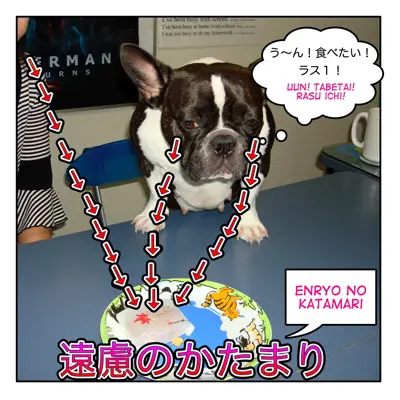
🐶「う〜ん、食べたい!ラス1食べたい!」
= Uun rasu ichi tabetai!
= “Oh~~I want the last piece!”
The other day, I posted “Enryo” lesson. This is an additional lesson.
「遠慮のかたまり」(= ”Enryo no katamari”) is a fun word to remember and you may not be able to find it in a dictionary.
Mostly in Kansai (west part of Japan such as Osaka, etc.) area. But we hear that often in Chubu (ex. Nagoya) area as well.
What is it?
Well, as I explained the other day, “some” Japanese people are 「遠慮深い」( = enryobukai ) (being politely reserved).
You know in certain situations when you eat with your friends or family, you see the last piece of food or snack left on a plate which nobody has the guts to eat because other people might think you are a pig! Everybody knows that it is there but they all act as if it doesn’t exist.
That is called 「遠慮のかたまり」(”Enryo no katamari”) “a last piece of food/snack which people are reluctant to eat for courtesy.)
If that happens, someone might jokingly point to the last one and say “遠慮のかたまり!”( = Enryo no katamari! )
or
「誰かこの”遠慮のかたまり”食べたら?」
= Dare ka kono enryo no katamari tabetara?
= “Somebody should eat this last piece!”
「塊 」(or 「固まり」)”Katamari” is a piece or lump.
I was thinking…
「う〜ん、食べたい!ラス一!」“Uu〜n tabetai! Rasuichi “ means “Oh…I want the last one!”
「ラスイチ」「ラス一」, or 「ラス1」( = rasu ichi)
Rasuichi is a slang and means “the last one”. It is not that common slang word but it is fun to remember.
最後の一つ or 一個 saigo no hitotsu (or ikko) (the last one)
→ラストの一つ ( = rasuto no hitotsu)
ラスイチ(イチ=1or 一) ( = rasuichi)
You may hear that expression in a boutique.
「これラスイチですよ!」kore rasu ichi desuyo! “This is the last one!”
:k: 「食べたい」tabetai :〜(し)たい (shi)tai = want to (wanna) + do something
Ex. 1) 寝たい( = netai) want to sleep ( 寝る neru = to sleep)
Ex. 2) 歌いたい ( = utaitai) want to sing (歌う utau = to sing)
 このラスイチのお菓子は、広島名物、「紅葉まんじゅう!」です!
誰が「遠慮のかたまり」を食べたって?当ててみて!
Kono rasu ichi no okashi wa hiroshima meibutsu “momiji manjyuu” desu!
Dare ga “enryo no katamari” wo tabetatte? Atete mite!
That last piece of sweet is called “Momiji manjyuu” which is very famous in Hiroshima.
Who ate that last piece? Guess who!
***
Will you be my Patron?
I appreciate your support! サポートありがとう!
22 Comments
Hello Maggie Sensei,
遠慮しながら人に手伝いを頼むくらいなら、自分でやったしまったほうがいい。
I understand the statement above means its better to do it yourself than to ask someone for help BUT what does the 遠慮しながら at the beginning of the sentence do? It can be used without it as in:
人に手伝いを頼むくらいなら、自分でやったしまったほうがいい。
What does 遠慮しながら人 mean?
Thx in advance
Hi Mark
遠慮しながら means “in an apologetic way, reluctantly, with hesitation, in a reserved way”
It would be like this..
ごめんなさい、忙しいかったらいいんだけど、もしよかったら〜してくれる?
人に人に手伝いを頼むくらいなら、自分でやったしまったほうがいい just means you’d rather do something by yourself without asking someone.
We have a very similar expression in Spain!
When a group of people are eating and there’s only one bit/piece of food left on the plate we call it “el de la vergüenza” or “la de la vergüenza” (“el/la” depends on whether the food noun is masculine or feminine”). It means “the piece/bit of shame” because everyone would be ashamed or embarrassed to eat it. :-D
So when that happens somebody says: “¿Quién quiere el/la de la vergüenza?” (“Who wants the piece/bit of shame?”.
It was great to learn the Japanese equivalent of that expression! Thanks!
Actually I ended up here by accident because I was googling another expression: 可愛いの塊. Does that mean the same, except that it is a cute thing somehow? ?_?
@Cristina
可愛いの塊 is a slang word to describe something super cute. Such as a cat, a dog, a baby, etc.
Ah síííí… Es verdad. Se dice el/la de la vergüenza también en español. Ahora me acuerdo la palabra. :) Gracias!!
全部分かりました。どうもありがとうございます。
@pheaktra
よかった!どういたしまして! !happyface!
hi maggie sensei ,since sensei tell me about the full sentence now i understand about the first sentence .and i never saw a sentence have “desu” after ” ka” so i a little confuse in here. thank you.
but the second sentence i still not so sure, 誰が私のことでぶって言ったって? “って” in here is の . but seem like in “って” lesson don’t mention anything “って” is like の. so it make me confuse . anyway thank you ,maggie sensei.
can you correct for me ?
明日休みよ。
明日休みって? = 明日休みなの?
@pheaktra
This is a very conversational expression so that you may have not seen it.
明日休み(だ)って(言った(の))?
or
明日休み(だ)って(言いましたか)?
If you want to make it sound a little polite, you can add です
明日休みですって?
yes,sensei i already read that って lesson.but i still not clear about the 2 sentence.because don’t have example in question
so 誰が〜を食べたかですって? is stress our own quote showing our frustration ” ってば” ? and we can use
です after か ?
and 誰が私のことでぶって言ったって?is the same ?
thank you.
@pheaktra
OK,
誰が〜を食べたかですって?
is repeating what other person has just asked.
You can also say
誰が食べたかって? in a casual situation.
hi maggie sensei i don’t understand this sentence
Q)誰が〜を食べたかですって? why you put です after か ?
A) To make it sound more polite
You can also say
誰が〜を食べたかって? or 誰が食べたって?in casual conversation.
Q ) what is it full sentence ? is it 誰が〜を食べたかだと聞きました?
「誰が〜を食べたか」と聞いているんですか?
or
誰が食べたのか知りたいのですか?
A) and what is the full sentence of this sentence ?
誰が私のことでぶって言ったって is って here the same as の ?
Yes, the last って is replaced with の to stress your emotion more.
「誰が私のこと(を)でぶ(だ)」って言ったの?
hi maggie sensei i don’t understand this sentence
誰が〜を食べたかですって?
why you put です after か ? what is it full sentence ? is it 誰が〜を食べたかだと聞きました?
and what is the full sentence of this sentence ?
誰が私のことでぶって言ったって?
is って here the same as の ?
thank you.
@pheaktra
I have a perfect lesson for you.
Go check “って” lesson. and if you still have a doubt, come back here.
Maggie! Did I guess right? :)
thanks for telling about this ressun^^ will keep in mind ^ ^
@Aki
Thank you for checking the lesson, Aki!!
Im excited when i saw that momiji manjyuu!
I had those snacks during my visit to Miyajima
みやじまはすごくきれいだ!!いつかもう一度行くつもりです〜。
私のうちにいつでも「遠慮のかたまり」が絶対にあります。
皆遠慮のかたまりが食べないので大変です。
Even though there is one there to see us eating the last piece.
おかしいですね。
@アリナ
Oh you visited Miyajima! (I haven’t…But I’d love to go there sometime.)
遠慮のかたまり is universal, huh?
Im not sure if it is universal or not but there is such attitude in my country usually young people.
So to encourage our friends eat the last piece we usually said:
”Who want the last piece? People said that whoever eats the last piece will get VERY kind husband (for girls) and VERY kind wife (for man)” haha
But there is a joke following that. Usually after the person ate the last piece people will add:
”But poor that VERY kind wife/husband because she/he we get fat husband/wife (because you ate the last piece = you ate more than others)” haha
@aaninoue8
Haha! It is always nice to have that kind of nice people around you!
I understand it now!
私は分からなかったって。でも、マギー先生は説明してくれたので、今分かります。 I said I didn’t understand. But because Maggie-sensei explained it to me, I understand now.
ありがとうございます!
Harin-san,
Thank you! If you allow me to correct your sentence,
私は分からなかったって。でも、マギー先生は説明してくれたので、今分かります。
分からないって言ったけれども、マギー先生が説明してくれたので、もう分かりました。will be natural!
Ganbatte!
Hello Maggie! I have a question.
In the sentence, “誰が「遠慮のかたまり」を食べたって?”, why does it end in って?
I got a lot from this lesson!
私は、いつも「遠慮のかたまり」を食べてしまいます。—> Is this correct?
Hello Harin-san!
The line comes from 1)
1)誰が〜を食べたかですって? (formal-basic)
2)誰が〜を食べたかだって? (casual)
3)誰が〜を食べたって? (very casual)
You end the quote with 「って」(The original form is 「と」. 「って」is a casual form.)
Ex. 彼、私のこと好きだって(言ったの。)Kare, watashi no koto sukidatte (ittano.) He said he loves me. (The quote part is “he loves me”)
(「と」is more formal. 彼は私のことを好きだと言いました。(Kare wa watashi no koto wo sukida to iimashita.)
Also
Ex. 彼の名字は”中村さん”って言うみたい。(Kare no myouji wa nakamura san tte iu mitai.) They said his last name is Nakamura. (more polite : 中村さんと言うそうです。(Nakamura san to iu sou desu.))
Can you translate the following sentences using 「って」(casual) or 「と」?
1) Maggie said hello to you.
2) Harin said Maggie is cute.
3) Who said I am fat?
Answers:
1) マギーがあなたによろしくって(言ってました)。(Maggie ga anata ni yoroshikutte) or あなたによろしくと言っていました。(Anata ni yoroshiku to itte imashita.)
2)Harin はマギーのことが可愛いって(言っていました)。(Harin wa Maggie no koto ga kawaiitte!) or 可愛いと言っていました。(Kawaii to itte imashita.)
3)誰が私のことでぶって言ったって?(Dare ga watashi no koto debutte ittatte?) 誰が私のことでぶと言ったの?(Dare ga watashi no koto debu to itta no?)
See you don’t need to finish the sentence when you use 「って」but usually it is natural to finish the sentence when you use 「と」after the quote.
OK, the next question.
私は、いつも「遠慮のかたまり」を食べてしまいます。 : It is correct and as a joke, it is a very cute sentence.
How’s that? Doudeshouka?