
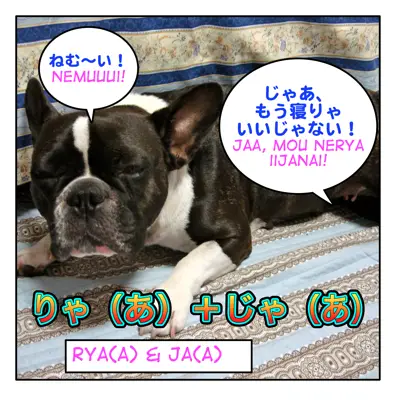
「ねむ〜い!」
= Nemuuui!
= I’m soooo sleepy!
「じゃあ、もう寝りゃいいじゃない!」
= Jaa mou nerya iijanai!
= Then why don’t you go to bed already!
Hi everyone! Before I hit the sack, I want to give you a lesson.
Today’s lesson is about casual suffixes. Here’s one of them that you don’t usually learn at school but you do hear a lot in daily conversation.
I have made
*ちゃう+ちゃった(=chau+chatta)
lesson in the past.
I got requests a long time ago to make more lessons of this type of casual contraction.
So today let’s learn
 じゃ(あ)( = ja(a)) and りゃ(あ) ( = rya)/ りゃ(あ) ( = rya(a)
:n: Let’s start from じゃ ( = ja) / じゃあ( = jaa)
Have you ever seen the following expressions?
Ex. じゃ(あ)またね!
= Ja(a) matane!
= OK, see you! / Bye now!
Ex. じゃ(あ)お元気で!
= Ja(a) ogenki de
= OK, take care of yourself!
Or simply.
じゃ(あ)ね!= ja(a)ne! (female speech )
or
じゃ(あ)!( = ja(a))
It means, “See you!”, “I am off!”
じゃ(あ) ( = ja(a) is from では ( = dewa)
Ex. それでは、また明日!
= Soredewa mata ashita!
= OK, then I will see you tomorrow!
→それじゃ(あ)、また明日!
= Soreja(a) mata ashita!
Ex. それではお元気で!
= Soredewa ogenki de! (formal)
= OK, then, please take care of yourself!
→それじゃあ、元気で(ね)!
= Sorejaa genki de(ne)!
= OK, then, take care! (This is more casual.)
Note: じゃあ ( = jaa) or じゃ ( = ja) are almost the same. じゃ( = jaa) is a bit lighter than じゃあ ( = jaa)It means, OK/ Then/ In that case/ if you say so, or you say that when you suggest something.
!kirakira! では ( = dewa) →じゃ(あ)( = ja(a))
Ex. では、ここで失礼します。
= Dewa koko de shitsurei shimasu.
= Then, I’ll excuse myself here.
じゃ(あ)、ここで失礼します。
= Ja(a) koko de shitsurei shimasu.
Ex. では、私は、どうしたらいいの?
= Dewa, doushitara iino?
= Then, what should I do?
じゃ(あ)、私はどうしたらいいの?
= Ja(a) watashi wa doushitara iino?
Ex. では、そんなに言うんだったらもうちょっとだけつきあうよ。
= Dewa sonnani iun dattara mou chotto dake tsukiauyo.
= Well, if you really insist, I’ll hang out with you just a little longer.
じゃ(あ)、そんなに言うんだったらもうちょっとだけつきあうよ。
= Jaa sonnani iundattara mou chotto dake tsukiauyo.
Ex.マギー行かないの?では私もやめとく。
= Maggie ikanai no? Dewa watashi mo yametoku.
= You are not going, Maggie? Well then (in that case), I won’t go either.
マギー行かないの?じゃ(あ)私もやめとく。
= Maggie ikanai no? Ja(a) watashi mo yametoku.
Note : ~ とく ( ~toku) is another casual contraction of ~ておく ( = ~ te oku)
Ex. 犬ではなくて猫が欲しい。
= Inu dewa nakute neko ga hoshii.
= I want a cat, not a dog.
犬じゃなくて猫が欲しい。
= Inu janakute neko ga hoshii.
Ex. 来週では遅過ぎる。
= Raishuu dewa ososugiru
= If it is next week, it is going to be too late.
来週じゃ(あ)遅過ぎる。
= Raishuu ja(a) ososugiru
******************* りゃ(あ) = rya(a)
In my opinion じゃ(あ) ( = ja(a)) is a casual — yet cute — contraction, りゃ(あ)= rya(a) is even more casual.
1) 〜れは( = rewa ) →りゃ ( = rya) or りゃあ ( = ryaa)
We have learned こそあど言葉(=kosoado kotoba), demonstrative adjective
When you use これ ( = kore) = this 、それ(=sore) =it, this, that、あれ ( = are) = that and a subject marker, は ( = rewa ) with a surprised feeling or with more emotion, it will be
★それは ( = sore wa) →そりゃ(あ) ( = sorya(a))
★これは ( = kore wa) →こりゃ(あ) ( = korya(a))
★あれは ( = are wa) →ありゃ(あ) ( = arya(a))
Ex. そりゃ(あ)ひょっとして風邪じゃない?
= Sorya(a) hyotto shite kaze janai?
= (Maybe you have a cold.) → Don’t you have a cold?
Ex. そりゃ(あ)おかしいよ
= Sorya(a) okashiiyo.
= It’s strange!
Ex. そりゃ(あ)そうだ
= Sorya(a) souda.
= You’re right.
Ex. そりゃ(あ)大変だね。
= Sorya(a) taihen dane.
= It’s tough, isn’t it?
Ex. そりゃないよ!
= Sorya naiyo!
= You can’t do that to me! / No way! / It can’t be true! / You must be kidding me!
Ex. こりゃ(あ)ありがたい (a kind of old fashioned.)
= Korya(a) arigatai!
= Thank heavens!
Ex. こりゃ(あ)すごい!
= Korya sugoi!
= This is great!
Ex.こりゃ(あ)高すぎる!
= Korya takasugiru!
= This is way too expensive!
Ex.なんだこりゃ(あ)!
= Nanda korya(a)!
= What is this??
Ex.ありゃ(あ)ひどい
= Arya hidoi.
= That’s horrible.
Ex.駄目だ、こりゃ!
= Dame da, korya!
= This is bad.
Note : りゃ ( = rya) and りゃあ ( = rya) means the same but りゃあ ( = ryaa) stresses the feeling more.
1)verb + れば ( = reba) → りゃ ( = rya) or りゃあ ( = ryaa)
れば ( = reba)→ りゃ(あ) ( = rya(a)) is used when you suggest something or make a hypothetical situation.
You might think this is slang but this contraction is not new at all. Some of you might have heard an old saying,
!to right! 坊主憎けりゃ袈裟まで憎い。
= Bouzu nikukerya kesa made nikui.
= to hate everything about that person
• 坊主 = bouzu = a Buddhist priest, bonze
• 憎い = nikui = to hate
(憎ければ = nikukereba → 憎けりゃ = nikukerya = If you hate ~ )
• まで = made = even
• 袈裟 = kesa= a robe for Buddhist priests
This literally means if you hate a Buddhist priest, you even hate his robe.
Ex. いい点数を取りたければ勉強すればいいではないですか。
= Ii tensuu wo toritakereba benkyou sureba ii de wa nai desuka?
= If you want to get a good score, why don’t you just study?
いい点数を取りたけりゃ勉強すりゃ(あ)いいじゃない。(casual)
= Iitensuu wo toritakerya benkyou surya(a) iijanai.
Ex. A :「今、忙しい?」
= Ima isogashii?
= Are you busy now?
B :「見ればわかるでしょ!。」
= Mireba wakaru desho!
= Can’t you tell?/ Isn’t it obvious? (If you see something/somebody you will know what it is/who they are.)
見りゃ(あ)わかるでしょ!(casual)
= Mirya(a) wakaru desho!
Ex. どうすればいいのだろう。
= Dousureba iinodarou.
= I don’t know what to do.
どうすりゃ(あ)いいんだろう。(casual)
= Dousurya(a) iindarou
Ex.マギーのスッピンなんて見なければよかった。
= Maggie no suppin nante minakereba yokatta
= I wish I hadn’t seen Maggie’s face without make-up on.
マギーのスッピンなんて見なけりゃよかった。
= Maggie no suppin nante minakerya yokatta.
Ex. どんなに難しいかやってみればわかるよ。
= Donna ni muzukashii ka yatte mireba wakaruyo.
= If you try, you will see how hard it is.
どんなに難しいかやってみりゃわかるよ。
= Donnani muzukashii ka yatte mirya wakaru yo.
2) ありは ( = ariwa) +しない→ありゃ(あ)( = arya(a) + しない ( = shinai) = There is not~
Ex. いいことばかりありはしない。
= iikoto bakari ari wa shinai.
= You’re not always lucky.
いいことばかりありゃしない。
= iikoto bakari aryashinai.
⭐️ Special expression :
🔸 〜ったらない ( = ~ttara nai)=There is nothing more than ~
adjective + ったらありゃしない ( = ~ ttara aryashinai)
= It is very ~/ It is so ~ (emphasize)
Ex. 面白いったらない。
= Omoshiroittara nai
= It is very interesting. It is so much fun. (There is nothing more fun than this.)
面白いったらありゃしない!
= Omoshiroittara aryashinai
Ex. ばかばかしいといったらない。
= Bakabakashii toittaranai.
= This is so ridiculous. / There is nothing more stupid than this.
ばかばかしいったらありゃしない。
= Bakabakashittara aryashinai.
 マギー先生より = Maggie Snese yori = From Maggie Sensei
ねむたいったらありゃしない!じゃあ、もう寝ますね。お休みなさい… 😴💤
= Nemutaittara aryashinai! Jaa mou nemasune. Oyasumi nasai…
= I am so sleepy! Well, then I’ll will go to bed now. Good night!
***
Will you be my Patron?
I appreciate your support! サポートありがとう!
23 Comments
マギーセンセイ、ありがとうございます! :w:
じゃあ、りゃあの使い方が面白くて、今からよく使います!
@チャン
どういたしまして!カジュアルですが日常(にちじょう= daily life)でよく使う言葉ですよ。
少しずつ練習してね。
今日は、先生!元気ですか?日本はまだ暑いかな?
このレッスンを作ってくれて有り難うございます!
質問がありますね
なきゃ can stand for なければ or なければならない/いけない. Is なけりゃ completely equivalent to なきゃ or it stands only for なければ?
@Orti
こんにちは!Orti! はい、日本はまだまだ37〜39度の暑い日が続いていいますよ。
なければ has two casual contractions : なきゃ and なけりゃ.
I can’t think of the big difference at the moment but we don’t usually finish the sentence with なけりゃ.
勉強しなくちゃ。
勉強しなけりゃ。(strange)
I will add if I find other differences.
ああ、大変ですね。我慢して!
有り難うございます、先生!
@Orti
はい!!がんばります!!ありがとう!
Ex. ばかばかしいといったらない
マギー先生、もう一度説明してくれてくださいませんか?
「ばかばかしいったらない」の言うことが理解できる。
しかし「 ばかばかしいといったらない」の言うことを理解するな。
有り難う御座います、 ご苦労様でした。
@glenn
First,
~といったらない is the most formal form.
*i-adjective+ といったらない
*na-adjective+ といったらない
*verb (dictionary form) + といったらない
Ex. ばかばかしいといったらない = It is extremely ridiculous
And if you want to make it sound more casual, we say
↓
ばかばかしいったらない
more casual↓
ばかばかしいったらありゃしない
How’s that?
はい、全部分かりました。
いつもお世話に。
I would like this to recommend to my other fellow Japanese language learners. Maggie you’re so good I want to marry you..haha.
冗談だ。やばいだ!
@Ron
What!? You are not going to marry me??? !gejigeji!
If its ok to you! Wjy not. I like people who really help other people.
Maggie, why not mentioning that famous 落ち from those Japanese comedians? They always ended up saying ダメだこりゃ! I would like to know about them actually, hah.
I’d also buy your books, hehe.
@Cygnus
Wow! I’m impressed that you know the line ダメだこりゃ! www
You’re right. It is a famous line of いかりや長介, a leader of a comedian group, ドリフターズ.
It is a kind of old show but it used to be very popular.
There is a series of the skit in their show called,
もしもこんな〜がいたら/あったら What if there is a person like this in ~ / What if there is a place/shop/ like this.
Ex.もしもこんな先生がいたら…Ex. もしもこんな病院があったら
Here’s a link! “もしもシリーズ”
They show a very extreme situational comedy skit. And it always finish with a line of the leader, ダメだこりゃ!
Good! Now I can sell at least “5” books!
先生、ちょっとまちがいましたかもしれない。
この辺:
B ; 「見ればわかるでしょ!。」
= Mireba wakaru dewa nai desuka.
= Can’t you tell?/ Isn’t it obvious? (If you see something/somebody you will know what it is/who they are.)
見りゃ(あ)わかるでしょ!(casual)
= Mirya(a) wakaru janai ka.
@WolfHavenXIII
Ooops!! ほんとだ〜!
途中で文章変えたんですがローマ字を変えるのを忘れていました。ありがとう!!
really cool, yeah that´s right we don´t learn these sentences at the school… Thanx… Jya…
@andre
Thank you for your comment!
じゃあ、またね! !happyface!
このレーソンは面白いったらありゃしない!Awesome lesson. Have you ever thought about writing some kind of book? I would definitely buy a copy, and probably one for a couple friends of mine learning Japanese too.
とにがく、それじゃ;)
@aookezoid
Haha, you can use them perfectly!
Yes, I’d love to publish a book someday. じゃあ、本を作ったら2、3冊は確実に売れますね! :)
もちろん!
本を書いて下さい!ブログを読んだら、いつもたくさん学びますよ!
ありがとうございます〜ミ☆
@Claudia
ありがとう、Claudia!! それじゃあいつか本が出たらよろしくね!